Uttar Pradesh | Yogi's saffron tour de force
Besieged by the Ayodhya row ahead of polls, the CM dares the SP on Hindutva in an all-out kinetic war—covering key bases in a whirlwind trip
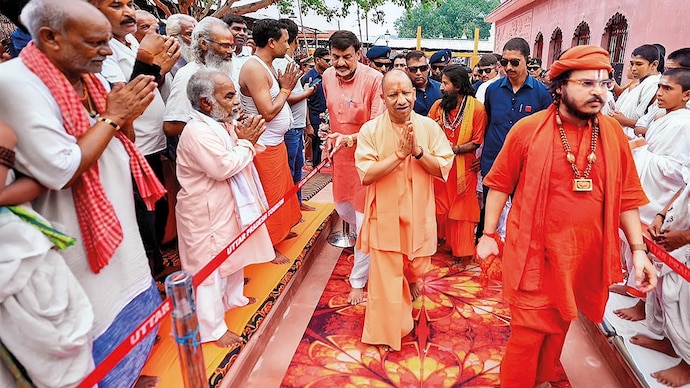
Chitrakoot isn’t a place that Chief Minister Yogi Adityanath’s steps have not traced before—in fact, his two-day visit that began on July 8 was his 15th since assuming office. But he stayed overnight, after seven years. And the rituals, both of the administrative and religious sort, were in full flow. Foundation stones for 124 development projects, the inauguration of a bridge across the Yamuna on the district’s border with Kaushambi and a defence corridor, financial assistance to young entrepreneurs. Also, a parikrama of the Kamadgiri hill. And a speech that, in characteristic style, blended governance with high-octane political messaging.
Chitrakoot isn’t a place that Chief Minister Yogi Adityanath’s steps have not traced before—in fact, his two-day visit that began on July 8 was his 15th since assuming office. But he stayed overnight, after seven years. And the rituals, both of the administrative and religious sort, were in full flow. Foundation stones for 124 development projects, the inauguration of a bridge across the Yamuna on the district’s border with Kaushambi and a defence corridor, financial assistance to young entrepreneurs. Also, a parikrama of the Kamadgiri hill. And a speech that, in characteristic style, blended governance with high-octane political messaging.
Chitrakoot isn’t a place that Chief Minister Yogi Adityanath’s steps have not traced before—in fact, his two-day visit that began on July 8 was his 15th since assuming office. But he stayed overnight, after seven years. And the rituals, both of the administrative and religious sort, were in full flow. Foundation stones for 124 development projects, the inauguration of a bridge across the Yamuna on the district’s border with Kaushambi and a defence corridor, financial assistance to young entrepreneurs. Also, a parikrama of the Kamadgiri hill. And a speech that, in characteristic style, blended governance with high-octane political messaging.
None of this is novel for Yogi, who’s never short of combative, but there was a touch of extra keening in his tonal register. The donation theft at the Ram temple in Ayodhya has handed the ruling Bharatiya Janata Party (BJP) one of its most complex challenges. The controversy is seen as one that can enfeeble the very foundation of its political being—the appeal to the common Hindu’s piety—so the embattled sense is not like any it has encountered before. More than anyone else in the saffron hierarchy, it is Yogi who has sprung up to meet the challenge openly. Perhaps no one suits the job more, with his saffron robes not flecked by any other tint.
THE COMING BATTLE
That his state is leaning into poll season also explains the urgency. There’s just about six months to go before February 2027, and it was crucial to shepherd the bemused flock anew with lightning-rod calls to faith. Since it was the Samajwadi Party (SP) that lent amplitude to the Ayodhya controversy, he also had to subvert any chance of his principal rival gaining any fresh legitimacy among doubters and floaters. In a fiery, 40-minute speech at Chitrakoot Inter College on July 8, he let his hypersonic missiles fly. “The money my government is spending on developing Tulsidas’s birthplace, Valmiki Ashram and beautifying the Mandakini river banks in Chitrakoot is what the SP would have spent on constructing boundary walls around graveyards,” Yogi said.
Chitrakoot, which the Ramayana lists as a prime site of Ram’s passage during his exile, was an apt place to dig deep into that part-expiatory project. But it was hardly a lone pit-stop for Yogi. Rather, he has been in kinetic overdrive. Beginning with Varanasi on June 12, he had made landfall in as many as 30 districts within the month, averaging nearly one district every day. On July 9, in neighbouring Banda, he reiterated his commitment to turn Bundelkhand into “a heaven on earth”.
This was the first time in his second term that Yogi had spent so much time in Bundelkhand. In the preceding 20 days, he had also toured Jhansi, Lalitpur, Mahoba and Hamirpur in the region. The goad for this outreach isn’t hard to fathom. In the 2022 state election, its alliance had won 16 of the 19 seats across Bundelkhand’s seven districts. But the landscape tilted in 2024. Of the region’s four Lok Sabha seats, the BJP retained only Jhansi-Lalitpur, losing three to the SP. It’s a grudge match.
RELIGION PLUS CASTE
The nature of his outreach was also designed such that its benefits can flow outward. At a Banda intersection, he unveiled a statue of the legendary 1857 martyr-queen Avantibai Lodhi—a gesture at the 1.25 million-strong OBC Lodh community, who can single-handedly swing 40 seats and influence another 40 across the central-south and western UP. Marrying Hindutva with caste-specific appeals remains a crucial tactic as the BJP seeks an unprecedented third consecutive term in the state.
Perhaps the CM’s most aggressive salvo came on June 28 in Hathras, in the vicinity of Mathura. Here, he laid down the gauntlet to SP chief Akhilesh Yadav. “If the SP is truly committed to religion, it should openly support the Krishna Janmabhoomi campaign,” he said. With that single statement, he sought to put the Opposition on the defensive, deflect the focus from Ayodhya and dial up Hindutva, all at once. It was also a signal aimed at the crucial Braj region, which has 65 assembly seats.
It was one of the BJP’s strongest bastions, and had also shown signs that it was no longer immune to electoral slippage. In 2022, its tally fell from 57 to 53; that became more pronounced in 2024, when it slid from 12 out the region’s 13 Lok Sabha seats to eight. Who better to come calling, then, than the warrior monk?

