How Sonam Wangchuk made Aamir Khan's Rancho the hero every Indian needed
Engineer-activist Sonam Wangchuk's life and ideas helped shape actor Aamir Khan's Rancho in 3 Idiots. Here is how that real-world foundation turned the film's protagonist into a survival guide for a burned-out generation.
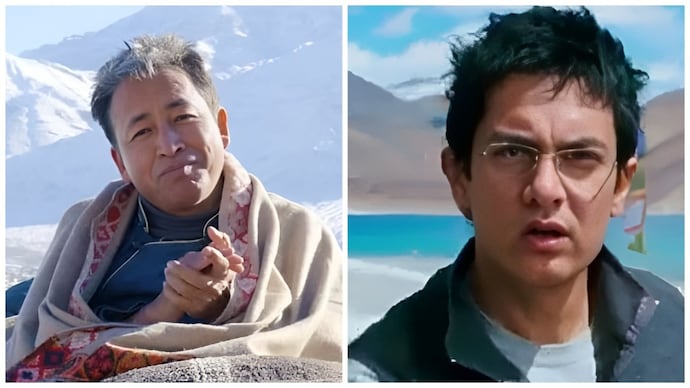
When director Rajkumar Hirani’s 3 Idiots released in 2009, actor Aamir Khan’s Rancho walked into an engineering college, irritated his professors and calmly told an entire generation of students that this race to success is the problem. Long before burnout became a social media discussion, Rancho was already asking everyone to slow down and understand what they were actually studying. And behind Aamir's much-loved character from 3 Idiots was the life and work of Sonam Wangchuk, currently on a hunger strike for 17 days.
The Ladakh-based engineer and education reformer’s ideas helped shape Rancho’s world, particularly the curious, practical thinker audiences eventually discovered as Phunsukh Wangdu. More than 16 years later, Wangchuk's influence also explains why Rancho remains a cult favourite.
When the film finally revealed Rancho as Phunsukh Wangdu, an innovator living and teaching in Ladakh, it gave Hirani’s film one of its most satisfying twists. But Wangchuk had been carrying out his own experiments far away from a Hindi film set. His idea of education came down to something surprisingly simple: if you are learning something, perhaps it should help you solve an actual problem.
Sonam Wangchuk’s influence is easiest to spot in the Ladakh school shown towards the climax of 3 Idiots. Rancho’s students are not sitting silently with their noses buried in textbooks. They are building things, experimenting and learning from the world around them.
The setting echoes Wangchuk’s work with Students' Educational and Cultural Movement of Ladakh (SECMOL), where students learn by doing rather than spending their entire day trying to remember which paragraph was on page 73.
That same spirit runs through Khan’s Rancho. He is not against studying. In fact, he is probably the biggest nerd in the room. His problem is with learning something only because an examiner expects the correct paragraph to magically appear on an answer sheet.
For Rancho, a machine has to make life easier. A definition should actually mean something. And a degree cannot be the sole purpose of spending some of the most important years of your life inside a classroom. This is exactly why Rancho became a cult favourite among Indian students. They knew his world a little too well. The fear of scoring less, disappointing parents and watching Sharma ji’s son mysteriously score 99 per cent existed long before social media gave everyone a place to complain about it. Rancho simply said aloud what many students were thinking.
But he never felt like a motivational speaker with a microphone and a weekend workshop to sell. Inspired partly by Sonam Wangchuk’s gentle and solution-oriented approach, Rancho spoke like a friend who had escaped the panic everyone else was trapped in.
More than 16 years after 3 Idiots, that quality has given the character an unusual shelf life. The jokes still work and Chatur’s speech will probably continue embarrassing families during television reruns. But Rancho himself has aged differently. In a culture obsessed with hustle, productivity and constantly staying ahead of someone, Rancho's refusal to participate in the race feels almost rebellious again.
And that rebellion may be even more important for today’s generation. In 2009, there was Sharma ji’s son and the occasional relative asking about your marks at a wedding. In 2026, the comparison follows you home, sits inside your phone and refreshes every few seconds.
Open Instagram and someone your age is travelling across Europe. Open LinkedIn and another person has become a CEO at 24, apparently after waking up at 4 am and drinking warm water. Somewhere in between are side hustles, productivity hacks and the slightly uncomfortable question of whether AI might learn your office job before you finish learning it yourself.
Suddenly, Rancho’s obsession with understanding things does not sound quite so filmy. Memorising the right answer may get you through an exam. A world where technology can produce answers in seconds, curiosity, original thinking and the ability to solve a problem have become harder to ignore. These were the ideas Wangchuk had been championing long before everyone started nervously discussing automation over office coffee.
Rancho’s famous mantra: “Make yourself capable, success will follow”, was once the kind of line students wrote on notebooks and Facebook statuses. Today, it sounds suspiciously close to career advice.
Perhaps that is why the character still works. Rancho never promised that life would become easy if you shouted “All is well” three times. He simply believed intelligence was bigger than a mark-sheet and curiosity deserved more space than fear. For anxious young people constantly being told to catch up, that remains a comforting thought.
Hirani and Khan took inspiration from Wangchuk’s life and ideas and turned them into one of Hindi cinema’s most recognisable characters. Audiences met Rancho as a funny engineering student, discovered Phunsukh Wangdu in Ladakh and eventually turned him into a cult favourite.
Meanwhile, Wangchuk’s real-life crusade continues to play out on the streets of Delhi, where his fight for the next generation remains incredibly urgent. He has been on an indefinite hunger strike at Jantar Mantar, joining forces with the Cockroach Janta Party (CJP) to demand the resignation of Union Education Minister Dharmendra Pradhan over the controversies and alleged paper leaks surrounding the NEET examinations.
As his health rapidly deteriorates — with reports of severe muscle loss and a weight drop of over 8 kilograms—waves of support and appeals to end his fast have poured in from student bodies, public figures, and political leaders nationwide.
When director Rajkumar Hirani’s 3 Idiots released in 2009, actor Aamir Khan’s Rancho walked into an engineering college, irritated his professors and calmly told an entire generation of students that this race to success is the problem. Long before burnout became a social media discussion, Rancho was already asking everyone to slow down and understand what they were actually studying. And behind Aamir's much-loved character from 3 Idiots was the life and work of Sonam Wangchuk, currently on a hunger strike for 17 days.
The Ladakh-based engineer and education reformer’s ideas helped shape Rancho’s world, particularly the curious, practical thinker audiences eventually discovered as Phunsukh Wangdu. More than 16 years later, Wangchuk's influence also explains why Rancho remains a cult favourite.
When the film finally revealed Rancho as Phunsukh Wangdu, an innovator living and teaching in Ladakh, it gave Hirani’s film one of its most satisfying twists. But Wangchuk had been carrying out his own experiments far away from a Hindi film set. His idea of education came down to something surprisingly simple: if you are learning something, perhaps it should help you solve an actual problem.
Sonam Wangchuk’s influence is easiest to spot in the Ladakh school shown towards the climax of 3 Idiots. Rancho’s students are not sitting silently with their noses buried in textbooks. They are building things, experimenting and learning from the world around them.
The setting echoes Wangchuk’s work with Students' Educational and Cultural Movement of Ladakh (SECMOL), where students learn by doing rather than spending their entire day trying to remember which paragraph was on page 73.
That same spirit runs through Khan’s Rancho. He is not against studying. In fact, he is probably the biggest nerd in the room. His problem is with learning something only because an examiner expects the correct paragraph to magically appear on an answer sheet.
For Rancho, a machine has to make life easier. A definition should actually mean something. And a degree cannot be the sole purpose of spending some of the most important years of your life inside a classroom. This is exactly why Rancho became a cult favourite among Indian students. They knew his world a little too well. The fear of scoring less, disappointing parents and watching Sharma ji’s son mysteriously score 99 per cent existed long before social media gave everyone a place to complain about it. Rancho simply said aloud what many students were thinking.
But he never felt like a motivational speaker with a microphone and a weekend workshop to sell. Inspired partly by Sonam Wangchuk’s gentle and solution-oriented approach, Rancho spoke like a friend who had escaped the panic everyone else was trapped in.
More than 16 years after 3 Idiots, that quality has given the character an unusual shelf life. The jokes still work and Chatur’s speech will probably continue embarrassing families during television reruns. But Rancho himself has aged differently. In a culture obsessed with hustle, productivity and constantly staying ahead of someone, Rancho's refusal to participate in the race feels almost rebellious again.
And that rebellion may be even more important for today’s generation. In 2009, there was Sharma ji’s son and the occasional relative asking about your marks at a wedding. In 2026, the comparison follows you home, sits inside your phone and refreshes every few seconds.
Open Instagram and someone your age is travelling across Europe. Open LinkedIn and another person has become a CEO at 24, apparently after waking up at 4 am and drinking warm water. Somewhere in between are side hustles, productivity hacks and the slightly uncomfortable question of whether AI might learn your office job before you finish learning it yourself.
Suddenly, Rancho’s obsession with understanding things does not sound quite so filmy. Memorising the right answer may get you through an exam. A world where technology can produce answers in seconds, curiosity, original thinking and the ability to solve a problem have become harder to ignore. These were the ideas Wangchuk had been championing long before everyone started nervously discussing automation over office coffee.
Rancho’s famous mantra: “Make yourself capable, success will follow”, was once the kind of line students wrote on notebooks and Facebook statuses. Today, it sounds suspiciously close to career advice.
Perhaps that is why the character still works. Rancho never promised that life would become easy if you shouted “All is well” three times. He simply believed intelligence was bigger than a mark-sheet and curiosity deserved more space than fear. For anxious young people constantly being told to catch up, that remains a comforting thought.
Hirani and Khan took inspiration from Wangchuk’s life and ideas and turned them into one of Hindi cinema’s most recognisable characters. Audiences met Rancho as a funny engineering student, discovered Phunsukh Wangdu in Ladakh and eventually turned him into a cult favourite.
Meanwhile, Wangchuk’s real-life crusade continues to play out on the streets of Delhi, where his fight for the next generation remains incredibly urgent. He has been on an indefinite hunger strike at Jantar Mantar, joining forces with the Cockroach Janta Party (CJP) to demand the resignation of Union Education Minister Dharmendra Pradhan over the controversies and alleged paper leaks surrounding the NEET examinations.
As his health rapidly deteriorates — with reports of severe muscle loss and a weight drop of over 8 kilograms—waves of support and appeals to end his fast have poured in from student bodies, public figures, and political leaders nationwide.

