Gen Z protesters prove democracy vibrant in India, puncturing western narrative
The Gen Z-led student protests over exam irregularities, culminating in a direct response from the Prime Minister, is evidence that India's democracy remains vibrant, self-correcting and responsive, challenging Western portrayals of the country as authoritarian.
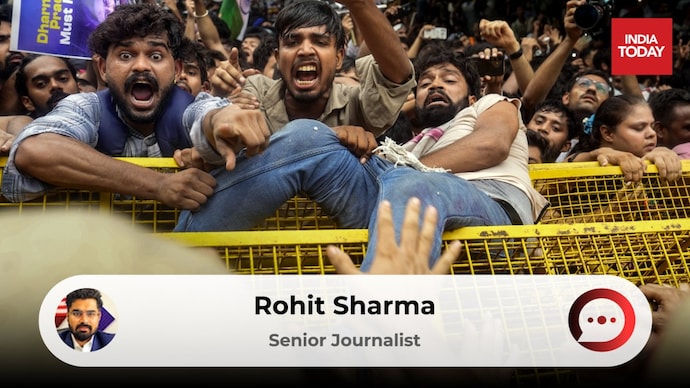
For years, a remarkably rigid and deeply flawed paradigm has dominated Western think tanks, academic circles, and international media conglomerates. This prevailing orthodoxy routinely categorises the modern Indian state as intrinsically authoritarian, with leftist commentators casually wielding terms like "fascist." Yet, the empirical reality unfolding on the streets of New Delhi offers an explosive, undeniable counter-narrative. Driven by a politically awakened Generation Z, recent grassroots mobilisations have not merely challenged this Western echo chamber; they have shattered it. They prove that India’s democratic experiment remains noisy, contested, and fiercely alive.
THE EPISTEMOLOGY OF A GRASSROOTS MOBILIZATION
To comprehend the sheer vitality of Indian democracy, one must look beyond foreign abstractions to the actual mechanisms of civic life. The nation has recently seen widespread, deeply emotive student protests over leaked examination papers and marking controversies within institutions like the National Eligibility cum Entrance Test (NEET) and Central Board of Secondary Education (CBSE).
For millions of young citizens, educational integrity is not an abstract policy debate—it is an existential imperative. What makes this uprising profoundly compelling is its total independence from established political dynasties. When a Supreme Court judge made a disparaging remark utilising the term "cockroach," it did not stifle dissent; it ignited a masterpiece of digital political agency. The youth coalesced around the satirically named "Cockroach Janata Party," utilising digital irony, memes, and social networks as instruments of democratic leverage.
This organic mobilisation occurred while the BJP continues to govern following its historic third consecutive election victory in 2024—a cycle that notably saw its absolute parliamentary majority reduced, reflecting a dynamic electorate. The fact that young citizens can seamlessly organise, command national attention, and force institutional accountability under this administration utterly dismantles the Western thesis of an autocratic takeover.
INSTITUTIONAL INERTIA AND HISTORICAL PARALLELS
The visceral power of these student protests heavily echoes pivotal inflection points in modern Indian history—most notably the 2012 anti-corruption movement and the nationwide outrage following the Nirbhaya case. Those historic moments reshaped the national zeitgeist and ultimately served as the catalyst that propelled the BJP to power.
A critical analysis reveals a stark political irony: over the past twelve years, the formal political opposition has suffered from acute institutional inertia. They have proven fundamentally incapable of constructing or articulating an issue that resonates with voters at a similar emotional frequency. The student protests have ruthlessly exposed the opposition's strategic failures during the 2014, 2019, and 2024 cycles as reactive and out of touch.
Where the opposition’s so-called "heir apparent" repeatedly failed to capture the nation's political imagination, an everyday "nobody" on the street sparked a movement that compelled the Prime Minister to release a direct address via a selfie video, explicitly acknowledging student demands and promising decisive actions. Genuine political energy in India still originates from ordinary citizens, not party headquarters.
DECONSTRUCTING THE WESTERN ECHO CHAMBER
This reality exposes the profound cognitive dissonance at the heart of Western discourse. For over six decades, foreign observers and Western intelligentsia heavily hobnobbed with the Indian National Congress during its prolonged dominance. Consequently, when the BJP secured its historic mandate, Western commentary defaulted to an ideological panic, mistaking the decline of a favoured political party for the demise of democracy itself. When domestic political factions questioned electoral integrity following the 2024 elections as a desperate manoeuvre to soothe their base, Western media eagerly amplified these claims without applying standard journalistic scepticism.
Partisan rhetoric was instantly elevated into "evidence" of systemic autocracy. Yet, this narrative ignores the core democratic reality: India is currently navigating authentic, healthy anti-incumbency driven by material issues like inflation, joblessness, and administrative friction.
THE TRIUMPH OF DEMOCRATIC SELF-CORRECTION
No democracy is pristine or immune to structural challenges. But the measure of a democratic state lies in its capacity for self-correction and institutional responsiveness.
The Gen Z-led movement has proven that India’s democratic institutions remain deeply attuned to public sentiment. Ordinary students—operating without permission from ideological gatekeepers or political dynasties—successfully dominated the national discourse, spoke truth to power, and forced a direct response from the highest office in the land. India's democracy is argumentative, chaotic, and relentlessly demanding. But it is precisely this unyielding public spirit that keeps it invincible.
The West would do well to discard its outdated, patronising analytical models and recognise a fundamental truth: the world’s largest democracy is not only alive and kicking—it is actively teaching the other democracies what political vitality truly looks like.
For years, a remarkably rigid and deeply flawed paradigm has dominated Western think tanks, academic circles, and international media conglomerates. This prevailing orthodoxy routinely categorises the modern Indian state as intrinsically authoritarian, with leftist commentators casually wielding terms like "fascist." Yet, the empirical reality unfolding on the streets of New Delhi offers an explosive, undeniable counter-narrative. Driven by a politically awakened Generation Z, recent grassroots mobilisations have not merely challenged this Western echo chamber; they have shattered it. They prove that India’s democratic experiment remains noisy, contested, and fiercely alive.
THE EPISTEMOLOGY OF A GRASSROOTS MOBILIZATION
To comprehend the sheer vitality of Indian democracy, one must look beyond foreign abstractions to the actual mechanisms of civic life. The nation has recently seen widespread, deeply emotive student protests over leaked examination papers and marking controversies within institutions like the National Eligibility cum Entrance Test (NEET) and Central Board of Secondary Education (CBSE).
For millions of young citizens, educational integrity is not an abstract policy debate—it is an existential imperative. What makes this uprising profoundly compelling is its total independence from established political dynasties. When a Supreme Court judge made a disparaging remark utilising the term "cockroach," it did not stifle dissent; it ignited a masterpiece of digital political agency. The youth coalesced around the satirically named "Cockroach Janata Party," utilising digital irony, memes, and social networks as instruments of democratic leverage.
This organic mobilisation occurred while the BJP continues to govern following its historic third consecutive election victory in 2024—a cycle that notably saw its absolute parliamentary majority reduced, reflecting a dynamic electorate. The fact that young citizens can seamlessly organise, command national attention, and force institutional accountability under this administration utterly dismantles the Western thesis of an autocratic takeover.
INSTITUTIONAL INERTIA AND HISTORICAL PARALLELS
The visceral power of these student protests heavily echoes pivotal inflection points in modern Indian history—most notably the 2012 anti-corruption movement and the nationwide outrage following the Nirbhaya case. Those historic moments reshaped the national zeitgeist and ultimately served as the catalyst that propelled the BJP to power.
A critical analysis reveals a stark political irony: over the past twelve years, the formal political opposition has suffered from acute institutional inertia. They have proven fundamentally incapable of constructing or articulating an issue that resonates with voters at a similar emotional frequency. The student protests have ruthlessly exposed the opposition's strategic failures during the 2014, 2019, and 2024 cycles as reactive and out of touch.
Where the opposition’s so-called "heir apparent" repeatedly failed to capture the nation's political imagination, an everyday "nobody" on the street sparked a movement that compelled the Prime Minister to release a direct address via a selfie video, explicitly acknowledging student demands and promising decisive actions. Genuine political energy in India still originates from ordinary citizens, not party headquarters.
DECONSTRUCTING THE WESTERN ECHO CHAMBER
This reality exposes the profound cognitive dissonance at the heart of Western discourse. For over six decades, foreign observers and Western intelligentsia heavily hobnobbed with the Indian National Congress during its prolonged dominance. Consequently, when the BJP secured its historic mandate, Western commentary defaulted to an ideological panic, mistaking the decline of a favoured political party for the demise of democracy itself. When domestic political factions questioned electoral integrity following the 2024 elections as a desperate manoeuvre to soothe their base, Western media eagerly amplified these claims without applying standard journalistic scepticism.
Partisan rhetoric was instantly elevated into "evidence" of systemic autocracy. Yet, this narrative ignores the core democratic reality: India is currently navigating authentic, healthy anti-incumbency driven by material issues like inflation, joblessness, and administrative friction.
THE TRIUMPH OF DEMOCRATIC SELF-CORRECTION
No democracy is pristine or immune to structural challenges. But the measure of a democratic state lies in its capacity for self-correction and institutional responsiveness.
The Gen Z-led movement has proven that India’s democratic institutions remain deeply attuned to public sentiment. Ordinary students—operating without permission from ideological gatekeepers or political dynasties—successfully dominated the national discourse, spoke truth to power, and forced a direct response from the highest office in the land. India's democracy is argumentative, chaotic, and relentlessly demanding. But it is precisely this unyielding public spirit that keeps it invincible.
The West would do well to discard its outdated, patronising analytical models and recognise a fundamental truth: the world’s largest democracy is not only alive and kicking—it is actively teaching the other democracies what political vitality truly looks like.
For years, a remarkably rigid and deeply flawed paradigm has dominated Western think tanks, academic circles, and international media conglomerates. This prevailing orthodoxy routinely categorises the modern Indian state as intrinsically authoritarian, with leftist commentators casually wielding terms like "fascist." Yet, the empirical reality unfolding on the streets of New Delhi offers an explosive, undeniable counter-narrative. Driven by a politically awakened Generation Z, recent grassroots mobilisations have not merely challenged this Western echo chamber; they have shattered it. They prove that India’s democratic experiment remains noisy, contested, and fiercely alive.
THE EPISTEMOLOGY OF A GRASSROOTS MOBILIZATION
To comprehend the sheer vitality of Indian democracy, one must look beyond foreign abstractions to the actual mechanisms of civic life. The nation has recently seen widespread, deeply emotive student protests over leaked examination papers and marking controversies within institutions like the National Eligibility cum Entrance Test (NEET) and Central Board of Secondary Education (CBSE).
For millions of young citizens, educational integrity is not an abstract policy debate—it is an existential imperative. What makes this uprising profoundly compelling is its total independence from established political dynasties. When a Supreme Court judge made a disparaging remark utilising the term "cockroach," it did not stifle dissent; it ignited a masterpiece of digital political agency. The youth coalesced around the satirically named "Cockroach Janata Party," utilising digital irony, memes, and social networks as instruments of democratic leverage.
This organic mobilisation occurred while the BJP continues to govern following its historic third consecutive election victory in 2024—a cycle that notably saw its absolute parliamentary majority reduced, reflecting a dynamic electorate. The fact that young citizens can seamlessly organise, command national attention, and force institutional accountability under this administration utterly dismantles the Western thesis of an autocratic takeover.
INSTITUTIONAL INERTIA AND HISTORICAL PARALLELS
The visceral power of these student protests heavily echoes pivotal inflection points in modern Indian history—most notably the 2012 anti-corruption movement and the nationwide outrage following the Nirbhaya case. Those historic moments reshaped the national zeitgeist and ultimately served as the catalyst that propelled the BJP to power.
A critical analysis reveals a stark political irony: over the past twelve years, the formal political opposition has suffered from acute institutional inertia. They have proven fundamentally incapable of constructing or articulating an issue that resonates with voters at a similar emotional frequency. The student protests have ruthlessly exposed the opposition's strategic failures during the 2014, 2019, and 2024 cycles as reactive and out of touch.
Where the opposition’s so-called "heir apparent" repeatedly failed to capture the nation's political imagination, an everyday "nobody" on the street sparked a movement that compelled the Prime Minister to release a direct address via a selfie video, explicitly acknowledging student demands and promising decisive actions. Genuine political energy in India still originates from ordinary citizens, not party headquarters.
DECONSTRUCTING THE WESTERN ECHO CHAMBER
This reality exposes the profound cognitive dissonance at the heart of Western discourse. For over six decades, foreign observers and Western intelligentsia heavily hobnobbed with the Indian National Congress during its prolonged dominance. Consequently, when the BJP secured its historic mandate, Western commentary defaulted to an ideological panic, mistaking the decline of a favoured political party for the demise of democracy itself. When domestic political factions questioned electoral integrity following the 2024 elections as a desperate manoeuvre to soothe their base, Western media eagerly amplified these claims without applying standard journalistic scepticism.
Partisan rhetoric was instantly elevated into "evidence" of systemic autocracy. Yet, this narrative ignores the core democratic reality: India is currently navigating authentic, healthy anti-incumbency driven by material issues like inflation, joblessness, and administrative friction.
THE TRIUMPH OF DEMOCRATIC SELF-CORRECTION
No democracy is pristine or immune to structural challenges. But the measure of a democratic state lies in its capacity for self-correction and institutional responsiveness.
The Gen Z-led movement has proven that India’s democratic institutions remain deeply attuned to public sentiment. Ordinary students—operating without permission from ideological gatekeepers or political dynasties—successfully dominated the national discourse, spoke truth to power, and forced a direct response from the highest office in the land. India's democracy is argumentative, chaotic, and relentlessly demanding. But it is precisely this unyielding public spirit that keeps it invincible.
The West would do well to discard its outdated, patronising analytical models and recognise a fundamental truth: the world’s largest democracy is not only alive and kicking—it is actively teaching the other democracies what political vitality truly looks like.

