AI eyes on Jantar Mantar: Police using face recognition vans to connect protesters with Aadhaar?
AI-powered facial recognition vans deployed at Delhi's Jantar Mantar have triggered a fresh privacy debate after viral videos claimed protesters were being identified in real time. While social media users suspect Aadhaar links, there is no official confirmation that the system is connected to the database.
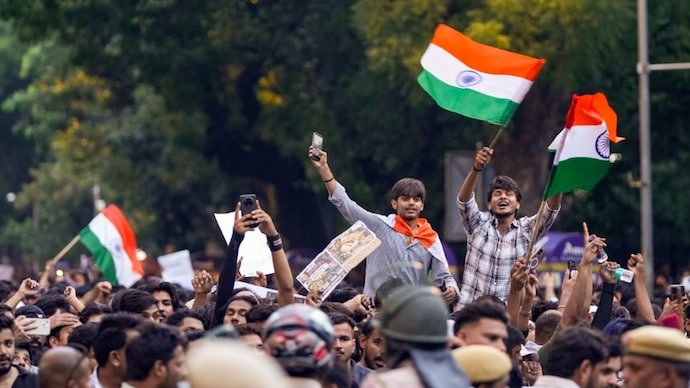
The student protests at Delhi's Jantar Mantar have sparked a fresh debate over the technology being used to monitor them. Videos filmed at the protest site are spreading rapidly on X, with several users claiming that Delhi Police personnel are using AI-powered facial recognition systems to identify protesters instantly. The clips, which were also shared by CJP on X, appear to show footage from a live CCTV surveillance vehicle equipped with 360-degree cameras. The screen inside the vehicle also appears to display the names, photographs, and other details of select protesters.
The videos do not mention Aadhaar anywhere. However, because the system is reportedly able to pull up personal information after scanning faces, many social media users have questioned whether it is connected to Aadhaar or another government database. So far, there is no official confirmation that Aadhaar is being used, and Delhi Police has not stated that the technology is linked to the Aadhaar database.
AI vans deployed outside protest venue
An Indian Express report claims that Delhi Police has positioned two surveillance vehicles near the protest site. One functions as a mobile monitoring unit that receives live feeds from CCTV cameras installed around the area. The second vehicle uses artificial intelligence to analyse those video feeds and compare faces captured on camera with images available in a police database.
Officials say the technology is not meant to identify every protester. Instead, they claim its purpose is to alert police if someone with a criminal record is detected in the crowd.
"We have a large database of criminals, with their pictures. So, we run facial recognition on the footage that is received from the various CCTVs in the area, to see if it flags any face the software matches with someone on our criminal database," a senior police officer told Indian Express.
The facial recognition system is housed inside the Ikshana vehicle, which Delhi Police first introduced ahead of the 2023 G20 Summit as part of its surveillance infrastructure.
Aadhaar questions remain unanswered
Although the viral videos have triggered speculation that Aadhaar records are being accessed, there is no evidence in the videos themselves to support that claim. The footage only appears to show faces being matched with personal information on a police system.
That has nevertheless raised an important question: If the information is not coming from Aadhaar, which database is being used to identify people? Authorities have not publicly explained the source of the data visible on the monitoring screens.
Protesters say constant monitoring is intimidating
Many students taking part in the demonstrations say the visible use of cameras has made them uncomfortable. Some have started covering their faces because they worry that images captured during the protest could be stored and used against them in the future.
One UPSC aspirant told Indian Express that participants were hiding their identities because they did not want to risk being profiled while preparing for government jobs.
Questions have also been raised about how long the footage collected during the protests will remain with the police. According to another senior officer quoted by the publication, there is no fixed timeline for deleting the recordings, especially if they may later become relevant to an investigation.
Meanwhile, the surveillance has become the subject of a legal challenge. A petition before the Delhi High Court argues that continuous monitoring of protesters violates their rights to privacy and peaceful assembly. Delhi Police, however, has maintained before the court that videography at the protest site is being carried out only to maintain law and order and ensure public safety, and not to conduct surveillance, according to the report.
The student protests at Delhi's Jantar Mantar have sparked a fresh debate over the technology being used to monitor them. Videos filmed at the protest site are spreading rapidly on X, with several users claiming that Delhi Police personnel are using AI-powered facial recognition systems to identify protesters instantly. The clips, which were also shared by CJP on X, appear to show footage from a live CCTV surveillance vehicle equipped with 360-degree cameras. The screen inside the vehicle also appears to display the names, photographs, and other details of select protesters.
The videos do not mention Aadhaar anywhere. However, because the system is reportedly able to pull up personal information after scanning faces, many social media users have questioned whether it is connected to Aadhaar or another government database. So far, there is no official confirmation that Aadhaar is being used, and Delhi Police has not stated that the technology is linked to the Aadhaar database.
AI vans deployed outside protest venue
An Indian Express report claims that Delhi Police has positioned two surveillance vehicles near the protest site. One functions as a mobile monitoring unit that receives live feeds from CCTV cameras installed around the area. The second vehicle uses artificial intelligence to analyse those video feeds and compare faces captured on camera with images available in a police database.
Officials say the technology is not meant to identify every protester. Instead, they claim its purpose is to alert police if someone with a criminal record is detected in the crowd.
"We have a large database of criminals, with their pictures. So, we run facial recognition on the footage that is received from the various CCTVs in the area, to see if it flags any face the software matches with someone on our criminal database," a senior police officer told Indian Express.
The facial recognition system is housed inside the Ikshana vehicle, which Delhi Police first introduced ahead of the 2023 G20 Summit as part of its surveillance infrastructure.
Aadhaar questions remain unanswered
Although the viral videos have triggered speculation that Aadhaar records are being accessed, there is no evidence in the videos themselves to support that claim. The footage only appears to show faces being matched with personal information on a police system.
That has nevertheless raised an important question: If the information is not coming from Aadhaar, which database is being used to identify people? Authorities have not publicly explained the source of the data visible on the monitoring screens.
Protesters say constant monitoring is intimidating
Many students taking part in the demonstrations say the visible use of cameras has made them uncomfortable. Some have started covering their faces because they worry that images captured during the protest could be stored and used against them in the future.
One UPSC aspirant told Indian Express that participants were hiding their identities because they did not want to risk being profiled while preparing for government jobs.
Questions have also been raised about how long the footage collected during the protests will remain with the police. According to another senior officer quoted by the publication, there is no fixed timeline for deleting the recordings, especially if they may later become relevant to an investigation.
Meanwhile, the surveillance has become the subject of a legal challenge. A petition before the Delhi High Court argues that continuous monitoring of protesters violates their rights to privacy and peaceful assembly. Delhi Police, however, has maintained before the court that videography at the protest site is being carried out only to maintain law and order and ensure public safety, and not to conduct surveillance, according to the report.
The student protests at Delhi's Jantar Mantar have sparked a fresh debate over the technology being used to monitor them. Videos filmed at the protest site are spreading rapidly on X, with several users claiming that Delhi Police personnel are using AI-powered facial recognition systems to identify protesters instantly. The clips, which were also shared by CJP on X, appear to show footage from a live CCTV surveillance vehicle equipped with 360-degree cameras. The screen inside the vehicle also appears to display the names, photographs, and other details of select protesters.
The videos do not mention Aadhaar anywhere. However, because the system is reportedly able to pull up personal information after scanning faces, many social media users have questioned whether it is connected to Aadhaar or another government database. So far, there is no official confirmation that Aadhaar is being used, and Delhi Police has not stated that the technology is linked to the Aadhaar database.
AI vans deployed outside protest venue
An Indian Express report claims that Delhi Police has positioned two surveillance vehicles near the protest site. One functions as a mobile monitoring unit that receives live feeds from CCTV cameras installed around the area. The second vehicle uses artificial intelligence to analyse those video feeds and compare faces captured on camera with images available in a police database.
Officials say the technology is not meant to identify every protester. Instead, they claim its purpose is to alert police if someone with a criminal record is detected in the crowd.
"We have a large database of criminals, with their pictures. So, we run facial recognition on the footage that is received from the various CCTVs in the area, to see if it flags any face the software matches with someone on our criminal database," a senior police officer told Indian Express.
The facial recognition system is housed inside the Ikshana vehicle, which Delhi Police first introduced ahead of the 2023 G20 Summit as part of its surveillance infrastructure.
Aadhaar questions remain unanswered
Although the viral videos have triggered speculation that Aadhaar records are being accessed, there is no evidence in the videos themselves to support that claim. The footage only appears to show faces being matched with personal information on a police system.
That has nevertheless raised an important question: If the information is not coming from Aadhaar, which database is being used to identify people? Authorities have not publicly explained the source of the data visible on the monitoring screens.
Protesters say constant monitoring is intimidating
Many students taking part in the demonstrations say the visible use of cameras has made them uncomfortable. Some have started covering their faces because they worry that images captured during the protest could be stored and used against them in the future.
One UPSC aspirant told Indian Express that participants were hiding their identities because they did not want to risk being profiled while preparing for government jobs.
Questions have also been raised about how long the footage collected during the protests will remain with the police. According to another senior officer quoted by the publication, there is no fixed timeline for deleting the recordings, especially if they may later become relevant to an investigation.
Meanwhile, the surveillance has become the subject of a legal challenge. A petition before the Delhi High Court argues that continuous monitoring of protesters violates their rights to privacy and peaceful assembly. Delhi Police, however, has maintained before the court that videography at the protest site is being carried out only to maintain law and order and ensure public safety, and not to conduct surveillance, according to the report.

