Watch: Chinese rocket hit by lightning seconds after launch, keeps flying
A Chinese Long March-3B rocket was struck by lightning seconds after lift-off from Xichang but still placed the Tianlian-2-06 satellite into geostationary transfer orbit.
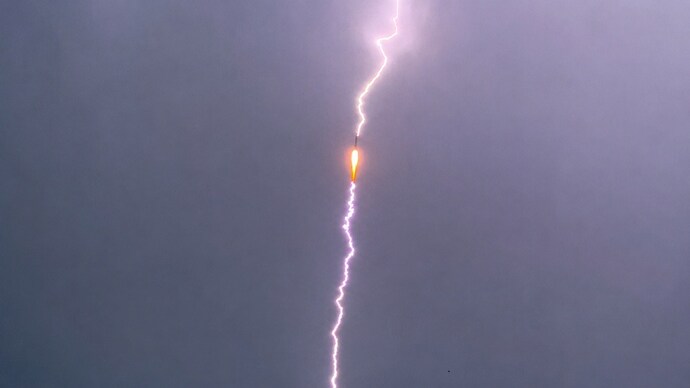
A Chinese Long March-3B (LM-3B) rocket shrugged off a dramatic lightning strike just seconds after liftoff, successfully delivering the Tianlian-2-06 data relay satellite into geostationary transfer orbit (GTO), demonstrating the resilience of one of China's workhorse launch vehicles.
The launch took place from the Xichang Satellite Launch Center, one of the most lightning-prone regions in China. Moments after the rocket cleared the launch pad, a bolt of lightning appeared to strike the ascending vehicle.
Despite the spectacular flash, the rocket continued climbing without any visible deviation, completing its mission as planned.
WATCH CHINESE ROCKET HIT BY LIGHTNING
With the successful launch, the Long March-3B joins a small group of orbital launch vehicles known to have survived lightning strikes during ascent, including NASA's iconic Saturn V and Russia's Soyuz-2 rocket.
The mission carried Tianlian-2-06, the sixth satellite in China's second-generation Tianlian data relay constellation. Often described as China's equivalent of NASA's Tracking and Data Relay Satellite System (TDRSS), the Tianlian network enables continuous communication with spacecraft beyond the range of ground stations.
These satellites relay telemetry, tracking and command data from spacecraft in orbit, support crewed missions, and provide communications during rocket launches. The latest spacecraft is also the fourth Tianlian-2 satellite launched in the past two years, reflecting China's rapid expansion of its space-based communications infrastructure.
Lightning has long posed a challenge for rocket launches because it can induce powerful electrical currents capable of disrupting onboard electronics. The most famous example occurred during NASA's Apollo 12 mission in 1969, when a Saturn V rocket was struck by lightning shortly after launch.
Although the spacecraft briefly lost telemetry, quick action by mission controllers allowed the mission to continue safely.
The latest Chinese launch adds another example to the short list of rockets that have successfully flown through lightning without compromising mission success.
The flawless ascent further also shows the reliability of the Long March-3B, one of China's most frequently used heavy-lift launch vehicles, even under challenging weather conditions at Xichang, where thunderstorms and lightning are common during the launch season.
A Chinese Long March-3B (LM-3B) rocket shrugged off a dramatic lightning strike just seconds after liftoff, successfully delivering the Tianlian-2-06 data relay satellite into geostationary transfer orbit (GTO), demonstrating the resilience of one of China's workhorse launch vehicles.
The launch took place from the Xichang Satellite Launch Center, one of the most lightning-prone regions in China. Moments after the rocket cleared the launch pad, a bolt of lightning appeared to strike the ascending vehicle.
Despite the spectacular flash, the rocket continued climbing without any visible deviation, completing its mission as planned.
WATCH CHINESE ROCKET HIT BY LIGHTNING
With the successful launch, the Long March-3B joins a small group of orbital launch vehicles known to have survived lightning strikes during ascent, including NASA's iconic Saturn V and Russia's Soyuz-2 rocket.
The mission carried Tianlian-2-06, the sixth satellite in China's second-generation Tianlian data relay constellation. Often described as China's equivalent of NASA's Tracking and Data Relay Satellite System (TDRSS), the Tianlian network enables continuous communication with spacecraft beyond the range of ground stations.
These satellites relay telemetry, tracking and command data from spacecraft in orbit, support crewed missions, and provide communications during rocket launches. The latest spacecraft is also the fourth Tianlian-2 satellite launched in the past two years, reflecting China's rapid expansion of its space-based communications infrastructure.
Lightning has long posed a challenge for rocket launches because it can induce powerful electrical currents capable of disrupting onboard electronics. The most famous example occurred during NASA's Apollo 12 mission in 1969, when a Saturn V rocket was struck by lightning shortly after launch.
Although the spacecraft briefly lost telemetry, quick action by mission controllers allowed the mission to continue safely.
The latest Chinese launch adds another example to the short list of rockets that have successfully flown through lightning without compromising mission success.
The flawless ascent further also shows the reliability of the Long March-3B, one of China's most frequently used heavy-lift launch vehicles, even under challenging weather conditions at Xichang, where thunderstorms and lightning are common during the launch season.
A Chinese Long March-3B (LM-3B) rocket shrugged off a dramatic lightning strike just seconds after liftoff, successfully delivering the Tianlian-2-06 data relay satellite into geostationary transfer orbit (GTO), demonstrating the resilience of one of China's workhorse launch vehicles.
The launch took place from the Xichang Satellite Launch Center, one of the most lightning-prone regions in China. Moments after the rocket cleared the launch pad, a bolt of lightning appeared to strike the ascending vehicle.
Despite the spectacular flash, the rocket continued climbing without any visible deviation, completing its mission as planned.
WATCH CHINESE ROCKET HIT BY LIGHTNING
With the successful launch, the Long March-3B joins a small group of orbital launch vehicles known to have survived lightning strikes during ascent, including NASA's iconic Saturn V and Russia's Soyuz-2 rocket.
The mission carried Tianlian-2-06, the sixth satellite in China's second-generation Tianlian data relay constellation. Often described as China's equivalent of NASA's Tracking and Data Relay Satellite System (TDRSS), the Tianlian network enables continuous communication with spacecraft beyond the range of ground stations.
These satellites relay telemetry, tracking and command data from spacecraft in orbit, support crewed missions, and provide communications during rocket launches. The latest spacecraft is also the fourth Tianlian-2 satellite launched in the past two years, reflecting China's rapid expansion of its space-based communications infrastructure.
Lightning has long posed a challenge for rocket launches because it can induce powerful electrical currents capable of disrupting onboard electronics. The most famous example occurred during NASA's Apollo 12 mission in 1969, when a Saturn V rocket was struck by lightning shortly after launch.
Although the spacecraft briefly lost telemetry, quick action by mission controllers allowed the mission to continue safely.
The latest Chinese launch adds another example to the short list of rockets that have successfully flown through lightning without compromising mission success.
The flawless ascent further also shows the reliability of the Long March-3B, one of China's most frequently used heavy-lift launch vehicles, even under challenging weather conditions at Xichang, where thunderstorms and lightning are common during the launch season.

