Viral video: Alaska's waterfall has a bear-salmon frenzy. Reason will surprise you
A viral video of bears swarming Brooks Falls in Alaska has resurfaced online. Here is the real science behind the salmon run, the waterfall, and why it feeds an entire forest.
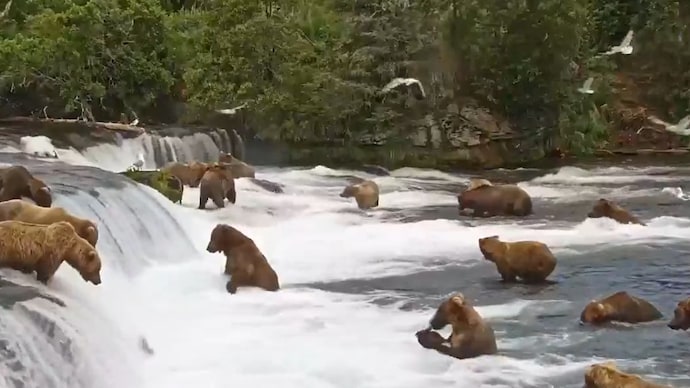
A video of dozens of brown bears crowding a waterfall in Alaska, swiping at airborne salmon, has been doing the rounds online again this July. It looks chaotic, but is not.
Every part of what is happening at Brooks Falls, from the timing to the fighting to the fish themselves, follows a script written through millions of years of evolution.
Here is the science behind the spectacle.
WHERE IS THIS HAPPENING?
Brooks Falls sits inside Katmai National Park and Preserve in Alaska, on a river that connects Brooks Lake to Naknek Lake.
It is one of the most studied bear habitats on Earth, partly because live cameras run by the US National Park Service and Explore.org have watched it around the clock for years.
That is also why footage from the falls keeps going viral.
Somebody is always filming it.
WHY DO THE SALMON EVEN COME BACK HERE?
The fish in the video are sockeye salmon. They hatch in freshwater, swim out to the Pacific Ocean, spend two to three years feeding and growing out there, and then swim all the way back to the exact stream where they were born.
They arrive at the mouth of the Brooks River in mid-to-late June. Numbers build through late June, and the run peaks in the surrounding Naknek watershed in early July, which is exactly why the footage tends to surge online at this time of year.
By the end of July, most fish have finished the journey to their spawning grounds.
The scale is enormous. An estimated 2,00,000 to 4,00,000 sockeye salmon successfully leap Brooks Falls in a single season.
WHY DOES A SIX-FOOT WATERFALL MATTER SO MUCH?
Brooks Falls is only about 1.8 metres high, roughly six feet. That is not much of an obstacle for a fish built to swim across an ocean. But it is just enough to force salmon to pause, gather in the pool below, and time their jumps.
That pause is the whole story. Instead of being spread out across kilometres of river, fish get concentrated into one small pool. For a bear, that is the difference between hunting scattered prey and standing at a buffet.
WHY ARE THE SALMON TURNING RED AND GROWING HUMPS?
Once sockeye enter freshwater, they stop feeding entirely. From that point on, they are living off whatever fat and energy they have already stored at sea.
Their bodies transform as a result. Red pigment that was hidden in their muscles moves into the skin.
Their backs develop a hump. Jaws lengthen, and males in particular grow hooked jaws and larger teeth to compete with rivals.
Females carry roughly 4,000 eggs each. Almost all adult salmon die within weeks of spawning, and their carcasses become a second wave of food for bears later in the season.
WHY ARE THE BEARS SO DESPERATE FOR FISH RIGHT NOW?
Brown bears have to pack on a full year's worth of energy in about six months, a state biologists call hyperphagia.
A single sockeye contains roughly 4,500 calories, and the most dominant bears can catch and eat more than 30 fish in a day.
Without this window, they simply cannot build enough fat to survive winter hibernation.
WHY DO SOME BEARS GET THE BEST SPOTS AND OTHERS DON'T?
Watch closely and the video is not really chaos, it is hierarchy. The biggest, most dominant males claim the lip of the falls and the plunge pool below it, the two most productive fishing spots.
Females with cubs and younger, subordinate bears are usually pushed to the quieter, less productive stretches of river downstream. Rank depends on size, age, health and temperament, and it can shift over time.
Bears fish in different styles too. Some stand-and-wait at the lip, snatching salmon out of midair. Some sit-and-wait in the plunge pool.
Others dash-and-grab, snorkel for carcasses later in the season, or simply steal a catch from another bear.
WHAT HAPPENS TO ALL THAT SALMON AFTERWARD?
This is where the story stops being about bears and starts being about forests.
Bears often eat only the richest parts of a fish, the brain, skin, eggs and fatty tissue, and leave the rest behind on land. In smaller river systems, bears can move more than half of the entire spawning salmon biomass out of the water and into the surrounding forest.
That has measurable effects on the soil itself. Near carcass sites, soil ammonium levels rise roughly three-fold, and nitrous oxide emissions rise by around 32-fold.
Salmon-derived nitrogen can make up close to a quarter of soil nitrogen in some riparian zones, or regions near a water body, and it shows up in the foliage of trees growing nearby, feeding forest growth far from the ocean the nutrients originally came from.
Leftover carcasses also support eagles, gulls, foxes and countless smaller scavengers, and bears help disperse the seeds of berry-producing shrubs as they move through the landscape.
HOW MANY BEARS ARE WE TALKING ABOUT?
Katmai National Park and Preserve is home to an estimated 2,200 brown bears, and as many as 50 or more have been recorded fishing at Brooks Falls at the same time.
That makes it one of the densest brown bear populations anywhere on Earth, a density made possible almost entirely by the seasonal glut of salmon. Many of the individual bears seen on camera here are the same familiar faces who go on to compete in the autumn's Fat Bear Week.
IS ANY OF THIS AT RISK?
Scientists are watching one thing closely: warming river temperatures. Sockeye do best in cold water, and warmer rivers can add physiological stress and shift the timing of the run.
Because the Brooks River has been studied continuously for decades, it is also one of the best long-term datasets researchers have for tracking how that timing might change.
A video of dozens of brown bears crowding a waterfall in Alaska, swiping at airborne salmon, has been doing the rounds online again this July. It looks chaotic, but is not.
Every part of what is happening at Brooks Falls, from the timing to the fighting to the fish themselves, follows a script written through millions of years of evolution.
Here is the science behind the spectacle.
WHERE IS THIS HAPPENING?
Brooks Falls sits inside Katmai National Park and Preserve in Alaska, on a river that connects Brooks Lake to Naknek Lake.
It is one of the most studied bear habitats on Earth, partly because live cameras run by the US National Park Service and Explore.org have watched it around the clock for years.
That is also why footage from the falls keeps going viral.
Somebody is always filming it.
WHY DO THE SALMON EVEN COME BACK HERE?
The fish in the video are sockeye salmon. They hatch in freshwater, swim out to the Pacific Ocean, spend two to three years feeding and growing out there, and then swim all the way back to the exact stream where they were born.
They arrive at the mouth of the Brooks River in mid-to-late June. Numbers build through late June, and the run peaks in the surrounding Naknek watershed in early July, which is exactly why the footage tends to surge online at this time of year.
By the end of July, most fish have finished the journey to their spawning grounds.
The scale is enormous. An estimated 2,00,000 to 4,00,000 sockeye salmon successfully leap Brooks Falls in a single season.
WHY DOES A SIX-FOOT WATERFALL MATTER SO MUCH?
Brooks Falls is only about 1.8 metres high, roughly six feet. That is not much of an obstacle for a fish built to swim across an ocean. But it is just enough to force salmon to pause, gather in the pool below, and time their jumps.
That pause is the whole story. Instead of being spread out across kilometres of river, fish get concentrated into one small pool. For a bear, that is the difference between hunting scattered prey and standing at a buffet.
WHY ARE THE SALMON TURNING RED AND GROWING HUMPS?
Once sockeye enter freshwater, they stop feeding entirely. From that point on, they are living off whatever fat and energy they have already stored at sea.
Their bodies transform as a result. Red pigment that was hidden in their muscles moves into the skin.
Their backs develop a hump. Jaws lengthen, and males in particular grow hooked jaws and larger teeth to compete with rivals.
Females carry roughly 4,000 eggs each. Almost all adult salmon die within weeks of spawning, and their carcasses become a second wave of food for bears later in the season.
WHY ARE THE BEARS SO DESPERATE FOR FISH RIGHT NOW?
Brown bears have to pack on a full year's worth of energy in about six months, a state biologists call hyperphagia.
A single sockeye contains roughly 4,500 calories, and the most dominant bears can catch and eat more than 30 fish in a day.
Without this window, they simply cannot build enough fat to survive winter hibernation.
WHY DO SOME BEARS GET THE BEST SPOTS AND OTHERS DON'T?
Watch closely and the video is not really chaos, it is hierarchy. The biggest, most dominant males claim the lip of the falls and the plunge pool below it, the two most productive fishing spots.
Females with cubs and younger, subordinate bears are usually pushed to the quieter, less productive stretches of river downstream. Rank depends on size, age, health and temperament, and it can shift over time.
Bears fish in different styles too. Some stand-and-wait at the lip, snatching salmon out of midair. Some sit-and-wait in the plunge pool.
Others dash-and-grab, snorkel for carcasses later in the season, or simply steal a catch from another bear.
WHAT HAPPENS TO ALL THAT SALMON AFTERWARD?
This is where the story stops being about bears and starts being about forests.
Bears often eat only the richest parts of a fish, the brain, skin, eggs and fatty tissue, and leave the rest behind on land. In smaller river systems, bears can move more than half of the entire spawning salmon biomass out of the water and into the surrounding forest.
That has measurable effects on the soil itself. Near carcass sites, soil ammonium levels rise roughly three-fold, and nitrous oxide emissions rise by around 32-fold.
Salmon-derived nitrogen can make up close to a quarter of soil nitrogen in some riparian zones, or regions near a water body, and it shows up in the foliage of trees growing nearby, feeding forest growth far from the ocean the nutrients originally came from.
Leftover carcasses also support eagles, gulls, foxes and countless smaller scavengers, and bears help disperse the seeds of berry-producing shrubs as they move through the landscape.
HOW MANY BEARS ARE WE TALKING ABOUT?
Katmai National Park and Preserve is home to an estimated 2,200 brown bears, and as many as 50 or more have been recorded fishing at Brooks Falls at the same time.
That makes it one of the densest brown bear populations anywhere on Earth, a density made possible almost entirely by the seasonal glut of salmon. Many of the individual bears seen on camera here are the same familiar faces who go on to compete in the autumn's Fat Bear Week.
IS ANY OF THIS AT RISK?
Scientists are watching one thing closely: warming river temperatures. Sockeye do best in cold water, and warmer rivers can add physiological stress and shift the timing of the run.
Because the Brooks River has been studied continuously for decades, it is also one of the best long-term datasets researchers have for tracking how that timing might change.
A video of dozens of brown bears crowding a waterfall in Alaska, swiping at airborne salmon, has been doing the rounds online again this July. It looks chaotic, but is not.
Every part of what is happening at Brooks Falls, from the timing to the fighting to the fish themselves, follows a script written through millions of years of evolution.
Here is the science behind the spectacle.
WHERE IS THIS HAPPENING?
Brooks Falls sits inside Katmai National Park and Preserve in Alaska, on a river that connects Brooks Lake to Naknek Lake.
It is one of the most studied bear habitats on Earth, partly because live cameras run by the US National Park Service and Explore.org have watched it around the clock for years.
That is also why footage from the falls keeps going viral.
Somebody is always filming it.
WHY DO THE SALMON EVEN COME BACK HERE?
The fish in the video are sockeye salmon. They hatch in freshwater, swim out to the Pacific Ocean, spend two to three years feeding and growing out there, and then swim all the way back to the exact stream where they were born.
They arrive at the mouth of the Brooks River in mid-to-late June. Numbers build through late June, and the run peaks in the surrounding Naknek watershed in early July, which is exactly why the footage tends to surge online at this time of year.
By the end of July, most fish have finished the journey to their spawning grounds.
The scale is enormous. An estimated 2,00,000 to 4,00,000 sockeye salmon successfully leap Brooks Falls in a single season.
WHY DOES A SIX-FOOT WATERFALL MATTER SO MUCH?
Brooks Falls is only about 1.8 metres high, roughly six feet. That is not much of an obstacle for a fish built to swim across an ocean. But it is just enough to force salmon to pause, gather in the pool below, and time their jumps.
That pause is the whole story. Instead of being spread out across kilometres of river, fish get concentrated into one small pool. For a bear, that is the difference between hunting scattered prey and standing at a buffet.
WHY ARE THE SALMON TURNING RED AND GROWING HUMPS?
Once sockeye enter freshwater, they stop feeding entirely. From that point on, they are living off whatever fat and energy they have already stored at sea.
Their bodies transform as a result. Red pigment that was hidden in their muscles moves into the skin.
Their backs develop a hump. Jaws lengthen, and males in particular grow hooked jaws and larger teeth to compete with rivals.
Females carry roughly 4,000 eggs each. Almost all adult salmon die within weeks of spawning, and their carcasses become a second wave of food for bears later in the season.
WHY ARE THE BEARS SO DESPERATE FOR FISH RIGHT NOW?
Brown bears have to pack on a full year's worth of energy in about six months, a state biologists call hyperphagia.
A single sockeye contains roughly 4,500 calories, and the most dominant bears can catch and eat more than 30 fish in a day.
Without this window, they simply cannot build enough fat to survive winter hibernation.
WHY DO SOME BEARS GET THE BEST SPOTS AND OTHERS DON'T?
Watch closely and the video is not really chaos, it is hierarchy. The biggest, most dominant males claim the lip of the falls and the plunge pool below it, the two most productive fishing spots.
Females with cubs and younger, subordinate bears are usually pushed to the quieter, less productive stretches of river downstream. Rank depends on size, age, health and temperament, and it can shift over time.
Bears fish in different styles too. Some stand-and-wait at the lip, snatching salmon out of midair. Some sit-and-wait in the plunge pool.
Others dash-and-grab, snorkel for carcasses later in the season, or simply steal a catch from another bear.
WHAT HAPPENS TO ALL THAT SALMON AFTERWARD?
This is where the story stops being about bears and starts being about forests.
Bears often eat only the richest parts of a fish, the brain, skin, eggs and fatty tissue, and leave the rest behind on land. In smaller river systems, bears can move more than half of the entire spawning salmon biomass out of the water and into the surrounding forest.
That has measurable effects on the soil itself. Near carcass sites, soil ammonium levels rise roughly three-fold, and nitrous oxide emissions rise by around 32-fold.
Salmon-derived nitrogen can make up close to a quarter of soil nitrogen in some riparian zones, or regions near a water body, and it shows up in the foliage of trees growing nearby, feeding forest growth far from the ocean the nutrients originally came from.
Leftover carcasses also support eagles, gulls, foxes and countless smaller scavengers, and bears help disperse the seeds of berry-producing shrubs as they move through the landscape.
HOW MANY BEARS ARE WE TALKING ABOUT?
Katmai National Park and Preserve is home to an estimated 2,200 brown bears, and as many as 50 or more have been recorded fishing at Brooks Falls at the same time.
That makes it one of the densest brown bear populations anywhere on Earth, a density made possible almost entirely by the seasonal glut of salmon. Many of the individual bears seen on camera here are the same familiar faces who go on to compete in the autumn's Fat Bear Week.
IS ANY OF THIS AT RISK?
Scientists are watching one thing closely: warming river temperatures. Sockeye do best in cold water, and warmer rivers can add physiological stress and shift the timing of the run.
Because the Brooks River has been studied continuously for decades, it is also one of the best long-term datasets researchers have for tracking how that timing might change.

