Pacific Ocean has a fever, and scientists warn there is no medicine for El Nino
Scientists say the Pacific is heating so quickly that the 2026-27 El Niño is far ahead of past events. They warn it could drive severe global weather and briefly lift 2027 above 2°C warming.
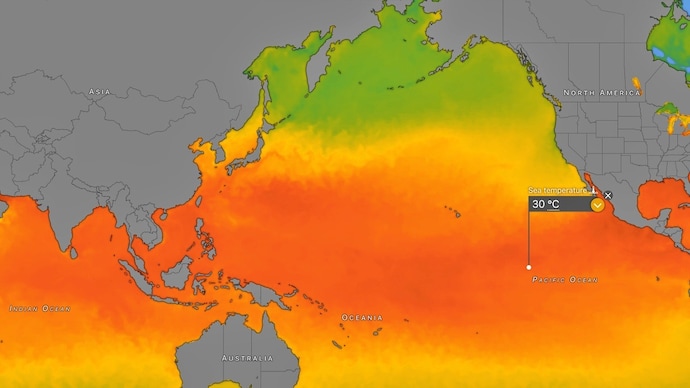
The Pacific Ocean is heating up at a pace that has stunned climate scientists, with the developing 2026-27 El Nino now tracking nearly seven weeks ahead of any previously recorded event at the same stage in its lifecycle.
If current forecasts hold, the world could be heading toward one of the strongest climate events ever observed, bringing extreme weather across continents over the next 12 to 18 months.
Climate models now project the event could peak at 3.6°C on the Relative Oceanic Nino Index (RONI), a newer metric that adjusts traditional El Nino measurements to account for long-term ocean warming caused by climate change. If realised, it would surpass the previous record set during the historic 1877 El Nino by 0.7°C, an enormous margin in climate science.
Scientists classify an event as a Super El Nino when the Nino 3.4 sea surface temperature anomaly remains at 2.0°C or higher for three consecutive months. Current ensemble forecasts now place the probability of reaching that threshold at 94 per cent, making a Super El Nino this winter appear almost certain.
The rapid warming has raised concerns because El Nino alters global atmospheric circulation, reshaping rainfall patterns, storm tracks, droughts, and temperatures worldwide.
Experts warn the developing event could influence weather far beyond the Pacific Ocean.
In the United States, forecasts continue to point toward an unusually wet winter across California and the southern states. Historically, many of California's largest floods have occurred during El Nino years, with stronger events significantly increasing the risk of prolonged heavy rainfall and flooding.
Climate researchers have also found that seven of eight simulated ARkStorm scenarios, catastrophic atmospheric river events capable of causing widespread flooding across California, occurred during moderate to strong El Nino years.
A powerful El Nino therefore substantially raises the likelihood of such extreme precipitation events.
Beyond regional impacts, scientists say the developing event could have profound global consequences. Combined with the long-term warming trend driven by greenhouse gas emissions, the exceptionally strong El Nino could push 2027 to become the first year in which the planet temporarily reaches 2°C above pre-industrial temperatures.
That threshold is significant because it represents a level of warming associated with more frequent and intense heatwaves, heavier rainfall, stronger droughts, coral bleaching, glacier loss, and other climate extremes.
While El Nino itself is a naturally occurring phenomenon, researchers emphasise that rising global temperatures are amplifying its impacts.
As the Pacific continues to warm at an unprecedented pace, scientists say the world is entering unfamiliar territory, one where the ocean's "fever" has no quick cure, and communities may need to prepare for increasingly volatile weather in the months ahead.
The Pacific Ocean is heating up at a pace that has stunned climate scientists, with the developing 2026-27 El Nino now tracking nearly seven weeks ahead of any previously recorded event at the same stage in its lifecycle.
If current forecasts hold, the world could be heading toward one of the strongest climate events ever observed, bringing extreme weather across continents over the next 12 to 18 months.
Climate models now project the event could peak at 3.6°C on the Relative Oceanic Nino Index (RONI), a newer metric that adjusts traditional El Nino measurements to account for long-term ocean warming caused by climate change. If realised, it would surpass the previous record set during the historic 1877 El Nino by 0.7°C, an enormous margin in climate science.
Scientists classify an event as a Super El Nino when the Nino 3.4 sea surface temperature anomaly remains at 2.0°C or higher for three consecutive months. Current ensemble forecasts now place the probability of reaching that threshold at 94 per cent, making a Super El Nino this winter appear almost certain.
The rapid warming has raised concerns because El Nino alters global atmospheric circulation, reshaping rainfall patterns, storm tracks, droughts, and temperatures worldwide.
Experts warn the developing event could influence weather far beyond the Pacific Ocean.
In the United States, forecasts continue to point toward an unusually wet winter across California and the southern states. Historically, many of California's largest floods have occurred during El Nino years, with stronger events significantly increasing the risk of prolonged heavy rainfall and flooding.
Climate researchers have also found that seven of eight simulated ARkStorm scenarios, catastrophic atmospheric river events capable of causing widespread flooding across California, occurred during moderate to strong El Nino years.
A powerful El Nino therefore substantially raises the likelihood of such extreme precipitation events.
Beyond regional impacts, scientists say the developing event could have profound global consequences. Combined with the long-term warming trend driven by greenhouse gas emissions, the exceptionally strong El Nino could push 2027 to become the first year in which the planet temporarily reaches 2°C above pre-industrial temperatures.
That threshold is significant because it represents a level of warming associated with more frequent and intense heatwaves, heavier rainfall, stronger droughts, coral bleaching, glacier loss, and other climate extremes.
While El Nino itself is a naturally occurring phenomenon, researchers emphasise that rising global temperatures are amplifying its impacts.
As the Pacific continues to warm at an unprecedented pace, scientists say the world is entering unfamiliar territory, one where the ocean's "fever" has no quick cure, and communities may need to prepare for increasingly volatile weather in the months ahead.

