Private spacecraft on its way to rescue falling telescope sends first pictures
Fresh images from orbit mark an important step in an ambitious mission that aims to give one of NASA's longest-running space observatories a new lease of life.
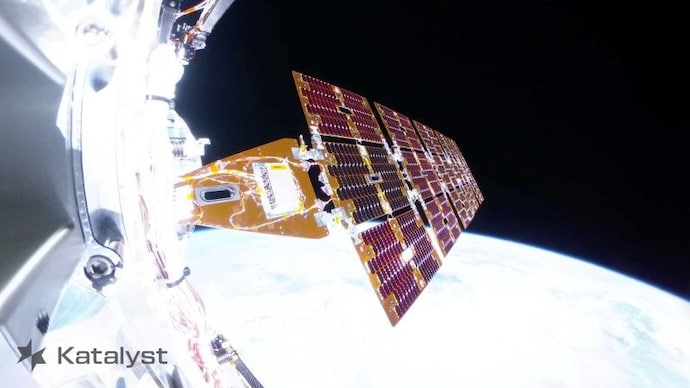
Katalyst Space has released the first in-orbit images from its Link robotic servicing spacecraft, marking a key milestone in the Swift Boost mission to extend the life of Nasa's Neil Gehrels Swift Observatory.
The Arizona-based company shared the images on social media after Link reached low-Earth orbit aboard Northrop Grumman's Pegasus XL rocket, which lifted off from Kwajalein Atoll in the Marshall Islands on Friday, July 3.
NASA COMPLETES EARLY TESTS
In its latest mission update, Nasa said Link has successfully completed several post-launch milestones.
Link is now undergoing on-orbit checkouts before beginning its rendezvous with the Swift Observatory.
The spacecraft has established communications with mission controllers, deployed its solar arrays and is generating power as expected.
Engineers are also testing its propulsion, navigation, communications and attitude-control systems before Link begins a series of orbital manoeuvres to catch up with Swift.
WHAT IS THE SWIFT BOOST MISSION?
Swift Boost is designed to rescue one of Nasa's longest-running space observatories, which has studied powerful cosmic explosions known as gamma-ray bursts since its launch in 2004.
Although the telescope remains scientifically productive, increased atmospheric drag caused by heightened solar activity has steadily lowered its orbit.
Because Swift was never designed to raise its orbit or be serviced in space, Nasa partnered with Katalyst Space to develop a commercial solution.
Built in just nine months, Link will autonomously rendezvous with the observatory, dock with it and gradually raise its orbit by around 300 kilometres, extending the mission by several years.
WHAT'S NEXT?
Once testing is complete, Link will begin adjusting its orbit before attempting an autonomous docking with Swift, one of the mission's most technically challenging phases.
If successful, Swift Boost will become the first US commercial mission to rescue and extend the life of an operational government science satellite in orbit.
The demonstration could pave the way for future missions to repair, refuel or reposition ageing satellites, reducing costs and space debris instead of replacing spacecraft altogether.
Katalyst Space has released the first in-orbit images from its Link robotic servicing spacecraft, marking a key milestone in the Swift Boost mission to extend the life of Nasa's Neil Gehrels Swift Observatory.
The Arizona-based company shared the images on social media after Link reached low-Earth orbit aboard Northrop Grumman's Pegasus XL rocket, which lifted off from Kwajalein Atoll in the Marshall Islands on Friday, July 3.
NASA COMPLETES EARLY TESTS
In its latest mission update, Nasa said Link has successfully completed several post-launch milestones.
Link is now undergoing on-orbit checkouts before beginning its rendezvous with the Swift Observatory.
The spacecraft has established communications with mission controllers, deployed its solar arrays and is generating power as expected.
Engineers are also testing its propulsion, navigation, communications and attitude-control systems before Link begins a series of orbital manoeuvres to catch up with Swift.
WHAT IS THE SWIFT BOOST MISSION?
Swift Boost is designed to rescue one of Nasa's longest-running space observatories, which has studied powerful cosmic explosions known as gamma-ray bursts since its launch in 2004.
Although the telescope remains scientifically productive, increased atmospheric drag caused by heightened solar activity has steadily lowered its orbit.
Because Swift was never designed to raise its orbit or be serviced in space, Nasa partnered with Katalyst Space to develop a commercial solution.
Built in just nine months, Link will autonomously rendezvous with the observatory, dock with it and gradually raise its orbit by around 300 kilometres, extending the mission by several years.
WHAT'S NEXT?
Once testing is complete, Link will begin adjusting its orbit before attempting an autonomous docking with Swift, one of the mission's most technically challenging phases.
If successful, Swift Boost will become the first US commercial mission to rescue and extend the life of an operational government science satellite in orbit.
The demonstration could pave the way for future missions to repair, refuel or reposition ageing satellites, reducing costs and space debris instead of replacing spacecraft altogether.

