Satellite captures dust from Sahara desert cross Atlantic to reach American skies
A vast Saharan dust plume is moving across the Atlantic towards the Caribbean and Florida. The event may affect air quality and visibility while also shaping weather and ecosystems.
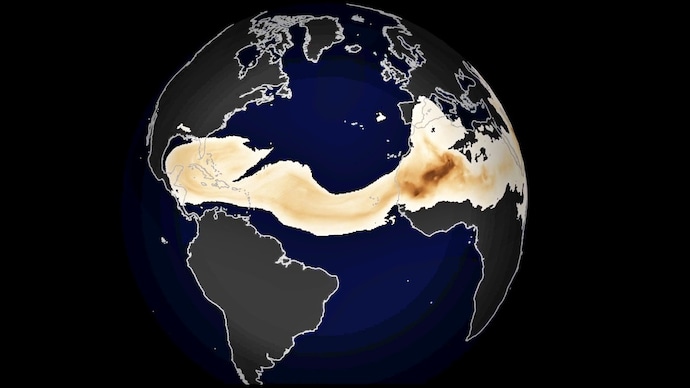
A massive plume of dust lifted from the Sahara Desert has been captured by satellites as it journeys thousands of kilometres across the Atlantic Ocean, carrying tiny mineral particles all the way to the Caribbean and the southeastern United States, including Florida.
According to the Copernicus Atmosphere Monitoring Service (CAMS), global aerosol forecasts since July 1 show an intense cloud of Saharan dust being transported westward across the Atlantic. At the same time, smoke from Canadian wildfires has been travelling in the opposite direction, reaching Europe, highlighting the remarkable scale of atmospheric circulation.
Although Florida and the Sahara Desert are separated by nearly 6,000 miles (9,600 kilometres), they become connected every summer through a seasonal weather phenomenon known as the Saharan Air Layer (SAL).
The Saharan Air Layer is a vast mass of hot, dry and dust-laden air that forms over North Africa before being swept westward by strong easterly winds.
The dust cloud typically travels across the tropical Atlantic, reaching the Caribbean, the Gulf of Mexico and parts of the United States between late spring and early autumn.
Satellite imagery and atmospheric models show the current dust plume stretching across large sections of the Atlantic, with some of the highest aerosol concentrations moving toward the Caribbean and Florida over the coming days.
The arrival of Saharan dust can produce hazy skies, vivid red and orange sunsets, and a noticeable decline in air quality, particularly for people with asthma or other respiratory conditions. Health experts often advise sensitive groups to limit prolonged outdoor activity during heavy dust events.
Despite its effects on visibility, Saharan dust also plays an important role in Earth's climate and ecosystems.
The mineral-rich particles contain nutrients such as iron and phosphorus, which fertilise soils in the Amazon rainforest and support marine ecosystems across the Atlantic.
Meteorologists say the dry air associated with the Saharan Air Layer can also suppress tropical storm development by reducing atmospheric moisture and increasing wind shear, making it an important factor during the Atlantic hurricane season.
The latest satellite observations underscore how interconnected Earth's atmosphere has become.
While Saharan dust drifts westward toward the Americas, wildfire smoke from Canada continues its transatlantic journey eastward to Europe, demonstrating that weather systems can transport aerosols and pollutants across entire oceans within days.
A massive plume of dust lifted from the Sahara Desert has been captured by satellites as it journeys thousands of kilometres across the Atlantic Ocean, carrying tiny mineral particles all the way to the Caribbean and the southeastern United States, including Florida.
According to the Copernicus Atmosphere Monitoring Service (CAMS), global aerosol forecasts since July 1 show an intense cloud of Saharan dust being transported westward across the Atlantic. At the same time, smoke from Canadian wildfires has been travelling in the opposite direction, reaching Europe, highlighting the remarkable scale of atmospheric circulation.
Although Florida and the Sahara Desert are separated by nearly 6,000 miles (9,600 kilometres), they become connected every summer through a seasonal weather phenomenon known as the Saharan Air Layer (SAL).
The Saharan Air Layer is a vast mass of hot, dry and dust-laden air that forms over North Africa before being swept westward by strong easterly winds.
The dust cloud typically travels across the tropical Atlantic, reaching the Caribbean, the Gulf of Mexico and parts of the United States between late spring and early autumn.
Satellite imagery and atmospheric models show the current dust plume stretching across large sections of the Atlantic, with some of the highest aerosol concentrations moving toward the Caribbean and Florida over the coming days.
The arrival of Saharan dust can produce hazy skies, vivid red and orange sunsets, and a noticeable decline in air quality, particularly for people with asthma or other respiratory conditions. Health experts often advise sensitive groups to limit prolonged outdoor activity during heavy dust events.
Despite its effects on visibility, Saharan dust also plays an important role in Earth's climate and ecosystems.
The mineral-rich particles contain nutrients such as iron and phosphorus, which fertilise soils in the Amazon rainforest and support marine ecosystems across the Atlantic.
Meteorologists say the dry air associated with the Saharan Air Layer can also suppress tropical storm development by reducing atmospheric moisture and increasing wind shear, making it an important factor during the Atlantic hurricane season.
The latest satellite observations underscore how interconnected Earth's atmosphere has become.
While Saharan dust drifts westward toward the Americas, wildfire smoke from Canada continues its transatlantic journey eastward to Europe, demonstrating that weather systems can transport aerosols and pollutants across entire oceans within days.

