From Australia to India: The story behind Karttikeya, Nandi and the Bhadrakali trishul
Australia is returning three stolen Tamil Nadu temple antiquities to India under the Mutual Legal Assistance Treaty. The return of a six-headed Karttikeya, a Nandi idol and a trishul with Bhadrakali marks not only the restoration of India's cultural heritage but also the beginning of a new chapter in the legacy of the southern Indian kingdoms.
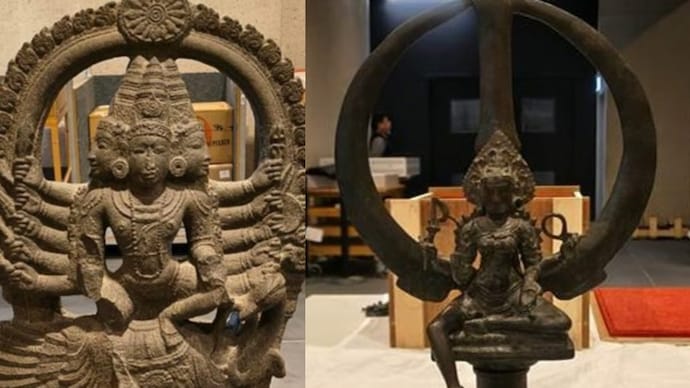
A Chola-era Karttikeya idol, a 14th-century Nandi sculpture and a Chola-period trishul are set to return to India from Australia, finding their place in Indian museums after years abroad. Prime Minister Narendra Modi's visit to Australia has coincided with the return of the historic treasures of India.
The three antiquities, currently housed in the National Gallery of Australia, are being repatriated under the Mutual Legal Assistance Treaty (MLAT) after investigations by the Tamil Nadu Idol Wing CID established that they had been removed from temples in Tamil Nadu and trafficked overseas.
Unlike many museum collections around the world, South Indian temple objects were never meant to sit behind glass and were part of temple life during medieval times.
These sacred idols travelled across the oceans to Australia in the decades after Independence. Along with them travelled a part of India's history, one that is now being reclaimed.
THE SIX HEADED KARTTIKEYA IDOL
Among the objects returning to India is a stone image of Shanmukha, the six-headed form of Karttikeya, known across different traditions as Murugan, Skanda and Subramanya.
Carved nearly nine centuries ago, the sculpture has travelled far from the temple for which it was first conceived; it now begins its journey home.
Its rightful place is the Naganathaswamy Temple at Manambadi, near Kumbakonam in Tamil Nadu.
Raised during the Chola period and associated with the reign of Rajendra Chola I, the temple preserves inscriptions that speak not merely of kings and conquests, but of administration, land grants, taxation and the orderly functioning of a medieval kingdom.
The six heads of Karttikeya have, through the centuries, invited many interpretations. One tradition sees in them the six directions; another, the six virtues of wisdom, strength, fame, prosperity, detachment and knowledge.
Yet another connects them with the six stars of the Krittika constellation, whose celestial mothers are believed to have nurtured the divine child. Whether regarded as history, mythology or faith, these interpretations reveal how closely religion, imagination and everyday life were woven together in medieval India.
In Tamil Nadu, Karttikeya is revered as Lord Murugan and holds a place unlike that of any other deity. He is regarded as the guardian of the Tamil land, and some of the state's best-known pilgrimage centres, Palani, Tiruchendur and Swamimalai among them, are dedicated to his worship.
The sculpture itself stands about 130 centimetres high and is dated to the 12th century.
It reflects the mature Chola tradition, where careful proportions, measured ornamentation and quiet balance give stone the appearance of life, while preserving the calm dignity expected of a sacred image.
NANDI: THE SILENT GUARDIAN OF SHIVA TEMPLES
The second object is a stone sculpture of Nandi, the sacred bull and vehicle of Lord Shiva.
The repatriated sculpture belongs to the Kailasanathar Temple at Kaduvankudi in present-day Tiruvarur district and dates between the 13th and 16th centuries.
The one-metre-long Nandi is made out of a single stone and reflects, to some extent, the level of expertise in sculpture-making that craftsmen of that time had.
Although the Idol Wing estimates its financial value at around Rs 4 crore, the sculpture's historical importance cannot be measured in market terms.
It has stood for centuries in a temple where daily worship continued across changing kingdoms, colonial rule and modern India.
A RARE CEREMONIAL TRISHUL WITH BHADRAKALI
Among the three objects making the journey back to India, one stands apart. It is neither a stone idol placed inside a shrine nor a bronze image carried in worship.
It is a ceremonial metal trishul, crowned with a figure of Goddess Bhadrakali, that once stood as a powerful symbol of protection within a temple.
The trishul comes from the Sri Kasiviswanathaswamy Temple in Tamil Nadu and dates to the Late Chola period. Standing about 46 centimetres high and stretching over a metre in width, it was not created simply to be admired. It was part of temple life.
During festivals and religious processions, it would have accompanied rituals, reminding devotees of the goddess's presence and her role as a protector of the community.
For many people, the trishul is immediately associated with Lord Shiva. Yet, in several traditions across South India, it is equally a symbol of the Goddess. Bhadrakali, one of her fierce forms, holds the trident not as an emblem of destruction alone but as a sign of strength, justice and protection.
Unlike stone sculptures that remain fixed inside temples for centuries, ceremonial objects like this trishul are used repeatedly during rituals.
HOW THE OBJECTS WERE TRACED
Recovering stolen antiquities is rarely a quick process.
The return of a stolen antiquity is a matter of a single decision. It is, more often, the end of a long pursuit often passes through archives and courtrooms, across borders and diplomatic channels, before an object is finally restored to the land from which it was taken.
The story of these three antiquities began in 2016, when First Information Reports (FIRs) were registered by the Tamil Nadu Idol Wing CID.
Temple records in the process were first examined, old photographs, governent archives and museum catalogues were put on the table to establish where the objects had once stood and how they had left the country.
Only after this chain of evidence was complete did India seek their return through the Mutual Legal Assistance Treaty (MLAT), under which Australian authorities agreed to repatriate the antiquities.
At the centre of such investigations lies provenance, the documented history of an artefact's ownership and movement.
In recent years, provenance has assumed increasing importance in museum practice across the world. Institutions now examine, with greater scrutiny than before, whether objects entered their collections through lawful and ethical means.
Where evidence points to theft or illegal export, museums and governments increasingly work with the country of origin to facilitate their return.
The repatriation of these three objects forms part of a larger effort by India to recover antiquities that were smuggled abroad through illegal art networks over several decades.
During the past ten years, several countries, including Australia, the United States, Canada and the United Kingdom, have returned Indian artefacts after investigations established their origin.
A Chola-era Karttikeya idol, a 14th-century Nandi sculpture and a Chola-period trishul are set to return to India from Australia, finding their place in Indian museums after years abroad. Prime Minister Narendra Modi's visit to Australia has coincided with the return of the historic treasures of India.
The three antiquities, currently housed in the National Gallery of Australia, are being repatriated under the Mutual Legal Assistance Treaty (MLAT) after investigations by the Tamil Nadu Idol Wing CID established that they had been removed from temples in Tamil Nadu and trafficked overseas.
Unlike many museum collections around the world, South Indian temple objects were never meant to sit behind glass and were part of temple life during medieval times.
These sacred idols travelled across the oceans to Australia in the decades after Independence. Along with them travelled a part of India's history, one that is now being reclaimed.
THE SIX HEADED KARTTIKEYA IDOL
Among the objects returning to India is a stone image of Shanmukha, the six-headed form of Karttikeya, known across different traditions as Murugan, Skanda and Subramanya.
Carved nearly nine centuries ago, the sculpture has travelled far from the temple for which it was first conceived; it now begins its journey home.
Its rightful place is the Naganathaswamy Temple at Manambadi, near Kumbakonam in Tamil Nadu.
Raised during the Chola period and associated with the reign of Rajendra Chola I, the temple preserves inscriptions that speak not merely of kings and conquests, but of administration, land grants, taxation and the orderly functioning of a medieval kingdom.
The six heads of Karttikeya have, through the centuries, invited many interpretations. One tradition sees in them the six directions; another, the six virtues of wisdom, strength, fame, prosperity, detachment and knowledge.
Yet another connects them with the six stars of the Krittika constellation, whose celestial mothers are believed to have nurtured the divine child. Whether regarded as history, mythology or faith, these interpretations reveal how closely religion, imagination and everyday life were woven together in medieval India.
In Tamil Nadu, Karttikeya is revered as Lord Murugan and holds a place unlike that of any other deity. He is regarded as the guardian of the Tamil land, and some of the state's best-known pilgrimage centres, Palani, Tiruchendur and Swamimalai among them, are dedicated to his worship.
The sculpture itself stands about 130 centimetres high and is dated to the 12th century.
It reflects the mature Chola tradition, where careful proportions, measured ornamentation and quiet balance give stone the appearance of life, while preserving the calm dignity expected of a sacred image.
NANDI: THE SILENT GUARDIAN OF SHIVA TEMPLES
The second object is a stone sculpture of Nandi, the sacred bull and vehicle of Lord Shiva.
The repatriated sculpture belongs to the Kailasanathar Temple at Kaduvankudi in present-day Tiruvarur district and dates between the 13th and 16th centuries.
The one-metre-long Nandi is made out of a single stone and reflects, to some extent, the level of expertise in sculpture-making that craftsmen of that time had.
Although the Idol Wing estimates its financial value at around Rs 4 crore, the sculpture's historical importance cannot be measured in market terms.
It has stood for centuries in a temple where daily worship continued across changing kingdoms, colonial rule and modern India.
A RARE CEREMONIAL TRISHUL WITH BHADRAKALI
Among the three objects making the journey back to India, one stands apart. It is neither a stone idol placed inside a shrine nor a bronze image carried in worship.
It is a ceremonial metal trishul, crowned with a figure of Goddess Bhadrakali, that once stood as a powerful symbol of protection within a temple.
The trishul comes from the Sri Kasiviswanathaswamy Temple in Tamil Nadu and dates to the Late Chola period. Standing about 46 centimetres high and stretching over a metre in width, it was not created simply to be admired. It was part of temple life.
During festivals and religious processions, it would have accompanied rituals, reminding devotees of the goddess's presence and her role as a protector of the community.
For many people, the trishul is immediately associated with Lord Shiva. Yet, in several traditions across South India, it is equally a symbol of the Goddess. Bhadrakali, one of her fierce forms, holds the trident not as an emblem of destruction alone but as a sign of strength, justice and protection.
Unlike stone sculptures that remain fixed inside temples for centuries, ceremonial objects like this trishul are used repeatedly during rituals.
HOW THE OBJECTS WERE TRACED
Recovering stolen antiquities is rarely a quick process.
The return of a stolen antiquity is a matter of a single decision. It is, more often, the end of a long pursuit often passes through archives and courtrooms, across borders and diplomatic channels, before an object is finally restored to the land from which it was taken.
The story of these three antiquities began in 2016, when First Information Reports (FIRs) were registered by the Tamil Nadu Idol Wing CID.
Temple records in the process were first examined, old photographs, governent archives and museum catalogues were put on the table to establish where the objects had once stood and how they had left the country.
Only after this chain of evidence was complete did India seek their return through the Mutual Legal Assistance Treaty (MLAT), under which Australian authorities agreed to repatriate the antiquities.
At the centre of such investigations lies provenance, the documented history of an artefact's ownership and movement.
In recent years, provenance has assumed increasing importance in museum practice across the world. Institutions now examine, with greater scrutiny than before, whether objects entered their collections through lawful and ethical means.
Where evidence points to theft or illegal export, museums and governments increasingly work with the country of origin to facilitate their return.
The repatriation of these three objects forms part of a larger effort by India to recover antiquities that were smuggled abroad through illegal art networks over several decades.
During the past ten years, several countries, including Australia, the United States, Canada and the United Kingdom, have returned Indian artefacts after investigations established their origin.

