Nissan Tekton vs Renault Duster: What's different and what stays the same?
Built on the same platform and sharing identical petrol powertrains, the Nissan Tekton distinguishes itself from the Renault Duster through its design language, different cabin colour and slightly lower top-end pricing.
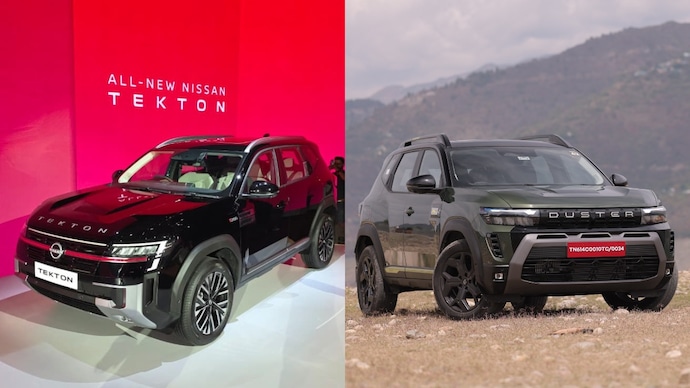
With the launch of the Tekton, Nissan has once again introduced its own interpretation of the Renault Duster for the Indian market. Much like the earlier Terrano, the new SUV is closely related to its French sibling beneath the skin, but Nissan has worked to give it a distinct identity through styling changes, interior treatment and subtle positioning. For review of the Renault Duster, click here.
Exterior: Patrol-inspired styling sets the Tekton apart
Although both SUVs share the same proportions and body shell, the Tekton adopts a more upright and muscular look inspired by Nissan's flagship Patrol SUV.
At the front, it gets a slimmer LED headlamp setup linked by a full-width light bar, while the C-shaped daytime running lights differ from the Duster's eyebrow-style signature. Nissan has also designed a unique grille with its logo placed at the centre and 'TEKTON' lettering embossed on the bonnet. A red accent strip integrated into the grille further differentiates the SUV, whereas the Duster prominently carries its name across the grille.
The front bumper also features a revised design with less silver cladding than the Renault.
Viewed from the side, the similarities are evident, but Nissan has introduced new 18-inch alloy wheels, distinctive C-shaped fender badges and silver roof rails.
Both SUVs continue to share practical elements such as chunky body cladding, front pull-type door handles, concealed rear door handles mounted on the C-pillar and a shark-fin antenna.
The rear is where the Tekton makes another visual departure, replacing the Duster's triangular tail-lamp graphics with a C-shaped LED signature inspired by the Patrol. The rear bumper has also been revised with matching silver detailing.
Interior: Different colours, same layout
Inside the cabin, the overall dashboard architecture remains common to both SUVs, but Nissan has introduced a different ambience.
The Tekton's flagship variant gets a rose gold and burgundy interior theme instead of the Duster's black-and-green colour scheme. Gold accents on the steering wheel, dashboard, centre console and door handles further give the cabin a more premium appearance.
Features: Nearly identical equipment list
Feature-wise, there is virtually no difference between the two SUVs. Both come equipped with:
- 10.1-inch touchscreen infotainment system
- 10.25-inch fully digital instrument cluster
- Panoramic sunroof
- Wireless phone charger
- Ventilated and six-way adjustable front seats
Safety equipment is equally comprehensive, with six airbags, Level 2 ADAS, a 360-degree camera with blind-spot assist, electronic parking brake, front and rear parking sensors, and a five-star Bharat NCAP crash safety rating.
Engine options: Shared petrol line-up
Mechanically, the Tekton mirrors the Duster.
Buyers can choose between a 1.0-litre turbo-petrol engine producing 100hp and a 1.3-litre turbo-petrol unit developing 163hp. Both engines are paired with a six-speed manual gearbox, while the more powerful motor also gets the option of a seven-speed dual-clutch automatic transmission. Fuel efficiency figures remain unchanged between the two models.
One notable difference is that Nissan will not offer the upcoming 1.8-litre strong-hybrid powertrain that Renault plans to introduce in the Duster around Diwali.
Price: Slight advantage for the Tekton
The Nissan Tekton is priced from Rs 10.49 lakh (ex-showroom), matching the Renault Duster's entry price. However, the fully loaded Tekton undercuts the equivalent Duster variant by Rs 10,000, with prices topping out at Rs 18.59 lakh (ex-showroom).
In India's fiercely contested mid-size SUV segment, the Tekton takes on rivals such as the Hyundai Creta, Tata Sierra, Kia Seltos, Maruti Suzuki Victoris, Maruti Suzuki Grand Vitara, Toyota Hyryder, Honda Elevate, Skoda Kushaq and Volkswagen Taigun.
Subscribe to Auto Today Magazine
With the launch of the Tekton, Nissan has once again introduced its own interpretation of the Renault Duster for the Indian market. Much like the earlier Terrano, the new SUV is closely related to its French sibling beneath the skin, but Nissan has worked to give it a distinct identity through styling changes, interior treatment and subtle positioning. For review of the Renault Duster, click here.
Exterior: Patrol-inspired styling sets the Tekton apart
Although both SUVs share the same proportions and body shell, the Tekton adopts a more upright and muscular look inspired by Nissan's flagship Patrol SUV.
At the front, it gets a slimmer LED headlamp setup linked by a full-width light bar, while the C-shaped daytime running lights differ from the Duster's eyebrow-style signature. Nissan has also designed a unique grille with its logo placed at the centre and 'TEKTON' lettering embossed on the bonnet. A red accent strip integrated into the grille further differentiates the SUV, whereas the Duster prominently carries its name across the grille.
The front bumper also features a revised design with less silver cladding than the Renault.
Viewed from the side, the similarities are evident, but Nissan has introduced new 18-inch alloy wheels, distinctive C-shaped fender badges and silver roof rails.
Both SUVs continue to share practical elements such as chunky body cladding, front pull-type door handles, concealed rear door handles mounted on the C-pillar and a shark-fin antenna.
The rear is where the Tekton makes another visual departure, replacing the Duster's triangular tail-lamp graphics with a C-shaped LED signature inspired by the Patrol. The rear bumper has also been revised with matching silver detailing.
Interior: Different colours, same layout
Inside the cabin, the overall dashboard architecture remains common to both SUVs, but Nissan has introduced a different ambience.
The Tekton's flagship variant gets a rose gold and burgundy interior theme instead of the Duster's black-and-green colour scheme. Gold accents on the steering wheel, dashboard, centre console and door handles further give the cabin a more premium appearance.
Features: Nearly identical equipment list
Feature-wise, there is virtually no difference between the two SUVs. Both come equipped with:
- 10.1-inch touchscreen infotainment system
- 10.25-inch fully digital instrument cluster
- Panoramic sunroof
- Wireless phone charger
- Ventilated and six-way adjustable front seats
Safety equipment is equally comprehensive, with six airbags, Level 2 ADAS, a 360-degree camera with blind-spot assist, electronic parking brake, front and rear parking sensors, and a five-star Bharat NCAP crash safety rating.
Engine options: Shared petrol line-up
Mechanically, the Tekton mirrors the Duster.
Buyers can choose between a 1.0-litre turbo-petrol engine producing 100hp and a 1.3-litre turbo-petrol unit developing 163hp. Both engines are paired with a six-speed manual gearbox, while the more powerful motor also gets the option of a seven-speed dual-clutch automatic transmission. Fuel efficiency figures remain unchanged between the two models.
One notable difference is that Nissan will not offer the upcoming 1.8-litre strong-hybrid powertrain that Renault plans to introduce in the Duster around Diwali.
Price: Slight advantage for the Tekton
The Nissan Tekton is priced from Rs 10.49 lakh (ex-showroom), matching the Renault Duster's entry price. However, the fully loaded Tekton undercuts the equivalent Duster variant by Rs 10,000, with prices topping out at Rs 18.59 lakh (ex-showroom).
In India's fiercely contested mid-size SUV segment, the Tekton takes on rivals such as the Hyundai Creta, Tata Sierra, Kia Seltos, Maruti Suzuki Victoris, Maruti Suzuki Grand Vitara, Toyota Hyryder, Honda Elevate, Skoda Kushaq and Volkswagen Taigun.
Subscribe to Auto Today Magazine

