Starship Flight 13: Most powerful rocket to fly with 20 Starlink satellites on this date
Elon Musk's SpaceX will launch Starship Flight 13 from Starbase, Texas, with the launch window opening at 4:15 am IST on July 17. The world's most powerful rocket will carry 20 Starlink V3 satellites for the first time and attempt a booster landing at sea.
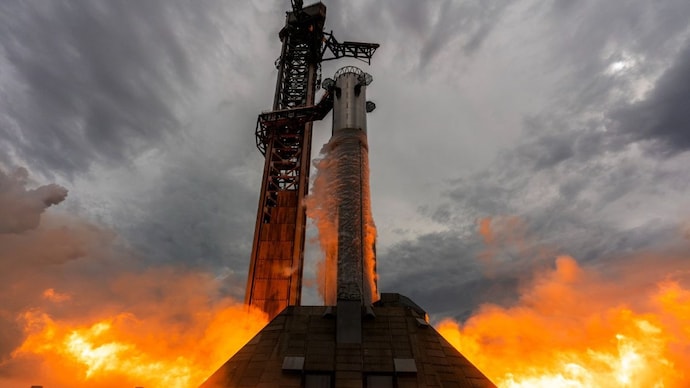
The most powerful rocket ever built is preparing to thunder into the sky once again. SpaceX's Starship, a fully stacked giant taller than a 30-storey building, is set to lift off from Starbase in Texas, United States, as early as Thursday, July 16, which is the early hours of Friday, July 17, in India, on its 13th flight test.
And this time, the mighty vehicle will not fly empty. For the first time, Starship will carry SpaceX's next-generation Starlink V3 satellites, spacecraft built to beam faster Internet down to Earth from space.
WHEN IS THE STARSHIP FLIGHT 13 LAUNCH AND HOW TO WATCH IT LIVE IN INDIA?
For viewers in India, the 90-minute launch window opens at 4:15 am IST on Friday, July 17, and runs until 5:45 am IST.
SpaceX will begin a live webcast about 30 minutes before liftoff, at around 3:45 am IST, on its website and on its X account. As with all developmental testing, the schedule is dynamic and could change.
WHAT WILL STARSHIP FLIGHT 13 DO?
Starship is a two-part vehicle. The lower half, called Super Heavy, is a booster powered by 33 Raptor engines. The upper half is the Starship spacecraft itself.
Minutes after liftoff, the two halves will split apart in a manoeuvre called stage separation. The booster will then flip around and perform a boostback burn, in which some of its engines reignite to push it back towards its landing zone.
Its final task is a landing burn, a controlled slowdown for a gentle touchdown at an offshore point at sea.
The upper stage, meanwhile, will deploy 20 Starlink V3 satellites, relight a single Raptor engine while in space, and attempt a controlled splashdown in the Indian Ocean.
WHAT WENT WRONG ON STARSHIP FLIGHT 12?
The upcoming mission repeats goals the previous flight could not achieve. On Flight 12, differences in engine startup caused the booster's flip to be off by roughly 90 degrees, and five of its 33 engines struggled to reignite, cutting the boostback burn short.
The spacecraft also lost one of its three vacuum-optimised Raptor engines, the type tuned to work best in the airless void of space. Even so, it reached its planned suborbital trajectory, a path that touches space but does not circle the Earth. SpaceX says hardware and software fixes have been made across both vehicles.
WHY ARE THE STARLINK V3 SATELLITES SPECIAL?
The V3 satellites aim to greatly expand the Starlink network's capacity and user speeds. After deployment, they will unfurl their solar arrays and antennas, and attempt to connect with ground stations in South Africa using high-capacity lasers.
Six of them carry cameras with an unusual job: scanning Starship's heat shield, the armour of tiles that protects the vehicle from the scorching heat of reentry.
Several tiles have been painted white to mimic missing ones, serving as targets for the cameras.
If all goes well, the flight ends, in SpaceX's own words, with an exciting landing.
The most powerful rocket ever built is preparing to thunder into the sky once again. SpaceX's Starship, a fully stacked giant taller than a 30-storey building, is set to lift off from Starbase in Texas, United States, as early as Thursday, July 16, which is the early hours of Friday, July 17, in India, on its 13th flight test.
And this time, the mighty vehicle will not fly empty. For the first time, Starship will carry SpaceX's next-generation Starlink V3 satellites, spacecraft built to beam faster Internet down to Earth from space.
WHEN IS THE STARSHIP FLIGHT 13 LAUNCH AND HOW TO WATCH IT LIVE IN INDIA?
For viewers in India, the 90-minute launch window opens at 4:15 am IST on Friday, July 17, and runs until 5:45 am IST.
SpaceX will begin a live webcast about 30 minutes before liftoff, at around 3:45 am IST, on its website and on its X account. As with all developmental testing, the schedule is dynamic and could change.
WHAT WILL STARSHIP FLIGHT 13 DO?
Starship is a two-part vehicle. The lower half, called Super Heavy, is a booster powered by 33 Raptor engines. The upper half is the Starship spacecraft itself.
Minutes after liftoff, the two halves will split apart in a manoeuvre called stage separation. The booster will then flip around and perform a boostback burn, in which some of its engines reignite to push it back towards its landing zone.
Its final task is a landing burn, a controlled slowdown for a gentle touchdown at an offshore point at sea.
The upper stage, meanwhile, will deploy 20 Starlink V3 satellites, relight a single Raptor engine while in space, and attempt a controlled splashdown in the Indian Ocean.
WHAT WENT WRONG ON STARSHIP FLIGHT 12?
The upcoming mission repeats goals the previous flight could not achieve. On Flight 12, differences in engine startup caused the booster's flip to be off by roughly 90 degrees, and five of its 33 engines struggled to reignite, cutting the boostback burn short.
The spacecraft also lost one of its three vacuum-optimised Raptor engines, the type tuned to work best in the airless void of space. Even so, it reached its planned suborbital trajectory, a path that touches space but does not circle the Earth. SpaceX says hardware and software fixes have been made across both vehicles.
WHY ARE THE STARLINK V3 SATELLITES SPECIAL?
The V3 satellites aim to greatly expand the Starlink network's capacity and user speeds. After deployment, they will unfurl their solar arrays and antennas, and attempt to connect with ground stations in South Africa using high-capacity lasers.
Six of them carry cameras with an unusual job: scanning Starship's heat shield, the armour of tiles that protects the vehicle from the scorching heat of reentry.
Several tiles have been painted white to mimic missing ones, serving as targets for the cameras.
If all goes well, the flight ends, in SpaceX's own words, with an exciting landing.

