Main Vaapas Aaunga changed how I saw my grandmother's dementia
After watching Imtiaz Ali's Main Vaapas Aaunga, I found myself questioning whether memories truly disappear, or whether they simply begin speaking a language only the person living with dementia can understand.
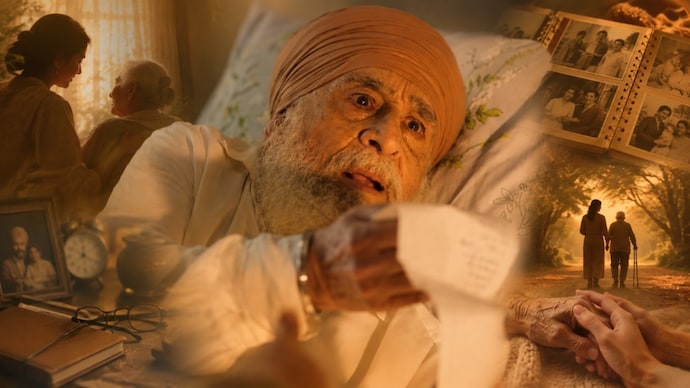
"Memory is an autumn leaf that murmurs a while in the wind and then is heard no more."
Kahlil Gibran imagined memory as something that eventually falls silent. But watching Imtiaz Ali's Main Vaapas Aaunga, I found myself questioning whether memories truly disappear, or whether they simply begin speaking a language only the person living with dementia can understand.
As Naseeruddin Shah's Ishar Singh Grewal (lovingly called Keenu in the film) wandered between the past and the present, trying to hold on to the pieces that still felt real, I wasn't just watching a film.
His confusion felt familiar. His pauses felt familiar. It was like watching my grandmother all over again.
Even the certainty with which he held on to memories that everyone around him knew had long slipped away felt painfully familiar. People often reduce dementia to forgetting. But anyone who has lived with someone diagnosed with it knows it is far more complicated than that, because it isn't just memory loss.
It is watching someone build an entirely different reality out of the few memories their brain still trusts.
That is exactly what Shah's Keenu does throughout Main Vaapas Aaunga.
For him, Partition never really happened. Sargodha is still home and crossing the Attari border still feels possible.
The years in between simply disappear.
As the film progresses, he desperately clings to fragments of a life that still make sense to him. His first love, Jiya, played by Sharvari, exists through a pair of chandbalis. Somewhere along the way, those earrings become the moon itself. His longing isn't merely to find her anymore; it is to reach the moon, because that's where his memories have decided she belongs.
It sounds surreal until you've watched dementia unfold inside your own home.
My grandmother, Suva Chowdhury, was one of the strongest women I have ever known. She raised three sons, looked after her mother-in-law, and quietly sacrificed almost every wish she ever had. Buying herself a saree was a luxury. Travelling was a dream postponed for another day that never came.
Then dementia slowly began taking away the language she had spent a lifetime building.
She would still complain about the nurse and still ask for food she loved. She would still tell us stories.
Only the words stopped obeying her.
The emotions never did.
She would speak in broken sentences, jumble one memory with another and often struggle to find the right words. Listening to her sometimes felt like watching a child trying to explain a dream before waking up completely.
As a teenager, I thought she was forgetting.
Looking back now, I wonder if she was simply trying to tell us something her brain no longer knew how to organise. That question stayed with me long after the film ended.
What actually happens inside the brain when memories begin slipping away? Why do some disappear almost overnight while others refuse to leave, surviving through a familiar song, an old photograph or the touch of someone they love?
WHEN THE BRAIN REMEMBERS DIFFERENTLY
Dr Atampreet Singh, Senior Director and Head of Neurology at ShardaCare-HealthCity, told India Today Digital that memory is not stored in one single location of the brain. Instead, it exists across interconnected neural networks.
In Alzheimer's disease and other forms of dementia, the earliest damage usually affects the hippocampus - the part of the brain responsible for forming and organising new memories. As these networks begin to deteriorate, the brain struggles to create and retrieve recent experiences.
Older memories, however, have had decades to strengthen themselves. "They are distributed across broader regions of the cerebral cortex, making them far more resilient," Dr Singh explained. Emotional memories also rely on the amygdala, the brain's emotional centre, which is why experiences associated with love, fear, joy or grief often survive long after recent events have faded.
Suddenly, Keenu's obsession with Jiya's chandbalis didn't seem symbolic anymore. Nor did my grandmother's repeated stories. Neither of them was choosing to live in the past.
Their brains were simply holding on to the strongest anchors they still had. That is also why families often feel their loved one is "stuck" in another time.
According to Dr Singh, as dementia affects the hippocampus and frontal lobes, the brain gradually loses its ability to place memories in the correct timeline. Recent experiences become difficult to process, while older memories, especially those tied to powerful emotions, become the brain's primary reference point.
"For the individual, this is not pretending or role-playing," he told India Today Digital. "The past genuinely feels more immediate and real than the present."
The same science also explains something many caregivers struggle to understand.
Why does a loved one confidently narrate incidents that never happened? Or merge different memories into one? The answer lies in confabulation.
As memory-monitoring networks become damaged, the brain unconsciously fills in missing pieces to create a story that feels complete. "From the patient's perspective, those memories are entirely real," Dr Singh told India Today Digital, adding that repeatedly correcting them often causes more distress than comfort.
Instead, he says, reassurance works better than confrontation. Because perhaps dementia isn't always about forgetting.
Sometimes, it's about remembering differently.
Dr Singh's explanation also answered something I had watched unfold inside my own home for years. It was seconded by Dr. Abhishek Shukla, Senior Geriatric Physician of Aastha Geriatric Hospital, Lucknow.
"A familiar voice, a favourite song, or the presence of a loved one may still bring comfort because the emotional imprint of that memory remains. Sometimes, when there are gaps in memory, the brain tries to create a connection between missing pieces using fragments of past experiences. This is known as confabulation, and for the person living with dementia, that reconstructed reality can feel very real," Dr Shukla mentioned.
Why did we spend so much time trying to remind my grandmother of things she could no longer remember?
Why did we keep telling her, "No, that's not what happened," as if facts alone could bring her back to us?
Perhaps because that is what every family does in the beginning.
They correct.
They argue.
They remind.
Until one day, they realise the person standing in front of them isn't being stubborn. Their brain is simply experiencing the world differently.
LEARNING TO ENTER THEIR WORLD
That shift, says Neha Sinha, dementia expert, clinical psychologist and co-founder of Epoch Elder Care, is often the hardest lesson for caregivers to learn.
"Caregivers usually begin by trying to reorient the elder to reality. Over time, they realise they have to reorient themselves instead," Sinha told India Today Digital.
According to her, this understanding rarely comes overnight. Most families begin in denial, dismissing the early signs as ageing or stress. Even after a diagnosis, many struggle because dementia awareness remains limited and every patient's journey is different.
"It is only after caregivers have exhausted every attempt to 'correct' their loved one that they begin seeing the world from the elder's perspective," she said. "Even then, the shift is never complete because somewhere, you never stop hoping you'll get the person you once knew back."
That sentiment echoed almost word for word in the stories caregivers shared with India Today Digital.
For Anupa Rachel Gnanakan, an educator, the turning point came after countless arguments with her mother.
Her mother would repeatedly ask for her parents, convinced they were waiting for her.
"I kept trying to explain that they were no longer alive," Gnanakan recalled. "It only made her more distressed." Everything changed after a conversation with her mother's doctor.
"She told me I had two choices," Gnanakan said. "I could either keep pulling my mother into my reality, or I could enter hers. She also said I could gently distract and reorient her when needed. From that day onwards, I chose to enter her world. It brought peace for both of us."
It also changed the way she looked at dementia.
"If I could go back to the day of the diagnosis, I'd tell myself to stop resisting," she said. "Dementia is like a sinking ship. You can't stop it. You can only accept it and love them through it. Once we understood that, we laughed our way through the disease."
Yet, amid the confusion, pieces of the woman she had always known never really disappeared.
Growing up, Gnanakan says, her mother had been the family's strongest pillar—someone who always knew how to comfort her. That instinct remained.
"Whenever she sensed I was stressed, she'd still try to encourage me," she said. "And she was a very strict mother and grandmother. Every time my children refused to listen, she'd give them one stern look. Somehow, it still worked."
But caregiving also carried a loneliness few people noticed.
"It was the nights," Gnanakan said quietly. "People saw what caregiving looked like during the day. They never saw the sleeplessness, the confusion and the restlessness that came with sundowning."
For Dr Dootika Liddle, Professor and Head of Anaesthesiology at CMC Ludhiana, accepting her mother's reality also meant letting go of the instinct to constantly explain.
"She would argue with Papa and I'd tell her she was right, even when she wasn't," Liddle told India Today Digital. "It wasn't her fault because she genuinely didn't remember."
Every morning, her mother would carefully get ready for school even when she had retired years ago.
"No matter how many times Papa reminded her, she believed she still had to go," Liddle said. And yet, dementia never erased everything. Her mother's lifelong love for dogs remained untouched.
"Our pet would always go and sit beside her because she continued stroking her just like she did when we were children."
Music, too, found a way through.
"If someone sang Ek Pyar Ka Nagma Hai, she'd immediately sing the next line," Liddle recalled. Even something as ordinary as a mango could momentarily bring back familiar habits.
"When we placed her favourite fruit in front of her, she instinctively picked up a fork and began eating." Looking back, Liddle says the diagnosis itself had offered clues she hadn't fully understood then.
"She had been a Hindi teacher all her life," she said. "After the neurologist examined her, my son asked her to explain a Hindi poem. She couldn't. Instead, she began talking about something completely different."
What stayed with her even more, however, was how isolating the journey became.
"The world around her changed," Liddle said. "Very few people understood what she, or we, were going through. So we simply tried to do for her what she had once done for us as children. We stepped into her world."
THE THINGS THEY NEVER REALLY FORGET
That, perhaps, is the quiet lesson Main Vaapas Aaunga leaves behind. Keenu wasn't trying to convince the world that his memories were real. He was simply living in the only world his brain could still piece together.
There was another character in the film who stayed with me long after the credits rolled.
Not because he had the most lines, but because he chose to ask questions instead of offering corrections.
Diljit Dosanjh's Nirvair wasn't Keenu's primary caregiver. He wasn't the one managing medicines or sleepless nights. But he did something equally important: he tried to understand what his grandfather was really holding on to.
He didn't always ask, "Do you remember?" Sometimes, he simply asked, "What are you remembering?"
Looking back, I realise that was my role too.
My grandmother had people who looked after her every need. They carried the weight of caregiving in ways I never had to. But somewhere between childhood and adulthood, I found myself becoming the person who wanted to understand the stories inside her silences.
When she repeated something over and over again, I stopped wondering why she couldn't remember the present. I began wondering which memory she was trying so desperately to return to.
Was it her childhood? Her parents? A happier afternoon? Or was it simply a feeling she couldn't quite put into words anymore?
Perhaps that is what Main Vaapas Aaunga quietly gets right. Dementia isn't always about remembering less. Sometimes, it's about remembering differently.
Dr Rahul Chandhok, Head Consultant, Mental Health and Behavioural Science at Artemis Hospitals, believes those fragments people hold on to are far from random.
"People with dementia may forget names, recent events or even close family members, but they may still respond to a familiar voice, a favourite song, a daily routine or a warm hug," Dr Chandhok told India Today Digital. "Feelings are strongly linked to emotional memories, which tend to last longer than memories of facts. A person may not remember their daughter's name but still find comfort in her presence."
That, he says, reveals something profound about the human mind.
"We don't store every memory in the same way," he explained. "Facts and recent events often fade first, but emotions, music, familiar smells and long-practised routines remain for much longer. The brain may forget details, but emotional bonds often endure. It reminds us that relationships are built not just on memory, but on feelings, trust and shared experiences."
It also changes the way we think about identity.
"Dementia slowly affects memory, speech and decision-making, but identity is much more than the ability to recall facts," Dr Chandhok said. "It is shaped by values, lived experiences, interests and relationships. Families can help preserve that identity by revisiting happy memories, looking through old photographs, playing favourite music, celebrating traditions and encouraging familiar hobbies. Even when words become difficult, people living with dementia still deserve to feel understood, respected and loved."
Perhaps that is why caregivers often describe dementia as grieving someone who is still alive.
"It is a gradual loss rather than a sudden one," Dr Chandhok said. "Families watch someone they love slowly forget memories, change behaviour and lose independence while still being physically present. It becomes an emotional roller coaster of love, hope, responsibility and heartbreak."
Yet, after years of working with people living with dementia, the lesson that has stayed with him is remarkably simple.
"Dementia reminds us that love is greater than memory," he told India Today Digital. "When names, dates and faces begin to fade, a gentle touch, a familiar voice or a comforting presence can still bring peace. Sometimes, it is more important to be emotionally present than to remember every detail."
His words took me back to my grandmother.
By the end of her illness, our conversations rarely followed a straight line.
She would begin with one story, drift into another and end somewhere neither of us expected. Sometimes the words refused to cooperate. Sometimes the people she spoke about had been gone for decades. Sometimes I understood exactly what she meant without understanding a single sentence.
Back then, I thought I had failed because I couldn't always bring her back to reality.
Today, I wonder if that was never my job. Maybe my job was simply to sit beside her while she travelled through hers. Perhaps that's what Diljit's character understood about Keenu all along. Love doesn't always look like helping someone remember. Sometimes, it looks like walking with them through the memories they still have.
And maybe that's why Main Vaapas Aaunga lingered with me long after it ended.
Because somewhere between Shah's Keenu and my didu, I realised that the saddest part of dementia isn't that memories disappear.
It's that we spend so much time mourning the memories they've lost that we forget to cherish the ones they still have.
"Memory is an autumn leaf that murmurs a while in the wind and then is heard no more."
Kahlil Gibran imagined memory as something that eventually falls silent. But watching Imtiaz Ali's Main Vaapas Aaunga, I found myself questioning whether memories truly disappear, or whether they simply begin speaking a language only the person living with dementia can understand.
As Naseeruddin Shah's Ishar Singh Grewal (lovingly called Keenu in the film) wandered between the past and the present, trying to hold on to the pieces that still felt real, I wasn't just watching a film.
His confusion felt familiar. His pauses felt familiar. It was like watching my grandmother all over again.
Even the certainty with which he held on to memories that everyone around him knew had long slipped away felt painfully familiar. People often reduce dementia to forgetting. But anyone who has lived with someone diagnosed with it knows it is far more complicated than that, because it isn't just memory loss.
It is watching someone build an entirely different reality out of the few memories their brain still trusts.
That is exactly what Shah's Keenu does throughout Main Vaapas Aaunga.
For him, Partition never really happened. Sargodha is still home and crossing the Attari border still feels possible.
The years in between simply disappear.
As the film progresses, he desperately clings to fragments of a life that still make sense to him. His first love, Jiya, played by Sharvari, exists through a pair of chandbalis. Somewhere along the way, those earrings become the moon itself. His longing isn't merely to find her anymore; it is to reach the moon, because that's where his memories have decided she belongs.
It sounds surreal until you've watched dementia unfold inside your own home.
My grandmother, Suva Chowdhury, was one of the strongest women I have ever known. She raised three sons, looked after her mother-in-law, and quietly sacrificed almost every wish she ever had. Buying herself a saree was a luxury. Travelling was a dream postponed for another day that never came.
Then dementia slowly began taking away the language she had spent a lifetime building.
She would still complain about the nurse and still ask for food she loved. She would still tell us stories.
Only the words stopped obeying her.
The emotions never did.
She would speak in broken sentences, jumble one memory with another and often struggle to find the right words. Listening to her sometimes felt like watching a child trying to explain a dream before waking up completely.
As a teenager, I thought she was forgetting.
Looking back now, I wonder if she was simply trying to tell us something her brain no longer knew how to organise. That question stayed with me long after the film ended.
What actually happens inside the brain when memories begin slipping away? Why do some disappear almost overnight while others refuse to leave, surviving through a familiar song, an old photograph or the touch of someone they love?
WHEN THE BRAIN REMEMBERS DIFFERENTLY
Dr Atampreet Singh, Senior Director and Head of Neurology at ShardaCare-HealthCity, told India Today Digital that memory is not stored in one single location of the brain. Instead, it exists across interconnected neural networks.
In Alzheimer's disease and other forms of dementia, the earliest damage usually affects the hippocampus - the part of the brain responsible for forming and organising new memories. As these networks begin to deteriorate, the brain struggles to create and retrieve recent experiences.
Older memories, however, have had decades to strengthen themselves. "They are distributed across broader regions of the cerebral cortex, making them far more resilient," Dr Singh explained. Emotional memories also rely on the amygdala, the brain's emotional centre, which is why experiences associated with love, fear, joy or grief often survive long after recent events have faded.
Suddenly, Keenu's obsession with Jiya's chandbalis didn't seem symbolic anymore. Nor did my grandmother's repeated stories. Neither of them was choosing to live in the past.
Their brains were simply holding on to the strongest anchors they still had. That is also why families often feel their loved one is "stuck" in another time.
According to Dr Singh, as dementia affects the hippocampus and frontal lobes, the brain gradually loses its ability to place memories in the correct timeline. Recent experiences become difficult to process, while older memories, especially those tied to powerful emotions, become the brain's primary reference point.
"For the individual, this is not pretending or role-playing," he told India Today Digital. "The past genuinely feels more immediate and real than the present."
The same science also explains something many caregivers struggle to understand.
Why does a loved one confidently narrate incidents that never happened? Or merge different memories into one? The answer lies in confabulation.
As memory-monitoring networks become damaged, the brain unconsciously fills in missing pieces to create a story that feels complete. "From the patient's perspective, those memories are entirely real," Dr Singh told India Today Digital, adding that repeatedly correcting them often causes more distress than comfort.
Instead, he says, reassurance works better than confrontation. Because perhaps dementia isn't always about forgetting.
Sometimes, it's about remembering differently.
Dr Singh's explanation also answered something I had watched unfold inside my own home for years. It was seconded by Dr. Abhishek Shukla, Senior Geriatric Physician of Aastha Geriatric Hospital, Lucknow.
"A familiar voice, a favourite song, or the presence of a loved one may still bring comfort because the emotional imprint of that memory remains. Sometimes, when there are gaps in memory, the brain tries to create a connection between missing pieces using fragments of past experiences. This is known as confabulation, and for the person living with dementia, that reconstructed reality can feel very real," Dr Shukla mentioned.
Why did we spend so much time trying to remind my grandmother of things she could no longer remember?
Why did we keep telling her, "No, that's not what happened," as if facts alone could bring her back to us?
Perhaps because that is what every family does in the beginning.
They correct.
They argue.
They remind.
Until one day, they realise the person standing in front of them isn't being stubborn. Their brain is simply experiencing the world differently.
LEARNING TO ENTER THEIR WORLD
That shift, says Neha Sinha, dementia expert, clinical psychologist and co-founder of Epoch Elder Care, is often the hardest lesson for caregivers to learn.
"Caregivers usually begin by trying to reorient the elder to reality. Over time, they realise they have to reorient themselves instead," Sinha told India Today Digital.
According to her, this understanding rarely comes overnight. Most families begin in denial, dismissing the early signs as ageing or stress. Even after a diagnosis, many struggle because dementia awareness remains limited and every patient's journey is different.
"It is only after caregivers have exhausted every attempt to 'correct' their loved one that they begin seeing the world from the elder's perspective," she said. "Even then, the shift is never complete because somewhere, you never stop hoping you'll get the person you once knew back."
That sentiment echoed almost word for word in the stories caregivers shared with India Today Digital.
For Anupa Rachel Gnanakan, an educator, the turning point came after countless arguments with her mother.
Her mother would repeatedly ask for her parents, convinced they were waiting for her.
"I kept trying to explain that they were no longer alive," Gnanakan recalled. "It only made her more distressed." Everything changed after a conversation with her mother's doctor.
"She told me I had two choices," Gnanakan said. "I could either keep pulling my mother into my reality, or I could enter hers. She also said I could gently distract and reorient her when needed. From that day onwards, I chose to enter her world. It brought peace for both of us."
It also changed the way she looked at dementia.
"If I could go back to the day of the diagnosis, I'd tell myself to stop resisting," she said. "Dementia is like a sinking ship. You can't stop it. You can only accept it and love them through it. Once we understood that, we laughed our way through the disease."
Yet, amid the confusion, pieces of the woman she had always known never really disappeared.
Growing up, Gnanakan says, her mother had been the family's strongest pillar—someone who always knew how to comfort her. That instinct remained.
"Whenever she sensed I was stressed, she'd still try to encourage me," she said. "And she was a very strict mother and grandmother. Every time my children refused to listen, she'd give them one stern look. Somehow, it still worked."
But caregiving also carried a loneliness few people noticed.
"It was the nights," Gnanakan said quietly. "People saw what caregiving looked like during the day. They never saw the sleeplessness, the confusion and the restlessness that came with sundowning."
For Dr Dootika Liddle, Professor and Head of Anaesthesiology at CMC Ludhiana, accepting her mother's reality also meant letting go of the instinct to constantly explain.
"She would argue with Papa and I'd tell her she was right, even when she wasn't," Liddle told India Today Digital. "It wasn't her fault because she genuinely didn't remember."
Every morning, her mother would carefully get ready for school even when she had retired years ago.
"No matter how many times Papa reminded her, she believed she still had to go," Liddle said. And yet, dementia never erased everything. Her mother's lifelong love for dogs remained untouched.
"Our pet would always go and sit beside her because she continued stroking her just like she did when we were children."
Music, too, found a way through.
"If someone sang Ek Pyar Ka Nagma Hai, she'd immediately sing the next line," Liddle recalled. Even something as ordinary as a mango could momentarily bring back familiar habits.
"When we placed her favourite fruit in front of her, she instinctively picked up a fork and began eating." Looking back, Liddle says the diagnosis itself had offered clues she hadn't fully understood then.
"She had been a Hindi teacher all her life," she said. "After the neurologist examined her, my son asked her to explain a Hindi poem. She couldn't. Instead, she began talking about something completely different."
What stayed with her even more, however, was how isolating the journey became.
"The world around her changed," Liddle said. "Very few people understood what she, or we, were going through. So we simply tried to do for her what she had once done for us as children. We stepped into her world."
THE THINGS THEY NEVER REALLY FORGET
That, perhaps, is the quiet lesson Main Vaapas Aaunga leaves behind. Keenu wasn't trying to convince the world that his memories were real. He was simply living in the only world his brain could still piece together.
There was another character in the film who stayed with me long after the credits rolled.
Not because he had the most lines, but because he chose to ask questions instead of offering corrections.
Diljit Dosanjh's Nirvair wasn't Keenu's primary caregiver. He wasn't the one managing medicines or sleepless nights. But he did something equally important: he tried to understand what his grandfather was really holding on to.
He didn't always ask, "Do you remember?" Sometimes, he simply asked, "What are you remembering?"
Looking back, I realise that was my role too.
My grandmother had people who looked after her every need. They carried the weight of caregiving in ways I never had to. But somewhere between childhood and adulthood, I found myself becoming the person who wanted to understand the stories inside her silences.
When she repeated something over and over again, I stopped wondering why she couldn't remember the present. I began wondering which memory she was trying so desperately to return to.
Was it her childhood? Her parents? A happier afternoon? Or was it simply a feeling she couldn't quite put into words anymore?
Perhaps that is what Main Vaapas Aaunga quietly gets right. Dementia isn't always about remembering less. Sometimes, it's about remembering differently.
Dr Rahul Chandhok, Head Consultant, Mental Health and Behavioural Science at Artemis Hospitals, believes those fragments people hold on to are far from random.
"People with dementia may forget names, recent events or even close family members, but they may still respond to a familiar voice, a favourite song, a daily routine or a warm hug," Dr Chandhok told India Today Digital. "Feelings are strongly linked to emotional memories, which tend to last longer than memories of facts. A person may not remember their daughter's name but still find comfort in her presence."
That, he says, reveals something profound about the human mind.
"We don't store every memory in the same way," he explained. "Facts and recent events often fade first, but emotions, music, familiar smells and long-practised routines remain for much longer. The brain may forget details, but emotional bonds often endure. It reminds us that relationships are built not just on memory, but on feelings, trust and shared experiences."
It also changes the way we think about identity.
"Dementia slowly affects memory, speech and decision-making, but identity is much more than the ability to recall facts," Dr Chandhok said. "It is shaped by values, lived experiences, interests and relationships. Families can help preserve that identity by revisiting happy memories, looking through old photographs, playing favourite music, celebrating traditions and encouraging familiar hobbies. Even when words become difficult, people living with dementia still deserve to feel understood, respected and loved."
Perhaps that is why caregivers often describe dementia as grieving someone who is still alive.
"It is a gradual loss rather than a sudden one," Dr Chandhok said. "Families watch someone they love slowly forget memories, change behaviour and lose independence while still being physically present. It becomes an emotional roller coaster of love, hope, responsibility and heartbreak."
Yet, after years of working with people living with dementia, the lesson that has stayed with him is remarkably simple.
"Dementia reminds us that love is greater than memory," he told India Today Digital. "When names, dates and faces begin to fade, a gentle touch, a familiar voice or a comforting presence can still bring peace. Sometimes, it is more important to be emotionally present than to remember every detail."
His words took me back to my grandmother.
By the end of her illness, our conversations rarely followed a straight line.
She would begin with one story, drift into another and end somewhere neither of us expected. Sometimes the words refused to cooperate. Sometimes the people she spoke about had been gone for decades. Sometimes I understood exactly what she meant without understanding a single sentence.
Back then, I thought I had failed because I couldn't always bring her back to reality.
Today, I wonder if that was never my job. Maybe my job was simply to sit beside her while she travelled through hers. Perhaps that's what Diljit's character understood about Keenu all along. Love doesn't always look like helping someone remember. Sometimes, it looks like walking with them through the memories they still have.
And maybe that's why Main Vaapas Aaunga lingered with me long after it ended.
Because somewhere between Shah's Keenu and my didu, I realised that the saddest part of dementia isn't that memories disappear.
It's that we spend so much time mourning the memories they've lost that we forget to cherish the ones they still have.

