Watch: Killer whale hits a 2,000-kg fish so hard that it explodes
Marine biologists recorded an orca ramming a dead ocean sunfish until it burst apart. The footage points to a coordinated feeding tactic that may be more than a one-off.
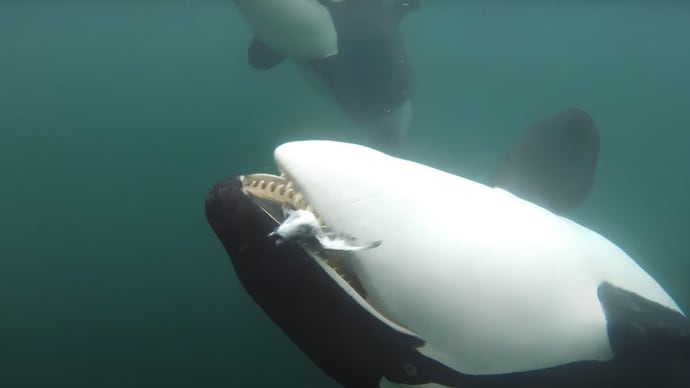
Marine biologists have documented a remarkable hunting behaviour never before captured on camera, showing an orca deliberately ramming a giant ocean sunfish with such force that the massive fish exploded into thousands of pieces.
The extraordinary footage was recorded in the Gulf of California, Mexico, by marine biologist Dr Kathryn Ayres of the conservation organisation Beneath The Waves.
The event offers scientists a rare glimpse into the intelligence and cooperative hunting strategies of killer whales.
Ocean sunfish, or Mola mola, are among the world's largest bony fish, growing to more than three metres in length and weighing as much as 2,000 kilograms (4,400 pounds). Despite their enormous size, they are a known prey species for orcas.
In the newly recorded encounter, a female killer whale was seen holding the tail of a dead sunfish while an adult male swam rapidly toward the carcass. Moments before impact, the female released the fish, allowing the male to slam into it at high speed.
The collision produced an audible crunch as the enormous fish burst apart, leaving a cloud of white fragments suspended in the water. The shattered pieces then became an easy meal for the pod.
A juvenile orca was observed feeding on the smaller chunks of flesh while the adult whales consumed the larger remains.
Scientists say the behaviour appears to be an efficient feeding strategy, allowing multiple members of the pod, including younger whales, to access food that would otherwise be difficult to tear apart.
The event was not an isolated incident. In September 2025, a second similar encounter was recorded by a tourism operator in the same region. In that case, an adult female orca held a dead sunfish while another killer whale performed a high-speed ramming manoeuvre, once again breaking the carcass into thousands of pieces.
Researchers are still uncertain whether both events involved the same group of orcas. However, the repeated observations suggest the behaviour may represent a specialised hunting technique rather than a one-off occurrence.
The footage highlights the extraordinary problem-solving abilities and social coordination of orcas, widely regarded as among the most intelligent marine mammals.
Marine biologists have documented a remarkable hunting behaviour never before captured on camera, showing an orca deliberately ramming a giant ocean sunfish with such force that the massive fish exploded into thousands of pieces.
The extraordinary footage was recorded in the Gulf of California, Mexico, by marine biologist Dr Kathryn Ayres of the conservation organisation Beneath The Waves.
The event offers scientists a rare glimpse into the intelligence and cooperative hunting strategies of killer whales.
Ocean sunfish, or Mola mola, are among the world's largest bony fish, growing to more than three metres in length and weighing as much as 2,000 kilograms (4,400 pounds). Despite their enormous size, they are a known prey species for orcas.
In the newly recorded encounter, a female killer whale was seen holding the tail of a dead sunfish while an adult male swam rapidly toward the carcass. Moments before impact, the female released the fish, allowing the male to slam into it at high speed.
The collision produced an audible crunch as the enormous fish burst apart, leaving a cloud of white fragments suspended in the water. The shattered pieces then became an easy meal for the pod.
A juvenile orca was observed feeding on the smaller chunks of flesh while the adult whales consumed the larger remains.
Scientists say the behaviour appears to be an efficient feeding strategy, allowing multiple members of the pod, including younger whales, to access food that would otherwise be difficult to tear apart.
The event was not an isolated incident. In September 2025, a second similar encounter was recorded by a tourism operator in the same region. In that case, an adult female orca held a dead sunfish while another killer whale performed a high-speed ramming manoeuvre, once again breaking the carcass into thousands of pieces.
Researchers are still uncertain whether both events involved the same group of orcas. However, the repeated observations suggest the behaviour may represent a specialised hunting technique rather than a one-off occurrence.
The footage highlights the extraordinary problem-solving abilities and social coordination of orcas, widely regarded as among the most intelligent marine mammals.
Marine biologists have documented a remarkable hunting behaviour never before captured on camera, showing an orca deliberately ramming a giant ocean sunfish with such force that the massive fish exploded into thousands of pieces.
The extraordinary footage was recorded in the Gulf of California, Mexico, by marine biologist Dr Kathryn Ayres of the conservation organisation Beneath The Waves.
The event offers scientists a rare glimpse into the intelligence and cooperative hunting strategies of killer whales.
Ocean sunfish, or Mola mola, are among the world's largest bony fish, growing to more than three metres in length and weighing as much as 2,000 kilograms (4,400 pounds). Despite their enormous size, they are a known prey species for orcas.
In the newly recorded encounter, a female killer whale was seen holding the tail of a dead sunfish while an adult male swam rapidly toward the carcass. Moments before impact, the female released the fish, allowing the male to slam into it at high speed.
The collision produced an audible crunch as the enormous fish burst apart, leaving a cloud of white fragments suspended in the water. The shattered pieces then became an easy meal for the pod.
A juvenile orca was observed feeding on the smaller chunks of flesh while the adult whales consumed the larger remains.
Scientists say the behaviour appears to be an efficient feeding strategy, allowing multiple members of the pod, including younger whales, to access food that would otherwise be difficult to tear apart.
The event was not an isolated incident. In September 2025, a second similar encounter was recorded by a tourism operator in the same region. In that case, an adult female orca held a dead sunfish while another killer whale performed a high-speed ramming manoeuvre, once again breaking the carcass into thousands of pieces.
Researchers are still uncertain whether both events involved the same group of orcas. However, the repeated observations suggest the behaviour may represent a specialised hunting technique rather than a one-off occurrence.
The footage highlights the extraordinary problem-solving abilities and social coordination of orcas, widely regarded as among the most intelligent marine mammals.

