The blessing and curse of VAR: Football's never-ending debate
As the 2026 World Cup intensifies debates over VAR, we look at how football's pursuit of technological perfection has successfully eliminated blatant refereeing errors yet fundamentally compromised the sport's raw, emotional certainty.
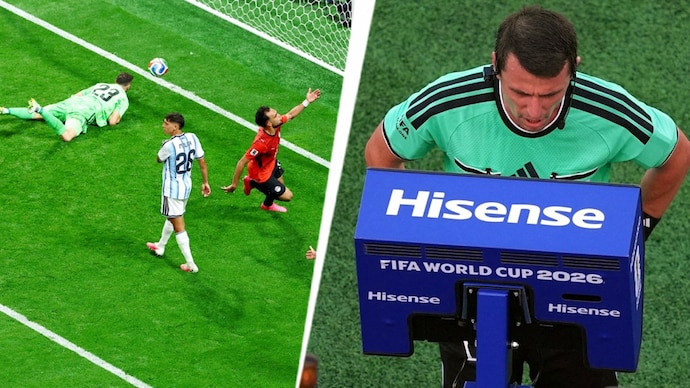
A stadium erupts.
Tens of thousands leap from their seats. Players sprint towards the corner flag. Commentators lose their voices. Somewhere, a television remote flies across a living room in celebration.
A goal has been scored. Or so everyone thinks. Then comes the pause.
The referee raises a finger to his ear. Players stop celebrating. Fans stare at giant screens. Television broadcasters begin drawing lines across replay footage. A goal that existed a few seconds ago suddenly enters a strange state of uncertainty.
Did it really happen?
Welcome to the age of VAR.
Introduced to make football fairer, the Video Assistant Referee system has transformed the world's most popular sport. It has corrected mistakes that once altered the course of World Cups and league titles. It has also created a new kind of drama – one measured not in goals and saves, but in freeze frames, replay angles and endless arguments.
The 2026 FIFA World Cup has once again exposed that contradiction.
There was heartbreak in Iran, where players celebrated a goal that never truly existed. There was disbelief in Croatia, where a dramatic equaliser against Portugal disappeared after a review. But no match captured the promise and peril of VAR quite like Argentina's extraordinary 3-2 victory over Egypt in the Round of 16.
For Egypt, it was a story about injustice. For Argentina, it was a story about survival. For the rest of the football world, it became a case study in the question that has followed VAR since its introduction:
When technology enters the game, who decides what gets reviewed – and what doesn't? Nearly a decade after its introduction, football still cannot decide whether VAR is the game's greatest innovation or its biggest mistake.
Perhaps that is because VAR was created to solve one problem but ended up exposing another.
It can tell us what happened. It cannot tell us what feels fair.
WHAT EXACTLY IS VAR?
For those who do not spend their weekends watching football, VAR – short for Video Assistant Referee – is football's version of a video review system. A team of officials sits in a dedicated operations room, monitoring multiple camera feeds from a match. If they believe the referee has made a significant error, they can recommend a review. The referee can then either accept the recommendation or walk to a pitch-side monitor to review the footage before making a final decision.
VAR is permitted to intervene only in four situations: goals, penalties, direct red cards and cases of mistaken identity. The idea sounds difficult to oppose. If technology can prevent a mistake that might decide a World Cup match, why shouldn't football use it? That question is precisely why VAR was introduced.
THE MISTAKES FOOTBALL COULD NEVER FORGET
Long before VAR arrived, football was haunted by moments that refused to fade away. The most famous came at the 1986 World Cup when Diego Maradona punched the ball into England's net. Millions watching on television could see what had happened. The officials could not. The goal stood and entered football folklore as the "Hand of God."
Then came Frank Lampard's disallowed goal against Germany at the 2010 World Cup. His shot crossed the line by a considerable distance before bouncing out. Replays made the error obvious. The officials missed it.
Such moments became harder to defend as television technology improved. Fans sitting at home often had a better view of an incident than the people responsible for officiating it. Football eventually surrendered to the logic of technology. If cameras could spot mistakes, why should the sport ignore them?
VAR arrived with a simple promise: fewer errors and greater fairness.
In many ways, it delivered.
Refereeing decisions are more accurate than they were a decade ago. Offside goals are spotted. Dangerous fouls are punished. Clear mistakes can be corrected before they decide matches.
Yet football discovered something unexpected. Accuracy and satisfaction are not the same thing.
EGYPT, ARGENTINA AND THE MATCH THAT CHANGED THE CONVERSATION
For more than an hour in Atlanta, Egypt were not merely competing with Argentina. They were threatening to eliminate the holders.
The defending champions looked rattled. Lionel Messi missed a penalty. Egypt were disciplined, organised and fearless. As the match wore on, the possibility of one of the great World Cup upsets began to feel real. Then came the moment that would define not only the match but much of the tournament's conversation around VAR.
When Mostafa Zico found the net to seemingly put Egypt 2-0 ahead, the Egyptian bench erupted. Players raced away in celebration. Supporters could scarcely believe what they were witnessing. Argentina, the defending champions and one of the favourites for the trophy, appeared to be on the brink.
Except they weren't.
VAR intervened.
After a lengthy review, officials ruled that an earlier foul in the attacking sequence invalidated the goal. What made the decision so contentious was not merely the outcome but the process itself. The review reached back into an earlier phase of play, identifying an infringement that many supporters had barely registered in real time.
To referees, it was an example of the system functioning exactly as intended. To many Egyptians, it felt like something entirely different.
The goal had already been celebrated. The moment had already happened. Yet technology had effectively travelled backwards through time and erased it.
The emotional fallout became even greater because of what followed. Argentina clawed their way back into the game. Cristian Romero scored. Messi eventually found the equaliser. Then, in stoppage time, Argentina completed one of the most dramatic comebacks of the tournament.
Within minutes, Egypt had gone from dreaming of a famous victory to watching Argentina celebrate qualification. Yet the disallowed goal was only part of the anger.
Egyptian players and officials believed there were other incidents that deserved the same scrutiny that VAR had applied to Zico's goal. Mohamed Salah was involved in a challenge that Egypt felt warranted a closer look. There were penalty appeals. There were questions about fouls in attacking build-ups. There were moments that Egyptian supporters believed should have triggered reviews but did not.
And that is where the debate moved beyond one decision. Football's biggest argument about VAR is no longer whether technology works. It is whether it is applied consistently. The technology itself may be objective. Human beings still decide when to intervene, how far back to look and whether an incident crosses the threshold for review. Those decisions remain subjective.
After the match, Egypt coach Hossam Hassan did not sound like a man discussing an offside call. He sounded like a man convinced his team had been denied a place in history. He questioned why some incidents received exhaustive scrutiny while others appeared to pass without review. He openly suggested that football's biggest star had benefited from crucial decisions. The Egyptian Football Association lodged an official complaint.
Whether those accusations were fair remains fiercely debated. What matters is that millions of Egyptians believed them. And that, perhaps, is VAR's greatest challenge. It was designed to eliminate arguments. Instead, it has often created new ones.
IRAN AND THE CRUELTY OF BEING RIGHT
If Egypt's defining emotion was anger, Iran's was heartbreak. Iran arrived at the World Cup carrying the hopes of a football-mad nation but few expectations from outsiders. They were not among the favourites. Yet they became one of the tournament's most compelling stories, fighting for every point and refusing to go quietly. That is why the disallowed goal against Egypt landed with such force.
Late in the match agannst Egypt, Shoja Khalilzadeh bundled the ball into the net and immediately set off scenes of celebration. Players sprinted away. Substitutes spilt onto the touchline. Supporters inside the stadium roared.
For a few precious seconds, Iran thought its World Cup story had taken a dramatic turn. Then came the review.
The celebrations slowed as players looked towards the referee. By the time the replay appeared on screens, anxiety had already begun replacing joy. The review confirmed what the technology had detected.
Offside.
What made the moment so painful was that there was no obvious injustice. There was no scandal. No controversial refereeing call. No villain. The technology had worked exactly as intended.
A generation ago, the goal might have stood and become part of Iranian football folklore. Instead, it became something else: a reminder that a decision can be completely correct and still feel devastating.
VAR had delivered justice.
It had not delivered comfort.
THE MILLIMETRE PROBLEM
No aspect of VAR generates more debate than offside. Modern football now uses semi-automated technology capable of tracking player movements with astonishing precision. Cameras and sensors can determine whether a shoulder, knee or boot was marginally ahead of a defender at the exact moment a pass was played.
The technology is extraordinary. The experience can be maddening.
Goals are now ruled out because a player was offside by a matter of centimetres. Sometimes the margin is so small that nobody inside the stadium can see it.
Technically, the decisions are correct. Emotionally, many supporters struggle to accept them. Nobody falls in love with football because of a computer-generated line. Nobody celebrates a goal thinking about whether a striker's shoulder was two centimetres ahead of a defender. Yet those tiny margins increasingly decide the biggest matches.
Perhaps VAR's greatest achievement is also its greatest failure. It has made football more accurate than ever before.
Take a look at how Croatia's goal vs Portugal was disallowed.
In doing so, it has taught an entire generation of supporters to distrust their own eyes.
FOOTBALL'S BIGGEST QUESTIONS HAVE NO PERFECT ANSWERS
The easiest decisions for VAR are factual ones. Did the ball cross the line? Was the player offside? Did the foul occur inside the penalty area?
Technology excels at answering such questions. The trouble begins when football asks questions that do not have objective answers. Was there enough contact for a penalty? Did a player deliberately handle the ball? Was the challenge reckless enough to deserve a red card?
These decisions remain matters of interpretation. Two referees can watch the same replay and reach different conclusions. Millions of supporters can watch the same incident and see entirely different things.
Technology provides more evidence. It does not eliminate judgment.
VAR has not removed the human element from football. It has simply given the human element more camera angles.
THE COST OF CERTAINTY
Football spent decades trying to eliminate mistakes. In many respects, it succeeded. The kind of controversies that produced the Hand of God or Lampard's ghost goal are far less likely today. Refereeing decisions are more accurate than ever before.
But fairness comes with trade-offs.
Before VAR, mistakes happened more often. Yet goals belonged entirely to the moment. A supporter could celebrate without hesitation. A striker could run towards the crowd without glancing nervously at the referee. A last-minute winner was a last-minute winner the instant the ball crossed the line.
That certainty no longer exists. Today, every goal carries an invisible question mark. Players celebrate and then wait. Fans cheer and then look towards the referee. The most familiar image in modern football is no longer a goal celebration. It is a stadium holding its breath.
Football is more accurate than it has ever been. It is not necessarily happier.
A PROBLEM TECHNOLOGY CANNOT SOLVE
The 2026 World Cup has once again demonstrated the limits of technology in sport.
VAR can identify an offside by a few centimetres. It can spot a foul hidden from the referee's view. It can provide evidence that previous generations never had.
What it cannot do is guarantee agreement. Because football fans were never arguing only about facts. They were arguing about fairness. And fairness is a far more complicated thing.
Technology can tell us whether a player was offside. It cannot tell us whether overturning a goal two minutes later feels right.
It can identify contact. It cannot tell us how that contact should be interpreted.
It can provide answers. It cannot provide closure.
That is why VAR remains both a blessing and a curse-football's most powerful tool for justice and its most reliable generator of controversy.
Football spent decades trying to eliminate human error. What it discovered is that human disagreement is much harder to eliminate. And that may be the ultimate lesson of the VAR era.
The technology solved the easy problem. The difficult one was always us.
FIFA World Cup | FIFA World Cup Schedule | FIFA World Cup Points Table | Football News
A stadium erupts.
Tens of thousands leap from their seats. Players sprint towards the corner flag. Commentators lose their voices. Somewhere, a television remote flies across a living room in celebration.
A goal has been scored. Or so everyone thinks. Then comes the pause.
The referee raises a finger to his ear. Players stop celebrating. Fans stare at giant screens. Television broadcasters begin drawing lines across replay footage. A goal that existed a few seconds ago suddenly enters a strange state of uncertainty.
Did it really happen?
Welcome to the age of VAR.
Introduced to make football fairer, the Video Assistant Referee system has transformed the world's most popular sport. It has corrected mistakes that once altered the course of World Cups and league titles. It has also created a new kind of drama – one measured not in goals and saves, but in freeze frames, replay angles and endless arguments.
The 2026 FIFA World Cup has once again exposed that contradiction.
There was heartbreak in Iran, where players celebrated a goal that never truly existed. There was disbelief in Croatia, where a dramatic equaliser against Portugal disappeared after a review. But no match captured the promise and peril of VAR quite like Argentina's extraordinary 3-2 victory over Egypt in the Round of 16.
For Egypt, it was a story about injustice. For Argentina, it was a story about survival. For the rest of the football world, it became a case study in the question that has followed VAR since its introduction:
When technology enters the game, who decides what gets reviewed – and what doesn't? Nearly a decade after its introduction, football still cannot decide whether VAR is the game's greatest innovation or its biggest mistake.
Perhaps that is because VAR was created to solve one problem but ended up exposing another.
It can tell us what happened. It cannot tell us what feels fair.
WHAT EXACTLY IS VAR?
For those who do not spend their weekends watching football, VAR – short for Video Assistant Referee – is football's version of a video review system. A team of officials sits in a dedicated operations room, monitoring multiple camera feeds from a match. If they believe the referee has made a significant error, they can recommend a review. The referee can then either accept the recommendation or walk to a pitch-side monitor to review the footage before making a final decision.
VAR is permitted to intervene only in four situations: goals, penalties, direct red cards and cases of mistaken identity. The idea sounds difficult to oppose. If technology can prevent a mistake that might decide a World Cup match, why shouldn't football use it? That question is precisely why VAR was introduced.
THE MISTAKES FOOTBALL COULD NEVER FORGET
Long before VAR arrived, football was haunted by moments that refused to fade away. The most famous came at the 1986 World Cup when Diego Maradona punched the ball into England's net. Millions watching on television could see what had happened. The officials could not. The goal stood and entered football folklore as the "Hand of God."
Then came Frank Lampard's disallowed goal against Germany at the 2010 World Cup. His shot crossed the line by a considerable distance before bouncing out. Replays made the error obvious. The officials missed it.
Such moments became harder to defend as television technology improved. Fans sitting at home often had a better view of an incident than the people responsible for officiating it. Football eventually surrendered to the logic of technology. If cameras could spot mistakes, why should the sport ignore them?
VAR arrived with a simple promise: fewer errors and greater fairness.
In many ways, it delivered.
Refereeing decisions are more accurate than they were a decade ago. Offside goals are spotted. Dangerous fouls are punished. Clear mistakes can be corrected before they decide matches.
Yet football discovered something unexpected. Accuracy and satisfaction are not the same thing.
EGYPT, ARGENTINA AND THE MATCH THAT CHANGED THE CONVERSATION
For more than an hour in Atlanta, Egypt were not merely competing with Argentina. They were threatening to eliminate the holders.
The defending champions looked rattled. Lionel Messi missed a penalty. Egypt were disciplined, organised and fearless. As the match wore on, the possibility of one of the great World Cup upsets began to feel real. Then came the moment that would define not only the match but much of the tournament's conversation around VAR.
When Mostafa Zico found the net to seemingly put Egypt 2-0 ahead, the Egyptian bench erupted. Players raced away in celebration. Supporters could scarcely believe what they were witnessing. Argentina, the defending champions and one of the favourites for the trophy, appeared to be on the brink.
Except they weren't.
VAR intervened.
After a lengthy review, officials ruled that an earlier foul in the attacking sequence invalidated the goal. What made the decision so contentious was not merely the outcome but the process itself. The review reached back into an earlier phase of play, identifying an infringement that many supporters had barely registered in real time.
To referees, it was an example of the system functioning exactly as intended. To many Egyptians, it felt like something entirely different.
The goal had already been celebrated. The moment had already happened. Yet technology had effectively travelled backwards through time and erased it.
The emotional fallout became even greater because of what followed. Argentina clawed their way back into the game. Cristian Romero scored. Messi eventually found the equaliser. Then, in stoppage time, Argentina completed one of the most dramatic comebacks of the tournament.
Within minutes, Egypt had gone from dreaming of a famous victory to watching Argentina celebrate qualification. Yet the disallowed goal was only part of the anger.
Egyptian players and officials believed there were other incidents that deserved the same scrutiny that VAR had applied to Zico's goal. Mohamed Salah was involved in a challenge that Egypt felt warranted a closer look. There were penalty appeals. There were questions about fouls in attacking build-ups. There were moments that Egyptian supporters believed should have triggered reviews but did not.
And that is where the debate moved beyond one decision. Football's biggest argument about VAR is no longer whether technology works. It is whether it is applied consistently. The technology itself may be objective. Human beings still decide when to intervene, how far back to look and whether an incident crosses the threshold for review. Those decisions remain subjective.
After the match, Egypt coach Hossam Hassan did not sound like a man discussing an offside call. He sounded like a man convinced his team had been denied a place in history. He questioned why some incidents received exhaustive scrutiny while others appeared to pass without review. He openly suggested that football's biggest star had benefited from crucial decisions. The Egyptian Football Association lodged an official complaint.
Whether those accusations were fair remains fiercely debated. What matters is that millions of Egyptians believed them. And that, perhaps, is VAR's greatest challenge. It was designed to eliminate arguments. Instead, it has often created new ones.
IRAN AND THE CRUELTY OF BEING RIGHT
If Egypt's defining emotion was anger, Iran's was heartbreak. Iran arrived at the World Cup carrying the hopes of a football-mad nation but few expectations from outsiders. They were not among the favourites. Yet they became one of the tournament's most compelling stories, fighting for every point and refusing to go quietly. That is why the disallowed goal against Egypt landed with such force.
Late in the match agannst Egypt, Shoja Khalilzadeh bundled the ball into the net and immediately set off scenes of celebration. Players sprinted away. Substitutes spilt onto the touchline. Supporters inside the stadium roared.
For a few precious seconds, Iran thought its World Cup story had taken a dramatic turn. Then came the review.
The celebrations slowed as players looked towards the referee. By the time the replay appeared on screens, anxiety had already begun replacing joy. The review confirmed what the technology had detected.
Offside.
What made the moment so painful was that there was no obvious injustice. There was no scandal. No controversial refereeing call. No villain. The technology had worked exactly as intended.
A generation ago, the goal might have stood and become part of Iranian football folklore. Instead, it became something else: a reminder that a decision can be completely correct and still feel devastating.
VAR had delivered justice.
It had not delivered comfort.
THE MILLIMETRE PROBLEM
No aspect of VAR generates more debate than offside. Modern football now uses semi-automated technology capable of tracking player movements with astonishing precision. Cameras and sensors can determine whether a shoulder, knee or boot was marginally ahead of a defender at the exact moment a pass was played.
The technology is extraordinary. The experience can be maddening.
Goals are now ruled out because a player was offside by a matter of centimetres. Sometimes the margin is so small that nobody inside the stadium can see it.
Technically, the decisions are correct. Emotionally, many supporters struggle to accept them. Nobody falls in love with football because of a computer-generated line. Nobody celebrates a goal thinking about whether a striker's shoulder was two centimetres ahead of a defender. Yet those tiny margins increasingly decide the biggest matches.
Perhaps VAR's greatest achievement is also its greatest failure. It has made football more accurate than ever before.
Take a look at how Croatia's goal vs Portugal was disallowed.
In doing so, it has taught an entire generation of supporters to distrust their own eyes.
FOOTBALL'S BIGGEST QUESTIONS HAVE NO PERFECT ANSWERS
The easiest decisions for VAR are factual ones. Did the ball cross the line? Was the player offside? Did the foul occur inside the penalty area?
Technology excels at answering such questions. The trouble begins when football asks questions that do not have objective answers. Was there enough contact for a penalty? Did a player deliberately handle the ball? Was the challenge reckless enough to deserve a red card?
These decisions remain matters of interpretation. Two referees can watch the same replay and reach different conclusions. Millions of supporters can watch the same incident and see entirely different things.
Technology provides more evidence. It does not eliminate judgment.
VAR has not removed the human element from football. It has simply given the human element more camera angles.
THE COST OF CERTAINTY
Football spent decades trying to eliminate mistakes. In many respects, it succeeded. The kind of controversies that produced the Hand of God or Lampard's ghost goal are far less likely today. Refereeing decisions are more accurate than ever before.
But fairness comes with trade-offs.
Before VAR, mistakes happened more often. Yet goals belonged entirely to the moment. A supporter could celebrate without hesitation. A striker could run towards the crowd without glancing nervously at the referee. A last-minute winner was a last-minute winner the instant the ball crossed the line.
That certainty no longer exists. Today, every goal carries an invisible question mark. Players celebrate and then wait. Fans cheer and then look towards the referee. The most familiar image in modern football is no longer a goal celebration. It is a stadium holding its breath.
Football is more accurate than it has ever been. It is not necessarily happier.
A PROBLEM TECHNOLOGY CANNOT SOLVE
The 2026 World Cup has once again demonstrated the limits of technology in sport.
VAR can identify an offside by a few centimetres. It can spot a foul hidden from the referee's view. It can provide evidence that previous generations never had.
What it cannot do is guarantee agreement. Because football fans were never arguing only about facts. They were arguing about fairness. And fairness is a far more complicated thing.
Technology can tell us whether a player was offside. It cannot tell us whether overturning a goal two minutes later feels right.
It can identify contact. It cannot tell us how that contact should be interpreted.
It can provide answers. It cannot provide closure.
That is why VAR remains both a blessing and a curse-football's most powerful tool for justice and its most reliable generator of controversy.
Football spent decades trying to eliminate human error. What it discovered is that human disagreement is much harder to eliminate. And that may be the ultimate lesson of the VAR era.
The technology solved the easy problem. The difficult one was always us.
FIFA World Cup | FIFA World Cup Schedule | FIFA World Cup Points Table | Football News

