Forgot Gmail password? Google will now let you sign in using selfie video
Forgot your Gmail password? Google now lets you use a selfie video to get back into your account. The new recovery option aims to make sign-ins easier while adding safeguards against deepfakes and keeping users in control of their biometric data.
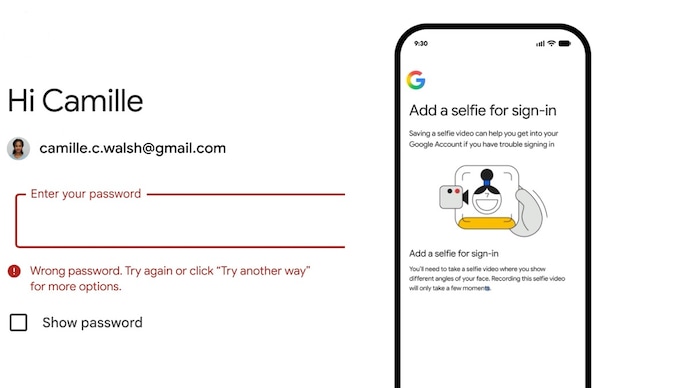
Forgetting your Gmail password can be stressful, especially if you no longer have access to your recovery phone, computer or two-factor authentication app. To make getting back into your account a little easier, Google is introducing a new feature called Selfie Video. The feature lets users verify their identity with a short selfie video instead of relying solely on traditional recovery methods.
According to Google, Selfie Video is designed to help people regain access to their accounts when standard sign-in options are unavailable. The company is rolling out the feature as an optional account recovery tool for Google Account users. So, the next time you get locked out of your account, Google may ask you to record a quick selfie video to prove it's really you before letting you sign back in. But for that option you will need to set it up.
How does Google Selfie Video work?
Before you can use the feature, you'll need to set it up while you still have access to your Google Account. During setup, Google will ask you to record a short selfie video by looking at your device's camera and following a few simple on-screen prompts, such as turning your head or making small movements. This video will become the reference video.
Once the video reference is all set up, next time whenever you forget your password or can't access your usual sign-in methods, Google will ask you to record another short selfie video. The system will then compare the new recording with the reference video saved to your account to authenticate your identity.
Google says the guided movements are important because they help verify that the recording is live and not simply a photograph or a pre-recorded video.
The feature can spot deepfakes too
Now keeping mind the AI-generated deepfakes, Google says it has built multiple layers of protection into this new video authentication system. Besides matching your new selfie video with the reference video, the feature will also check for signs that a real person is in front of the camera rather than someone using fake images, manipulated videos or AI-generated faces.
The company says it has also combined selfie verification with its existing security systems, which can analyse signals such as the device a person is using, browser settings, IP address, location and whether the sign-in attempt appears unusual.
What about your privacy?
Since face is a biometric data, Google says users remain in control of how it is stored and used. The reference selfie video is recorded only with the user's permission, encrypted while stored and can be deleted at any time from Google Account settings.
By default, the stored video is used only for sign-in and account recovery. Users can also choose to let Google use it for additional purposes, such as improving its identity verification systems.
However, Google still recommends keeping other recovery methods active, including passkeys, backup codes, recovery phone numbers and recovery email addresses. That way, if one recovery option isn't available, you'll still have other ways to get back into your account.
Availability
The Selfie Video feature is rolling out gradually to Google Account users worldwide.
Forgetting your Gmail password can be stressful, especially if you no longer have access to your recovery phone, computer or two-factor authentication app. To make getting back into your account a little easier, Google is introducing a new feature called Selfie Video. The feature lets users verify their identity with a short selfie video instead of relying solely on traditional recovery methods.
According to Google, Selfie Video is designed to help people regain access to their accounts when standard sign-in options are unavailable. The company is rolling out the feature as an optional account recovery tool for Google Account users. So, the next time you get locked out of your account, Google may ask you to record a quick selfie video to prove it's really you before letting you sign back in. But for that option you will need to set it up.
How does Google Selfie Video work?
Before you can use the feature, you'll need to set it up while you still have access to your Google Account. During setup, Google will ask you to record a short selfie video by looking at your device's camera and following a few simple on-screen prompts, such as turning your head or making small movements. This video will become the reference video.
Once the video reference is all set up, next time whenever you forget your password or can't access your usual sign-in methods, Google will ask you to record another short selfie video. The system will then compare the new recording with the reference video saved to your account to authenticate your identity.
Google says the guided movements are important because they help verify that the recording is live and not simply a photograph or a pre-recorded video.
The feature can spot deepfakes too
Now keeping mind the AI-generated deepfakes, Google says it has built multiple layers of protection into this new video authentication system. Besides matching your new selfie video with the reference video, the feature will also check for signs that a real person is in front of the camera rather than someone using fake images, manipulated videos or AI-generated faces.
The company says it has also combined selfie verification with its existing security systems, which can analyse signals such as the device a person is using, browser settings, IP address, location and whether the sign-in attempt appears unusual.
What about your privacy?
Since face is a biometric data, Google says users remain in control of how it is stored and used. The reference selfie video is recorded only with the user's permission, encrypted while stored and can be deleted at any time from Google Account settings.
By default, the stored video is used only for sign-in and account recovery. Users can also choose to let Google use it for additional purposes, such as improving its identity verification systems.
However, Google still recommends keeping other recovery methods active, including passkeys, backup codes, recovery phone numbers and recovery email addresses. That way, if one recovery option isn't available, you'll still have other ways to get back into your account.
Availability
The Selfie Video feature is rolling out gradually to Google Account users worldwide.
Forgetting your Gmail password can be stressful, especially if you no longer have access to your recovery phone, computer or two-factor authentication app. To make getting back into your account a little easier, Google is introducing a new feature called Selfie Video. The feature lets users verify their identity with a short selfie video instead of relying solely on traditional recovery methods.
According to Google, Selfie Video is designed to help people regain access to their accounts when standard sign-in options are unavailable. The company is rolling out the feature as an optional account recovery tool for Google Account users. So, the next time you get locked out of your account, Google may ask you to record a quick selfie video to prove it's really you before letting you sign back in. But for that option you will need to set it up.
How does Google Selfie Video work?
Before you can use the feature, you'll need to set it up while you still have access to your Google Account. During setup, Google will ask you to record a short selfie video by looking at your device's camera and following a few simple on-screen prompts, such as turning your head or making small movements. This video will become the reference video.
Once the video reference is all set up, next time whenever you forget your password or can't access your usual sign-in methods, Google will ask you to record another short selfie video. The system will then compare the new recording with the reference video saved to your account to authenticate your identity.
Google says the guided movements are important because they help verify that the recording is live and not simply a photograph or a pre-recorded video.
The feature can spot deepfakes too
Now keeping mind the AI-generated deepfakes, Google says it has built multiple layers of protection into this new video authentication system. Besides matching your new selfie video with the reference video, the feature will also check for signs that a real person is in front of the camera rather than someone using fake images, manipulated videos or AI-generated faces.
The company says it has also combined selfie verification with its existing security systems, which can analyse signals such as the device a person is using, browser settings, IP address, location and whether the sign-in attempt appears unusual.
What about your privacy?
Since face is a biometric data, Google says users remain in control of how it is stored and used. The reference selfie video is recorded only with the user's permission, encrypted while stored and can be deleted at any time from Google Account settings.
By default, the stored video is used only for sign-in and account recovery. Users can also choose to let Google use it for additional purposes, such as improving its identity verification systems.
However, Google still recommends keeping other recovery methods active, including passkeys, backup codes, recovery phone numbers and recovery email addresses. That way, if one recovery option isn't available, you'll still have other ways to get back into your account.
Availability
The Selfie Video feature is rolling out gradually to Google Account users worldwide.

