
Papa Yaar: Zakir Khan brings more heart than comedy in his most personal act yet

In Papa Yaar, comedian Zakir Khan turns his relationship with his father into the centre of a deeply personal Netflix special. The result is an affecting reflection on fathers and sons that lands harder emotionally than comically.
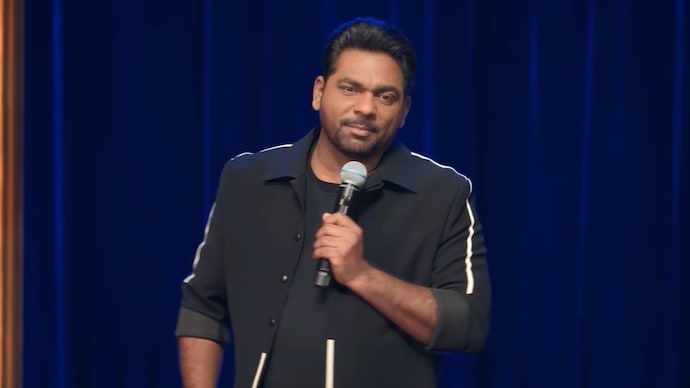

There are some childhood memories that stay tucked away somewhere, waiting for the smallest thing to bring them back. The gate opening in the evening, the familiar sound of a scooter pulling up outside. And then, almost without thinking, sitting up straight and reaching for a book. In Papa Yaar, comedian Zakir Khan takes this deeply familiar childhood ritual and turns it into the emotional heart of his latest stand-up special.
Now streaming on Netflix, the one-hour, 18-minute special is an ode to Khan's father, Ustad Ismail Khan, a classical sitar player and music teacher. More than a tribute, Papa Yaar is about the complicated, familiar and often unspoken relationship between fathers and sons in Indian households. It is an act in which the feelings land more strongly than the laughs.
Khan has spoken about his father before. In Haq Se Single, he drew from his father's old-school ways, limited English and unfamiliarity with urban habits. Kaksha Gyarvi leaned more on childhood and family memories, while Tathastu showed a more vulnerable side as he spoke about grief and personal loss. Across those specials, his father was never just a punchline, he was part of Khan's stories about growing up, finding his ambitions and understanding his family. Papa Yaar finally puts that relationship at the centre.
The special is at its best when Khan simply tells a story. He laughs off his father's exaggerated stories of hardship. He recalls how he and his friend Kuntal would ride a motorcycle hundreds of kilometres away from home, only to be found out by their fathers. He also revisits the difficulty of saying 'Thank you' to his father, and how awkward it was for his father to receive that compliment.
Then come the harder moments: the point at which fathers realise their children have grown up, the reassurance that they are there for them, and the quiet understanding that once their children move to a big city for work, they will mostly come home only during festivals. Khan also speaks of realising a father's importance, and what he meant, only after he is gone. That is where Papa Yaar hits hardest. Khan understands the emotional geography of an Indian household and knows which memories will feel personal even when they are not your own.
His performance strengthens those passages. Khan engages with the audience, acts out moments from his memories and moves between humour and emotion with ease. Just when a segment begins to feel too heavy, he pulls it back with a joke or an observation.
The emotional beats land, the storytelling works, and the relationship at the centre feels genuine. The comedy, however, often feels secondary. For a stand-up special, Papa Yaar spends a surprising amount of time asking the audience to feel rather than laugh. The emotional sections are given room to breathe, but the jokes can feel more like bridges between them than the driving force of the set.
Khan also traces his journey from Indore to performing at Madison Garden, turning that achievement into another tribute to his father. He jokes about being able to cause traffic outside Madison Garden, but ultimately credits the milestone to the man who shaped his journey. At one point during the act, he says all these "self-made people" don't understand that nobody is really self-made, but a product of their upbringing, their parents' efforts and the years of dreams, sacrifices and hopes that went into raising them. As Khan delivers that line, the camera pans across the audience, catching people wiping away a tiny tear, momentarily transported back to their childhoods and to memories of their parents.
That makes Papa Yaar feel less like a conventional stand-up special and more like a son trying to make sense of his father, his childhood and everything that changed along the way.
The timing makes the special more poignant. Khan announced in January 2026 that he would take an extended break from live comedy performances because of health concerns and personal reasons, with the hiatus potentially lasting three to five years. With Papa Yaar marking the end of this phase of his live comedy journey, there is a clear sense of closure around it, and that may be why the missing comic edge feels even more noticeable.
Papa Yaar has heart, strong writing, the right pace and a compelling performance by a storyteller. It has memories that sting, stories that linger and moments that make you think about your own parents. Khan shows, once again, how he can take something deeply personal and make it feel universal. But somewhere between the nostalgia, grief and life lessons, the comedian recedes behind the son.
Papa Yaar makes you emotional and reflective. It just does not make you laugh as much as a Zakir Khan special should, even if it leaves you wanting to call your father and say 'Thank you'.