
Sistan sand boa recorded in India for first time after 3 found in Rajasthan's Sikar

Researchers have scientifically recorded the Sistan sand boa in India after finding three snakes in Rajasthan's Sikar district. The discovery expands the species' known range and signals a need for wider surveys in the state.
 Last UpdatedSep 27, 2026 18:58 IST
  Published by
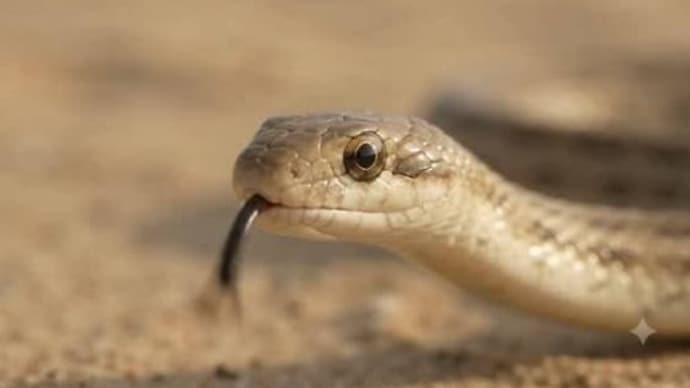
The Sistan sand boa, a non-venomous snake earlier known from Iran and Pakistan, has been scientifically recorded in India for the first time after researchers found three of them in Rajasthan's Sikar district. The finding was made during a survey in the Ramgarh-Shekhawati area and has been documented in a study published in the Journal of Threatened Taxa on May 26 this year.
Researchers Vivek Sharma of Jabalpur and wildlife biologist Dharmendra Khandal of Ranthambhore-based Tiger Watch said the discovery adds India to the known range of the thick-bodied snake, which is found in dry areas. They identified the species after studying the body shape, colour and scales of the three snakes found in 2025.
The first snake was found inside a gaushala on August 19, 2025. The second was found in the courtyard of a house at Sunda Ki Dhani on September 12, and the third near an under-construction house at Rukansar on September 21 last year.
Khandal said the team took time before publishing its findings. "We knew that this snake was different, but we did not rush to publish a research paper. We first decided to understand and study it properly," he said.
The Sistan sand boa looks similar to the red sand boa, which is commonly known in India. According to the study, one of the easier ways to tell the two apart is by the tail. The Sistan sand boa's tail gradually becomes thinner and ends in a pointed tip, while the red sand boa's tail remains thick for much of its length before narrowing towards the end.
Khandal said similar snakes had been noticed in Rajasthan for several years. Photographs of such snakes had been received from at least 40 locations, but pictures alone were not enough to scientifically confirm their identity. He said he had photographed similar snakes in Churu as far back as 2003 and 2006, but their species could not be confirmed then. Similar-looking snakes have also been reported around Bikaner, Hanumangarh and Jaisalmer, though these records are yet to be scientifically confirmed.
The Sistan sand boa was recognised as a separate species after a taxonomic study published in Iran in 2020 using morphological and genetic evidence. Researchers said the finding in Sikar suggests that the snake may also live in farms, orchards and areas close to human settlements, and not only in sand dunes. They said further studies are needed to understand how widely the species is distributed in Rajasthan and to assess its population and conservation needs.
The discovery of the three snakes in Sikar marks the first scientific record of the Sistan sand boa in India and points to the need for more surveys in Rajasthan to confirm its wider presence.