When sugar daddy is scared...: Tehseen Poonawalla claims detention at E20 protest

Sunday's incident marked the latest confrontation between Poonawalla and Delhi Police over his opposition to the E20 policy.
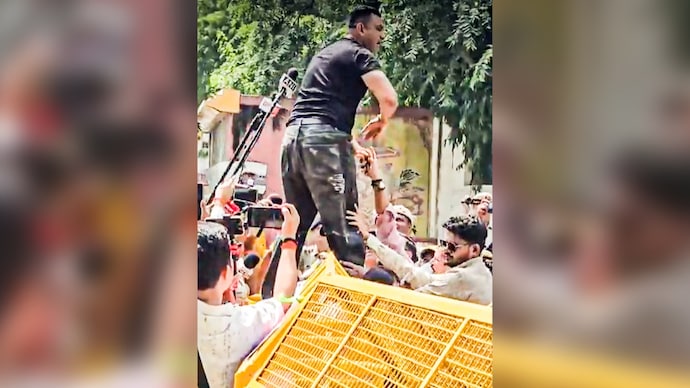

Political commentator Tehseen Poonawalla on Sunday claimed that Delhi Police detained him during a protest against E20 petrol at Jantar Mantar.
Poonawalla posted a video on X showing him breaking through police barricades. He said he would seek bail if arrested. “Breaking barricades. Detained on our way to be arrested by Delhi Police. Theek hai, will take bail,” he wrote.
Taking a swipe at Union Minister Nitin Gadkari, a strong advocate of ethanol-blended petrol, Poonawalla accused the government of using the police to suppress protests.
“Jab jab Sugar Daddy darte hain, police ko aage karte hain (“When Sugar Daddy gets scared, he puts the police in front),” he said, apparently referring to Gadkari.
Breaking Barricades!!!
Detained on our way to be arrested by Delhi Police! Thhek hain, will take bail!!
Jab Jab Sugar Daddy darte hain
Police ko aage karte hain!!
Give us E-10!
Remove MDR charge on UPI!
Arrest MCD Commissioner Sanjeev Khirwar #EthanolScam BETA BADHAO pic.twitter.com/zVopnptHUV— Tehseen Poonawalla Official (@tehseenp) September 20, 2026
Poonawalla demanded that the government withdraw E20 petrol and restore E10 fuel for older vehicles facing compatibility issues.
He also called for the removal of merchant discount rate charges on UPI transactions and demanded the arrest of MCD Commissioner Sanjeev Khirwar over the Satya Niketan building collapse.
Sunday’s incident marked the latest confrontation between Poonawalla and Delhi Police over his opposition to the E20 policy.
POONAWALLA VERSUS GOVERNMENT OVER E20 FUEL
Last month, Poonawalla claimed that he had been placed under house arrest while attempting to leave his residence for a protest against what he called the “sugar scam” and the E20 fuel policy.
Videos shared by him at the time showed him questioning police personnel about why he was being stopped from going to Jantar Mantar.
A police officer told him that permission for his visit to the protest site had been “cancelled”. The officer said allowing him to proceed could create a law-and-order problem if his supporters joined him.
The confrontation took an unusual turn when Poonawalla offered sugarcane juice to police personnel stationed outside his residence.
On July 31, Poonawalla also announced a solo march from APJ Abdul Kalam Road to Gandhi Smriti on Tees January Marg, where he planned to observe a day-long hunger strike against E20 petrol.
Earlier that month, he had threatened to protest outside Gadkari’s residence ahead of the first anti-E20 demonstration in New Delhi on July 5. The plan was dropped after Delhi Police granted permission for the protest at Jantar Mantar.
WHY POONAWALLA OPPOSES E20 FUEL
Poonawalla has been opposing the government’s E20 policy, under which petrol contains up to 20 per cent ethanol.
His campaign has since expanded to the government’s broader sugar and ethanol policies, which he has described on social media as the “sugar scam” and the “ethanol scam”.
He has repeatedly alleged that these policies benefit politically connected families while forcing consumers to bear higher costs.
Speaking to India Today Digital earlier, Poonawalla alleged that the ethanol-blending policy was “destroying our vehicles” and said his protests were directed at both E20 petrol and rising sugar prices.
“They don’t want us to protest against the ethanol 20 blending policy, which is destroying our vehicles,” he said.
Poonawalla also claimed that higher sugar prices were affecting household budgets and alleged that the government’s policies were enriching the children of politicians.
INDIA’S E20 POLICY
Under the Ethanol Blended Petrol programme, ethanol is mixed with petrol to reduce India’s dependence on imported crude oil and lower carbon emissions.
India expanded the programme nationwide and achieved its E20 target five years ahead of the original schedule.
The accelerated rollout has faced criticism from some vehicle owners and consumer groups, particularly over the use of E20 petrol in older vehicles designed for E10 or lower ethanol blends.
Critics have questioned whether the fuel was adequately tested across India’s existing vehicle fleet before the nationwide rollout.
Vehicle owners have also posted complaints on social media alleging reduced mileage, stalling, clogged fuel filters and higher repair costs. While these individual complaints have not established a direct link between E20 petrol and the reported problems, they have led to calls for greater transparency about its compatibility with older vehicles.
AUTOMAKERS DEFEND E20 POLICY
Senior automobile and energy sector representatives have defended the government’s E20 programme, saying extensive scientific testing found no evidence that the fuel posed a risk to vehicles.
At a press conference in July 2026, Vartika Shukla of Engineers India Limited said the transition followed years of consultation and testing. She acknowledged that engine performance could decline marginally but said it depended on factors such as driving habits.
Toyota Kirloskar Motor Country Head Vikram Gulati said ethanol was an effective automotive fuel and that India’s transition was supported by a robust regulatory framework.
Maruti Suzuki Senior Executive Officer Rahul Bharti said concerns largely involved vehicles manufactured before 2023 but maintained that the company had found no evidence that E20 petrol caused problems in such vehicles.
Former Indian Oil Corporation Chairman B Ashok said ethanol blending had strengthened India’s energy security and increased farmers’ incomes.