Can schools spot the next Messi? IIT professor says India is chasing wrong intelligence
An IIT Madras professor has argued that Indian schools are failing to identify sporting intelligence and future football talent. The claim gains weight as fresh UDISE+ data shows nearly one in five schools still do not have playgrounds.
"Poora India ONLY Watchega!? When are we going to playega!?"
India's education system is good at identifying academic toppers, but not future athletes, argues IIT Madras professor Edamana Prasad. Fresh UDISE+ 2025-26 data shows nearly one in five schools still lack playgrounds, raising questions about whether schools are equipped to nurture sporting talent.
As millions of Indians cheer every goal during the FIFA World Cup, Professor Prasad has a question that goes beyond football: Why does India only watch the World Cup instead of playing in it?
For the professor, who heads the Teaching Learning Centre (TLC) at IIT Madras, the answer lies not in a lack of passion but in the way India's education system recognises talent.
"Poora India ONLY Watchega!? When are we going to playega!?" Professor Prasad asks in a conversation with India Today, reflecting on India's long wait for a FIFA World Cup appearance.
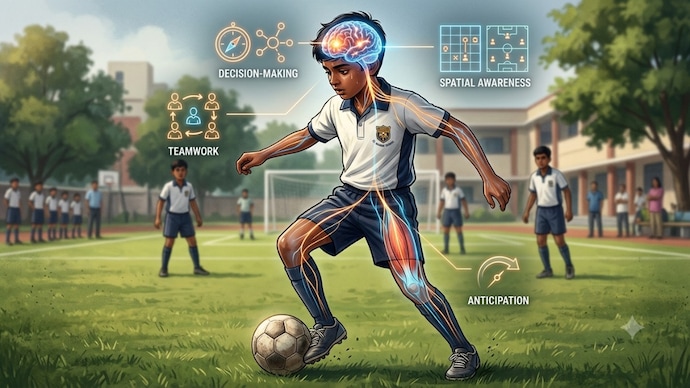
According to him, the education system in India continues to reward academic excellence while overlooking another equally important form of intelligence -- the ability to think, move and perform under pressure on the playing field.
His observations come as the latest UDISE+ 2025-26 report reveals that while schools have made significant gains in basic infrastructure, only 81.9 per cent have playgrounds, meaning nearly one in five schools still lack one of the most fundamental spaces where sporting talent can be discovered and nurtured.
'WHY ONLY WATCH?'
Prasad begins with a deeply personal memory.
Growing up in Kerala's Malappuram district, where football is woven into everyday life, he describes the sport as "more than just a game".
"Football is a great passion for us. It gets into the veins. It electrifies the mind. It is a zeal, it is ecstasy! A thrilling, memorable and breathtaking experience of 90 minutes," he says.
But one advertisement during the FIFA World Cup made him pause -- "Poora India watchega."
That slogan, he says, prompted an uncomfortable question. Countries with populations far smaller than many Indian states routinely qualify for football's biggest tournament. Why doesn't India?
SCHOOLS REWARD ONE KIND OF INTELLIGENCE
The professor believes the answer begins in classrooms.
Citing psychologist Howard Gardner's theory of Multiple Intelligences, he argues that Indian schools remain heavily oriented towards identifying logical and mathematical ability, often ignoring other forms of intelligence.
"The school education in our country... is highly oriented towards promoting only one skill – logical and mathematical intelligence. It is high time that schools re-orient to identify other types of intelligence in kids and try to nurture them at an early age," he says.
For him, this includes bodily-kinesthetic intelligence – the ability to coordinate the mind and body with speed, precision and creativity.
He argues that sporting excellence is not merely physical.
When players such as Lionel Messi, Kylian Mbapp or Cristiano Ronaldo dribble, anticipate passes or find space inside the penalty box, they are demonstrating rapid cognitive processing as much as physical skill.
"Sports is not a single skill - psychomotor skill has two components: psycho (mind) and motor (body)," says the IIT professor.
A GAP BETWEEN POLICY AND PRACTICE
The argument echoes the National Education Policy (NEP) 2020, which calls for holistic and multidisciplinary education rather than an excessive focus on examination performance.
The latest AISHE 2023-24 report reiterates this emphasis on a more holistic, flexible and multidisciplinary higher education system.
Yet the school ecosystem tells a more complicated story.
According to UDISE+, schools have achieved near-universal access to drinking water (99.5%), electricity (95%) and libraries (90.5%). Playground availability, however, stands at 81.9 per cent, leaving a significant number of children without access to spaces for regular sports and physical activity.
At the higher education level too, sports remain a niche area. AISHE 2023-24 shows that only 0.8 per cent of universities specialise in sports, yoga or physical education, compared with nearly 60 per cent that are multidisciplinary institutions.
THE MISSING PIECE: TRAINED COACHES
He says India also needs to rethink how it trains physical education teachers and coaches. Drawing from his experience in teacher education, he argues that demonstrating a skill is very different from teaching one.
Across India, millions of children play football during PT periods, lunch breaks and after school. But for most, those games remain recreational because very few schools have trained football coaches who can identify talent and help develop it systematically.
Students serious about the sport often have to rely on private football academies, provided their families can afford the extra time and expense.
Prasad argues that this is a gap schools need to address. He believes physical education alone is not enough, and that schools need trained coaches who can identify psychomotor skills early, design structured training programmes and nurture sporting talent from a young age.
"It is important to remember that a coach is not necessarily a good player. However, a good coach can shape an excellent player by designing a proper training programme and executing it systematically and rigorously," he says.
He believes India's Bachelor of Physical Education (BPEd) and Master of Physical Education (MPEd) programmes remain rich in theory, but schools often lack the infrastructure and ecosystem needed to translate that knowledge into everyday coaching.
Instead of treating football as an activity reserved for annual sports meets, Prasad argues it should become part of daily school life.
FROM PLAYGROUNDS TO THE NATIONAL TEAM
The IIT Madras professor proposes a structured pathway for identifying sporting talent.
Schools should identify children with exceptional psychomotor abilities at an early age. Community clubs should provide specialised coaching. The All India Football Federation (AIFF) should build a pipeline from grassroots football to state and national teams.
"A pyramid model where school systems, at the base, identify kids with excellent psychomotor skills, promoting them through community clubs, which can be the middle of the pyramid, feeding into government platforms like the All India Football Federation (AIFF) to identify players for national teams, at the top of the pyramid can be designed," he says.
He also recommends allowing schools to use Corporate Social Responsibility (CSR) funds to hire certified football coaches and partner with local clubs.
The professor points to the growing use of artificial intelligence by football clubs internationally to analyse match videos and identify promising players long before they enter professional academies.
"In a fast-moving world, policymakers and leaders have to be thinking in the future, not for the future," he says.
LOOKING BEYOND REPORT CARDS
India today has one of the world's largest school systems, educating more than 24 crore students across nearly 14.7 lakh schools.
But Prasad believes that if the country wants to compete on football's biggest stage, it must first rethink how it defines talent.
"If we can be at the top of the world in cricket, why not in football?"
His argument is ultimately less about football than education.
Finding India's next Messi, he suggests, may begin not in elite academies but in ordinary classrooms – provided schools learn to recognise intelligence that cannot always be measured by examination scores.
"Poora India ONLY Watchega!? When are we going to playega!?"
India's education system is good at identifying academic toppers, but not future athletes, argues IIT Madras professor Edamana Prasad. Fresh UDISE+ 2025-26 data shows nearly one in five schools still lack playgrounds, raising questions about whether schools are equipped to nurture sporting talent.
As millions of Indians cheer every goal during the FIFA World Cup, Professor Prasad has a question that goes beyond football: Why does India only watch the World Cup instead of playing in it?
For the professor, who heads the Teaching Learning Centre (TLC) at IIT Madras, the answer lies not in a lack of passion but in the way India's education system recognises talent.
"Poora India ONLY Watchega!? When are we going to playega!?" Professor Prasad asks in a conversation with India Today, reflecting on India's long wait for a FIFA World Cup appearance.
According to him, the education system in India continues to reward academic excellence while overlooking another equally important form of intelligence -- the ability to think, move and perform under pressure on the playing field.
His observations come as the latest UDISE+ 2025-26 report reveals that while schools have made significant gains in basic infrastructure, only 81.9 per cent have playgrounds, meaning nearly one in five schools still lack one of the most fundamental spaces where sporting talent can be discovered and nurtured.
'WHY ONLY WATCH?'
Prasad begins with a deeply personal memory.
Growing up in Kerala's Malappuram district, where football is woven into everyday life, he describes the sport as "more than just a game".
"Football is a great passion for us. It gets into the veins. It electrifies the mind. It is a zeal, it is ecstasy! A thrilling, memorable and breathtaking experience of 90 minutes," he says.
But one advertisement during the FIFA World Cup made him pause -- "Poora India watchega."
That slogan, he says, prompted an uncomfortable question. Countries with populations far smaller than many Indian states routinely qualify for football's biggest tournament. Why doesn't India?
SCHOOLS REWARD ONE KIND OF INTELLIGENCE
The professor believes the answer begins in classrooms.
Citing psychologist Howard Gardner's theory of Multiple Intelligences, he argues that Indian schools remain heavily oriented towards identifying logical and mathematical ability, often ignoring other forms of intelligence.
"The school education in our country... is highly oriented towards promoting only one skill – logical and mathematical intelligence. It is high time that schools re-orient to identify other types of intelligence in kids and try to nurture them at an early age," he says.
For him, this includes bodily-kinesthetic intelligence – the ability to coordinate the mind and body with speed, precision and creativity.
He argues that sporting excellence is not merely physical.
When players such as Lionel Messi, Kylian Mbapp or Cristiano Ronaldo dribble, anticipate passes or find space inside the penalty box, they are demonstrating rapid cognitive processing as much as physical skill.
"Sports is not a single skill - psychomotor skill has two components: psycho (mind) and motor (body)," says the IIT professor.
A GAP BETWEEN POLICY AND PRACTICE
The argument echoes the National Education Policy (NEP) 2020, which calls for holistic and multidisciplinary education rather than an excessive focus on examination performance.
The latest AISHE 2023-24 report reiterates this emphasis on a more holistic, flexible and multidisciplinary higher education system.
Yet the school ecosystem tells a more complicated story.
According to UDISE+, schools have achieved near-universal access to drinking water (99.5%), electricity (95%) and libraries (90.5%). Playground availability, however, stands at 81.9 per cent, leaving a significant number of children without access to spaces for regular sports and physical activity.
At the higher education level too, sports remain a niche area. AISHE 2023-24 shows that only 0.8 per cent of universities specialise in sports, yoga or physical education, compared with nearly 60 per cent that are multidisciplinary institutions.
THE MISSING PIECE: TRAINED COACHES
He says India also needs to rethink how it trains physical education teachers and coaches. Drawing from his experience in teacher education, he argues that demonstrating a skill is very different from teaching one.
Across India, millions of children play football during PT periods, lunch breaks and after school. But for most, those games remain recreational because very few schools have trained football coaches who can identify talent and help develop it systematically.
Students serious about the sport often have to rely on private football academies, provided their families can afford the extra time and expense.
Prasad argues that this is a gap schools need to address. He believes physical education alone is not enough, and that schools need trained coaches who can identify psychomotor skills early, design structured training programmes and nurture sporting talent from a young age.
"It is important to remember that a coach is not necessarily a good player. However, a good coach can shape an excellent player by designing a proper training programme and executing it systematically and rigorously," he says.
He believes India's Bachelor of Physical Education (BPEd) and Master of Physical Education (MPEd) programmes remain rich in theory, but schools often lack the infrastructure and ecosystem needed to translate that knowledge into everyday coaching.
Instead of treating football as an activity reserved for annual sports meets, Prasad argues it should become part of daily school life.
FROM PLAYGROUNDS TO THE NATIONAL TEAM
The IIT Madras professor proposes a structured pathway for identifying sporting talent.
Schools should identify children with exceptional psychomotor abilities at an early age. Community clubs should provide specialised coaching. The All India Football Federation (AIFF) should build a pipeline from grassroots football to state and national teams.
"A pyramid model where school systems, at the base, identify kids with excellent psychomotor skills, promoting them through community clubs, which can be the middle of the pyramid, feeding into government platforms like the All India Football Federation (AIFF) to identify players for national teams, at the top of the pyramid can be designed," he says.
He also recommends allowing schools to use Corporate Social Responsibility (CSR) funds to hire certified football coaches and partner with local clubs.
The professor points to the growing use of artificial intelligence by football clubs internationally to analyse match videos and identify promising players long before they enter professional academies.
"In a fast-moving world, policymakers and leaders have to be thinking in the future, not for the future," he says.
LOOKING BEYOND REPORT CARDS
India today has one of the world's largest school systems, educating more than 24 crore students across nearly 14.7 lakh schools.
But Prasad believes that if the country wants to compete on football's biggest stage, it must first rethink how it defines talent.
"If we can be at the top of the world in cricket, why not in football?"
His argument is ultimately less about football than education.
Finding India's next Messi, he suggests, may begin not in elite academies but in ordinary classrooms – provided schools learn to recognise intelligence that cannot always be measured by examination scores.

