India's US tariff barely moved. The real blow is in the fine print
The forced-labour duty that hits India on Friday mostly replaces an expiring one, and India's overall rate stays the lowest in South Asia. The exemptions are another story.
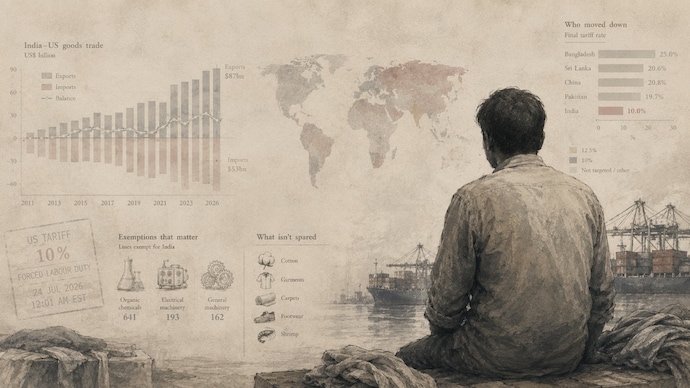
The American tariff that hits Indian goods this Friday looks new, but mostly isn't. The 10 per cent forced-labour duty takes effect at 12.01 am EST on July 24; the same moment, a temporary 10 per cent tariff on most imports expires. For the bulk of Indian exports, the rate barely moves. What changes is the law behind it: from an emergency power US courts have struck down to one that has survived their scrutiny.
India also came out of the process better than it feared.
The US Trade Representative had threatened 12.5 per cent in June. The final action set 10 per cent, making India one of only five economies where it was lowered. Counting every US tariff now in force, Indian goods face an effective rate of 11.7 per cent, the lowest in South Asia, well below Bangladesh's 25 per cent, Sri Lanka's 20.6 per cent, Pakistan's 19.7 per cent, and China's 20.8 per cent.
The relief stops at the goods that matter most to Indian workers. A tariff rate is only half of what an exporter pays; the other half is whether the product is exempt, and here the final action, signed on July 23, drew a sharp line. The general exemption list that applies to India runs to 2,113 product lines, but a single one of them is a textile. A separate list of 1,736 lines, almost all textiles, was written for Jordan, El Salvador, and Guatemala. India received no such list. Bangladesh did.
Cotton, garments, carpets, footwear and shrimp — the sectors that employ the most Indian workers — carry the full 10 per cent. All four South Asian economies in the investigation now sit in the lower tier: India and Sri Lanka were cut to 10 per cent, joining Bangladesh and Pakistan. But the carve-outs that decide who actually pays did not follow the rate.
Why India moved is not on the record. A US delegation was in New Delhi in early June to advance an interim trade agreement, and the lower tier rewards economies that commit to a forced-labour import ban through such a pact. But the United States Trade Representative has not linked the two, and a senior administration official who briefed reporters before the announcement confirmed only that India had secured 10 per cent instead of the threatened 12.5 per cent.
The USTR presents the outcome as pressure working. "President Trump recognises that decades of moral suasion have not eradicated forced labour from global supply chains," Jamieson Greer, the US trade representative, said, adding that the United States "has had a forced labour import ban for nearly a century, and rigorously enforces it; it's well past time for our trading partners to do the same." Greer said he was "encouraged by the trading partners who have moved quickly to adopt forced labour import prohibitions”.
The pattern of what is spared favours capital, not labour. On the list that covers India, organic chemicals carry 641 exempt lines, electrical machinery 193, general machinery 162. India's chemical and engineering exports are largely protected; its cotton, apparel, carpets, footwear and seafood are not.
The relief India lacks was written for others by name. Thirteen economies received their own country-specific exemption lists; India was not among them. Bangladesh, India's direct competitor in garments, received one running to 96 lines. It is also among four economies — with Cambodia, Indonesia, and Malaysia — for which the USTR will set tariff-rate quotas tied to how much American cotton and textile input each buys.
A tariff-rate quota lets a set quantity enter at a lower rate before the full duty applies. The mechanism steers those countries toward US cotton and away from suppliers the investigation flagged for forced labour, chief among them China. India was offered no such path.
The legal ground is contested. The Supreme Court struck down the administration's earlier tariffs in February, ordering roughly $160 billion refunded, according to the New York Times. The stopgap that followed, a 10 per cent global duty under Section 122 of the Trade Act, was itself struck down by the Court of International Trade in May and survives only on appeal. Section 301, the authority behind Friday's duties, is more tested, but has never been used across dozens of economies at once.
Critics call the labour rationale a cover. Peter Harrell, a Georgetown scholar and former Biden administration official, told the Times that the USTR was using the investigation "as a pretext to impose tariffs that Trump wants to impose for his own economic theories and preferences." India made its own objection on the record. At a USTR hearing on July 8, Brij Mohan Mishra, joint secretary in the commerce ministry, said the exemptions "not only undermine the policy rationale of addressing forced labour impact in the global supply chain but also of preventing such impact caused by circumvention practices."
More may be coming. The USTR has proposed a further round of Section 301 tariffs over manufacturing overcapacity that would stack on top of these. "Tonight's tariffs are more noise than shock," Olu Sonola, head of US economics at Fitch Ratings, said in a statement. "The real risk lies ahead."
For Indian exporters, the arithmetic is simple and awkward. The headline rate held, India's overall burden stayed the region's lowest, and yet a duty justified by labour abuses still lands the hardest on the goods that Indian labour makes.
The American tariff that hits Indian goods this Friday looks new, but mostly isn't. The 10 per cent forced-labour duty takes effect at 12.01 am EST on July 24; the same moment, a temporary 10 per cent tariff on most imports expires. For the bulk of Indian exports, the rate barely moves. What changes is the law behind it: from an emergency power US courts have struck down to one that has survived their scrutiny.
India also came out of the process better than it feared.
The US Trade Representative had threatened 12.5 per cent in June. The final action set 10 per cent, making India one of only five economies where it was lowered. Counting every US tariff now in force, Indian goods face an effective rate of 11.7 per cent, the lowest in South Asia, well below Bangladesh's 25 per cent, Sri Lanka's 20.6 per cent, Pakistan's 19.7 per cent, and China's 20.8 per cent.
The relief stops at the goods that matter most to Indian workers. A tariff rate is only half of what an exporter pays; the other half is whether the product is exempt, and here the final action, signed on July 23, drew a sharp line. The general exemption list that applies to India runs to 2,113 product lines, but a single one of them is a textile. A separate list of 1,736 lines, almost all textiles, was written for Jordan, El Salvador, and Guatemala. India received no such list. Bangladesh did.
Cotton, garments, carpets, footwear and shrimp — the sectors that employ the most Indian workers — carry the full 10 per cent. All four South Asian economies in the investigation now sit in the lower tier: India and Sri Lanka were cut to 10 per cent, joining Bangladesh and Pakistan. But the carve-outs that decide who actually pays did not follow the rate.
Why India moved is not on the record. A US delegation was in New Delhi in early June to advance an interim trade agreement, and the lower tier rewards economies that commit to a forced-labour import ban through such a pact. But the United States Trade Representative has not linked the two, and a senior administration official who briefed reporters before the announcement confirmed only that India had secured 10 per cent instead of the threatened 12.5 per cent.
The USTR presents the outcome as pressure working. "President Trump recognises that decades of moral suasion have not eradicated forced labour from global supply chains," Jamieson Greer, the US trade representative, said, adding that the United States "has had a forced labour import ban for nearly a century, and rigorously enforces it; it's well past time for our trading partners to do the same." Greer said he was "encouraged by the trading partners who have moved quickly to adopt forced labour import prohibitions”.
The pattern of what is spared favours capital, not labour. On the list that covers India, organic chemicals carry 641 exempt lines, electrical machinery 193, general machinery 162. India's chemical and engineering exports are largely protected; its cotton, apparel, carpets, footwear and seafood are not.
The relief India lacks was written for others by name. Thirteen economies received their own country-specific exemption lists; India was not among them. Bangladesh, India's direct competitor in garments, received one running to 96 lines. It is also among four economies — with Cambodia, Indonesia, and Malaysia — for which the USTR will set tariff-rate quotas tied to how much American cotton and textile input each buys.
A tariff-rate quota lets a set quantity enter at a lower rate before the full duty applies. The mechanism steers those countries toward US cotton and away from suppliers the investigation flagged for forced labour, chief among them China. India was offered no such path.
The legal ground is contested. The Supreme Court struck down the administration's earlier tariffs in February, ordering roughly $160 billion refunded, according to the New York Times. The stopgap that followed, a 10 per cent global duty under Section 122 of the Trade Act, was itself struck down by the Court of International Trade in May and survives only on appeal. Section 301, the authority behind Friday's duties, is more tested, but has never been used across dozens of economies at once.
Critics call the labour rationale a cover. Peter Harrell, a Georgetown scholar and former Biden administration official, told the Times that the USTR was using the investigation "as a pretext to impose tariffs that Trump wants to impose for his own economic theories and preferences." India made its own objection on the record. At a USTR hearing on July 8, Brij Mohan Mishra, joint secretary in the commerce ministry, said the exemptions "not only undermine the policy rationale of addressing forced labour impact in the global supply chain but also of preventing such impact caused by circumvention practices."
More may be coming. The USTR has proposed a further round of Section 301 tariffs over manufacturing overcapacity that would stack on top of these. "Tonight's tariffs are more noise than shock," Olu Sonola, head of US economics at Fitch Ratings, said in a statement. "The real risk lies ahead."
For Indian exporters, the arithmetic is simple and awkward. The headline rate held, India's overall burden stayed the region's lowest, and yet a duty justified by labour abuses still lands the hardest on the goods that Indian labour makes.
The American tariff that hits Indian goods this Friday looks new, but mostly isn't. The 10 per cent forced-labour duty takes effect at 12.01 am EST on July 24; the same moment, a temporary 10 per cent tariff on most imports expires. For the bulk of Indian exports, the rate barely moves. What changes is the law behind it: from an emergency power US courts have struck down to one that has survived their scrutiny.
India also came out of the process better than it feared.
The US Trade Representative had threatened 12.5 per cent in June. The final action set 10 per cent, making India one of only five economies where it was lowered. Counting every US tariff now in force, Indian goods face an effective rate of 11.7 per cent, the lowest in South Asia, well below Bangladesh's 25 per cent, Sri Lanka's 20.6 per cent, Pakistan's 19.7 per cent, and China's 20.8 per cent.
The relief stops at the goods that matter most to Indian workers. A tariff rate is only half of what an exporter pays; the other half is whether the product is exempt, and here the final action, signed on July 23, drew a sharp line. The general exemption list that applies to India runs to 2,113 product lines, but a single one of them is a textile. A separate list of 1,736 lines, almost all textiles, was written for Jordan, El Salvador, and Guatemala. India received no such list. Bangladesh did.
Cotton, garments, carpets, footwear and shrimp — the sectors that employ the most Indian workers — carry the full 10 per cent. All four South Asian economies in the investigation now sit in the lower tier: India and Sri Lanka were cut to 10 per cent, joining Bangladesh and Pakistan. But the carve-outs that decide who actually pays did not follow the rate.
Why India moved is not on the record. A US delegation was in New Delhi in early June to advance an interim trade agreement, and the lower tier rewards economies that commit to a forced-labour import ban through such a pact. But the United States Trade Representative has not linked the two, and a senior administration official who briefed reporters before the announcement confirmed only that India had secured 10 per cent instead of the threatened 12.5 per cent.
The USTR presents the outcome as pressure working. "President Trump recognises that decades of moral suasion have not eradicated forced labour from global supply chains," Jamieson Greer, the US trade representative, said, adding that the United States "has had a forced labour import ban for nearly a century, and rigorously enforces it; it's well past time for our trading partners to do the same." Greer said he was "encouraged by the trading partners who have moved quickly to adopt forced labour import prohibitions”.
The pattern of what is spared favours capital, not labour. On the list that covers India, organic chemicals carry 641 exempt lines, electrical machinery 193, general machinery 162. India's chemical and engineering exports are largely protected; its cotton, apparel, carpets, footwear and seafood are not.
The relief India lacks was written for others by name. Thirteen economies received their own country-specific exemption lists; India was not among them. Bangladesh, India's direct competitor in garments, received one running to 96 lines. It is also among four economies — with Cambodia, Indonesia, and Malaysia — for which the USTR will set tariff-rate quotas tied to how much American cotton and textile input each buys.
A tariff-rate quota lets a set quantity enter at a lower rate before the full duty applies. The mechanism steers those countries toward US cotton and away from suppliers the investigation flagged for forced labour, chief among them China. India was offered no such path.
The legal ground is contested. The Supreme Court struck down the administration's earlier tariffs in February, ordering roughly $160 billion refunded, according to the New York Times. The stopgap that followed, a 10 per cent global duty under Section 122 of the Trade Act, was itself struck down by the Court of International Trade in May and survives only on appeal. Section 301, the authority behind Friday's duties, is more tested, but has never been used across dozens of economies at once.
Critics call the labour rationale a cover. Peter Harrell, a Georgetown scholar and former Biden administration official, told the Times that the USTR was using the investigation "as a pretext to impose tariffs that Trump wants to impose for his own economic theories and preferences." India made its own objection on the record. At a USTR hearing on July 8, Brij Mohan Mishra, joint secretary in the commerce ministry, said the exemptions "not only undermine the policy rationale of addressing forced labour impact in the global supply chain but also of preventing such impact caused by circumvention practices."
More may be coming. The USTR has proposed a further round of Section 301 tariffs over manufacturing overcapacity that would stack on top of these. "Tonight's tariffs are more noise than shock," Olu Sonola, head of US economics at Fitch Ratings, said in a statement. "The real risk lies ahead."
For Indian exporters, the arithmetic is simple and awkward. The headline rate held, India's overall burden stayed the region's lowest, and yet a duty justified by labour abuses still lands the hardest on the goods that Indian labour makes.

