Saudi oil used Red Sea to bypass Hormuz. Now that route is blockaded
This is the first of a two-part story about how the war in West Asia has affected oil routes — again and again.
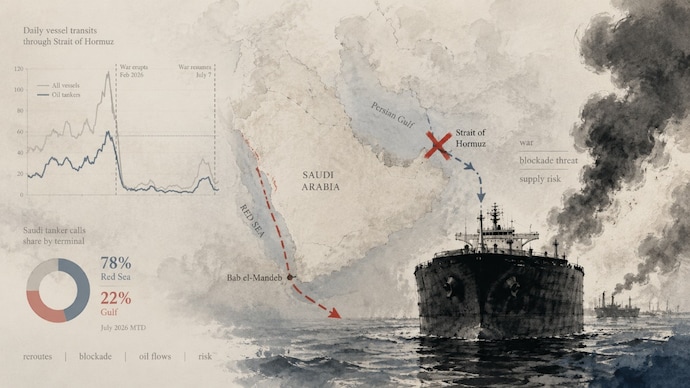
Saudi Arabia has spent the West Asia war moving its oil out the back door. Red Sea terminals now handle 78 per cent of the kingdom's tanker traffic, up from 43 per cent before the conflict began, according to the International Monetary Fund’s PortWatch. Calls at the Gulf terminals that must sail through the Strait of Hormuz have fallen by nearly two-thirds.
On July 20, Yemen's Iran-backed Houthi rebels declared a maritime blockade of Saudi Arabia and warned shipowners against calling at any Saudi port. The threat lands on the one route that has been working. Traffic through Bab el-Mandeb, at the mouth of the Red Sea, has climbed to 15.1 tankers a day in the week to July 19, up from 11.4 in 2025, as Saudi crude has been going that way.
Both of the kingdom's export routes are now compromised at once. Brent rose above $91 a barrel on Tuesday on the blockade threat, then eased below $88 as traders weighed a 10-day ceasefire proposed by Qatar, according to Rystad Energy, which reads the fall as diplomatic optimism rather than better supply.
THE SWITCH HAPPENED IN MARCH
The rerouting is not a response to Monday's threat. The war began at the end of February this year. Before it, the Gulf terminals at Ras Tanura, Juaymah, and Jubail handled 8.9 tanker calls a day between them. By March, that was 3.9, and it never recovered: since July 7, they have averaged 2.8, down 63 per cent from their 2025 norm.
The Red Sea moved the other way. Yanbu's King Fahd Port, outlet of the pipeline that carries crude across the peninsula from the eastern oilfields, has doubled its traffic to 6.5 calls a day against 3.3 in 2025. Rabigh is up 72 per cent and Jeddah 49 per cent. Together, the Red Sea terminals handle 10.7 calls a day against 6.1.
Independent ship-tracking says the same in volumes: Yanbu shipped four million barrels a day in recent weeks against about 973,000 a year earlier, nearly 2.5 million of it south through Bab el-Mandeb, where petroleum traffic rose to 7.4 million barrels a day in June from 4.2 million, according to Kpler and Signal Ocean data reported by Reuters.
That is the trade the Houthis have threatened.
THEY HAVE EMPTIED THIS SEA ONCE BEFORE
Houthi attacks from 2023 drove traffic through Bab el-Mandeb down from 73.7 vessels a day to 32.3 in 2024, a 56 per cent collapse that pushed operators around the Cape of Good Hope, adding about two weeks to an Asia-Europe voyage. Traffic never came back; what changed this year is the cargo mix, as Saudi barrels displaced from the Gulf took the western exit.
The group held its fire at sea for the first months of the US-Iran war. That ended in early July, when it sank two bulk carriers in quick succession, and struck a ship close to Yanbu.
WHAT WAS DECLARED, AND BY WHOM
"The Yemeni Armed Forces declare a maritime embargo against the criminal Saudi enemy, based on the equation of 'an eye for an eye,' effective immediately," Houthi spokesperson Yahya Saree said in a video posted on X. A separate message to shipowners warned all vessels against calling at Saudi ports.
The Saudi-led coalition in Yemen said it is taking steps to protect shipping in the area. The kingdom will take all necessary measures to protect vessels in accordance with international law, according to the Saudi Foreign Ministry.
The declaration ends a truce the Houthis had kept with Riyadh since 2022. It followed an exchange over airports: Yemen's Saudi-backed government struck the runway at Sanaa on July 13 to stop an Iranian flight landing with a Houthi delegation aboard, and the rebels, who blamed Riyadh, fired missiles at Abha airport.
HORMUZ IS SHUT IN ALL BUT NAME
The route the Saudis left with is not a viable one. An average of 3.9 oil tankers a day passed through the Strait of Hormuz in the week to July 19 against a 2025 norm of 51, a fall of 93 per cent. A week earlier it was 6.3. About a fifth of the world's traded oil normally moves along the 33-km-wide channel.
President Donald Trump ordered a two-week ceasefire on April 7, later extended, and signed a memorandum with Iran on 17 June under which Tehran was to arrange safe passage for commercial vessels out of the Gulf, according to his July 10 letter to Congress. Iran attacked several neutral-flagged ships in the strait on July 6 and 7, the letter says.
The US Navy-led Joint Maritime Information Centre raised its Hormuz threat level from "substantial" to "severe" on July 7 after three tankers were attacked in a day, among them the Qatari-owned LPG carrier Al Rekayyat and the Saudi-flagged Wedyan. Iran, estimated to have laid about 80 mines in the most-used channels, says vessels need its approval to pass.
TEN NIGHTS OF STRIKES
US Central Command said it completed another round of strikes at 9 pm Eastern time on July 20, the 10th consecutive night, hitting "Iranian military command centres, maritime capabilities, missile and drone launch sites, and air defence systems" to degrade Iran's ability to attack commercial shipping.
The conflict data show the tempo still rising. The Armed Conflict Location and Event Data Project has recorded 358 strikes across 172 locations in 10 countries since July 7, the date the President's letter gives for the resumption. In the seven days to July 21, there were 220, up 65 per cent on the 133 logged the week before, peaking at 40 on July 17.
US, Israeli, and allied forces launched 242 of those strikes at targets inside Iran. Iran and its allies launched 116 at Israel and the Gulf states, of which 60, or 52 per cent, were intercepted. ACLED records 70 confirmed deaths in the window, a minimum that will rise. The Pentagon says about 140 American troops have been wounded since July 7, a figure revised up from nearly 100, and three service members have been killed.
WHAT IS LEFT IF RED SEA CLOSES
Three routes carry Gulf oil past Hormuz: the Saudi pipeline to the Red Sea, the Emirati pipeline to Fujairah, and Oman's terminals, outside the strait altogether.
Oman's ports, shielded by geography and by Muscat's role as mediator, are the only ones holding steady, and they are small. Fujairah's fall overstates the change in pipeline crude, since the port is also the region's main refuelling stop. Of the alternatives to Hormuz, the Saudi Red Sea route carries the load, and it is the one now under threat.
A DECLARATION IS NOT A BLOCKADE
The shipping data cannot yet show what Monday's announcement does: PortWatch's port records run through July 17, three days before it. Whether owners stay away, and whether the Houthis can reach Yanbu, about 700km north of Bab el-Mandeb, will show up within days. The strike on a ship near Yanbu this month suggests the reach is not theoretical.
Diplomacy has not stopped either. Tehran says it has received new proposals from mediators even as the strikes continue, and Qatar has put a 10-day ceasefire on the table — the same sequence that produced the June memorandum, which lasted three weeks.
If the blockade holds, the kingdom loses the route carrying four-fifths of its tanker traffic while the other is still being fought over, and the pressure moves from freight rates to crude prices. If it does not, the Red Sea keeps absorbing the trade Hormuz can no longer carry.
Saudi Arabia has spent the West Asia war moving its oil out the back door. Red Sea terminals now handle 78 per cent of the kingdom's tanker traffic, up from 43 per cent before the conflict began, according to the International Monetary Fund’s PortWatch. Calls at the Gulf terminals that must sail through the Strait of Hormuz have fallen by nearly two-thirds.
On July 20, Yemen's Iran-backed Houthi rebels declared a maritime blockade of Saudi Arabia and warned shipowners against calling at any Saudi port. The threat lands on the one route that has been working. Traffic through Bab el-Mandeb, at the mouth of the Red Sea, has climbed to 15.1 tankers a day in the week to July 19, up from 11.4 in 2025, as Saudi crude has been going that way.
Both of the kingdom's export routes are now compromised at once. Brent rose above $91 a barrel on Tuesday on the blockade threat, then eased below $88 as traders weighed a 10-day ceasefire proposed by Qatar, according to Rystad Energy, which reads the fall as diplomatic optimism rather than better supply.
THE SWITCH HAPPENED IN MARCH
The rerouting is not a response to Monday's threat. The war began at the end of February this year. Before it, the Gulf terminals at Ras Tanura, Juaymah, and Jubail handled 8.9 tanker calls a day between them. By March, that was 3.9, and it never recovered: since July 7, they have averaged 2.8, down 63 per cent from their 2025 norm.
The Red Sea moved the other way. Yanbu's King Fahd Port, outlet of the pipeline that carries crude across the peninsula from the eastern oilfields, has doubled its traffic to 6.5 calls a day against 3.3 in 2025. Rabigh is up 72 per cent and Jeddah 49 per cent. Together, the Red Sea terminals handle 10.7 calls a day against 6.1.
Independent ship-tracking says the same in volumes: Yanbu shipped four million barrels a day in recent weeks against about 973,000 a year earlier, nearly 2.5 million of it south through Bab el-Mandeb, where petroleum traffic rose to 7.4 million barrels a day in June from 4.2 million, according to Kpler and Signal Ocean data reported by Reuters.
That is the trade the Houthis have threatened.
THEY HAVE EMPTIED THIS SEA ONCE BEFORE
Houthi attacks from 2023 drove traffic through Bab el-Mandeb down from 73.7 vessels a day to 32.3 in 2024, a 56 per cent collapse that pushed operators around the Cape of Good Hope, adding about two weeks to an Asia-Europe voyage. Traffic never came back; what changed this year is the cargo mix, as Saudi barrels displaced from the Gulf took the western exit.
The group held its fire at sea for the first months of the US-Iran war. That ended in early July, when it sank two bulk carriers in quick succession, and struck a ship close to Yanbu.
WHAT WAS DECLARED, AND BY WHOM
"The Yemeni Armed Forces declare a maritime embargo against the criminal Saudi enemy, based on the equation of 'an eye for an eye,' effective immediately," Houthi spokesperson Yahya Saree said in a video posted on X. A separate message to shipowners warned all vessels against calling at Saudi ports.
The Saudi-led coalition in Yemen said it is taking steps to protect shipping in the area. The kingdom will take all necessary measures to protect vessels in accordance with international law, according to the Saudi Foreign Ministry.
The declaration ends a truce the Houthis had kept with Riyadh since 2022. It followed an exchange over airports: Yemen's Saudi-backed government struck the runway at Sanaa on July 13 to stop an Iranian flight landing with a Houthi delegation aboard, and the rebels, who blamed Riyadh, fired missiles at Abha airport.
HORMUZ IS SHUT IN ALL BUT NAME
The route the Saudis left with is not a viable one. An average of 3.9 oil tankers a day passed through the Strait of Hormuz in the week to July 19 against a 2025 norm of 51, a fall of 93 per cent. A week earlier it was 6.3. About a fifth of the world's traded oil normally moves along the 33-km-wide channel.
President Donald Trump ordered a two-week ceasefire on April 7, later extended, and signed a memorandum with Iran on 17 June under which Tehran was to arrange safe passage for commercial vessels out of the Gulf, according to his July 10 letter to Congress. Iran attacked several neutral-flagged ships in the strait on July 6 and 7, the letter says.
The US Navy-led Joint Maritime Information Centre raised its Hormuz threat level from "substantial" to "severe" on July 7 after three tankers were attacked in a day, among them the Qatari-owned LPG carrier Al Rekayyat and the Saudi-flagged Wedyan. Iran, estimated to have laid about 80 mines in the most-used channels, says vessels need its approval to pass.
TEN NIGHTS OF STRIKES
US Central Command said it completed another round of strikes at 9 pm Eastern time on July 20, the 10th consecutive night, hitting "Iranian military command centres, maritime capabilities, missile and drone launch sites, and air defence systems" to degrade Iran's ability to attack commercial shipping.
The conflict data show the tempo still rising. The Armed Conflict Location and Event Data Project has recorded 358 strikes across 172 locations in 10 countries since July 7, the date the President's letter gives for the resumption. In the seven days to July 21, there were 220, up 65 per cent on the 133 logged the week before, peaking at 40 on July 17.
US, Israeli, and allied forces launched 242 of those strikes at targets inside Iran. Iran and its allies launched 116 at Israel and the Gulf states, of which 60, or 52 per cent, were intercepted. ACLED records 70 confirmed deaths in the window, a minimum that will rise. The Pentagon says about 140 American troops have been wounded since July 7, a figure revised up from nearly 100, and three service members have been killed.
WHAT IS LEFT IF RED SEA CLOSES
Three routes carry Gulf oil past Hormuz: the Saudi pipeline to the Red Sea, the Emirati pipeline to Fujairah, and Oman's terminals, outside the strait altogether.
Oman's ports, shielded by geography and by Muscat's role as mediator, are the only ones holding steady, and they are small. Fujairah's fall overstates the change in pipeline crude, since the port is also the region's main refuelling stop. Of the alternatives to Hormuz, the Saudi Red Sea route carries the load, and it is the one now under threat.
A DECLARATION IS NOT A BLOCKADE
The shipping data cannot yet show what Monday's announcement does: PortWatch's port records run through July 17, three days before it. Whether owners stay away, and whether the Houthis can reach Yanbu, about 700km north of Bab el-Mandeb, will show up within days. The strike on a ship near Yanbu this month suggests the reach is not theoretical.
Diplomacy has not stopped either. Tehran says it has received new proposals from mediators even as the strikes continue, and Qatar has put a 10-day ceasefire on the table — the same sequence that produced the June memorandum, which lasted three weeks.
If the blockade holds, the kingdom loses the route carrying four-fifths of its tanker traffic while the other is still being fought over, and the pressure moves from freight rates to crude prices. If it does not, the Red Sea keeps absorbing the trade Hormuz can no longer carry.
Saudi Arabia has spent the West Asia war moving its oil out the back door. Red Sea terminals now handle 78 per cent of the kingdom's tanker traffic, up from 43 per cent before the conflict began, according to the International Monetary Fund’s PortWatch. Calls at the Gulf terminals that must sail through the Strait of Hormuz have fallen by nearly two-thirds.
On July 20, Yemen's Iran-backed Houthi rebels declared a maritime blockade of Saudi Arabia and warned shipowners against calling at any Saudi port. The threat lands on the one route that has been working. Traffic through Bab el-Mandeb, at the mouth of the Red Sea, has climbed to 15.1 tankers a day in the week to July 19, up from 11.4 in 2025, as Saudi crude has been going that way.
Both of the kingdom's export routes are now compromised at once. Brent rose above $91 a barrel on Tuesday on the blockade threat, then eased below $88 as traders weighed a 10-day ceasefire proposed by Qatar, according to Rystad Energy, which reads the fall as diplomatic optimism rather than better supply.
THE SWITCH HAPPENED IN MARCH
The rerouting is not a response to Monday's threat. The war began at the end of February this year. Before it, the Gulf terminals at Ras Tanura, Juaymah, and Jubail handled 8.9 tanker calls a day between them. By March, that was 3.9, and it never recovered: since July 7, they have averaged 2.8, down 63 per cent from their 2025 norm.
The Red Sea moved the other way. Yanbu's King Fahd Port, outlet of the pipeline that carries crude across the peninsula from the eastern oilfields, has doubled its traffic to 6.5 calls a day against 3.3 in 2025. Rabigh is up 72 per cent and Jeddah 49 per cent. Together, the Red Sea terminals handle 10.7 calls a day against 6.1.
Independent ship-tracking says the same in volumes: Yanbu shipped four million barrels a day in recent weeks against about 973,000 a year earlier, nearly 2.5 million of it south through Bab el-Mandeb, where petroleum traffic rose to 7.4 million barrels a day in June from 4.2 million, according to Kpler and Signal Ocean data reported by Reuters.
That is the trade the Houthis have threatened.
THEY HAVE EMPTIED THIS SEA ONCE BEFORE
Houthi attacks from 2023 drove traffic through Bab el-Mandeb down from 73.7 vessels a day to 32.3 in 2024, a 56 per cent collapse that pushed operators around the Cape of Good Hope, adding about two weeks to an Asia-Europe voyage. Traffic never came back; what changed this year is the cargo mix, as Saudi barrels displaced from the Gulf took the western exit.
The group held its fire at sea for the first months of the US-Iran war. That ended in early July, when it sank two bulk carriers in quick succession, and struck a ship close to Yanbu.
WHAT WAS DECLARED, AND BY WHOM
"The Yemeni Armed Forces declare a maritime embargo against the criminal Saudi enemy, based on the equation of 'an eye for an eye,' effective immediately," Houthi spokesperson Yahya Saree said in a video posted on X. A separate message to shipowners warned all vessels against calling at Saudi ports.
The Saudi-led coalition in Yemen said it is taking steps to protect shipping in the area. The kingdom will take all necessary measures to protect vessels in accordance with international law, according to the Saudi Foreign Ministry.
The declaration ends a truce the Houthis had kept with Riyadh since 2022. It followed an exchange over airports: Yemen's Saudi-backed government struck the runway at Sanaa on July 13 to stop an Iranian flight landing with a Houthi delegation aboard, and the rebels, who blamed Riyadh, fired missiles at Abha airport.
HORMUZ IS SHUT IN ALL BUT NAME
The route the Saudis left with is not a viable one. An average of 3.9 oil tankers a day passed through the Strait of Hormuz in the week to July 19 against a 2025 norm of 51, a fall of 93 per cent. A week earlier it was 6.3. About a fifth of the world's traded oil normally moves along the 33-km-wide channel.
President Donald Trump ordered a two-week ceasefire on April 7, later extended, and signed a memorandum with Iran on 17 June under which Tehran was to arrange safe passage for commercial vessels out of the Gulf, according to his July 10 letter to Congress. Iran attacked several neutral-flagged ships in the strait on July 6 and 7, the letter says.
The US Navy-led Joint Maritime Information Centre raised its Hormuz threat level from "substantial" to "severe" on July 7 after three tankers were attacked in a day, among them the Qatari-owned LPG carrier Al Rekayyat and the Saudi-flagged Wedyan. Iran, estimated to have laid about 80 mines in the most-used channels, says vessels need its approval to pass.
TEN NIGHTS OF STRIKES
US Central Command said it completed another round of strikes at 9 pm Eastern time on July 20, the 10th consecutive night, hitting "Iranian military command centres, maritime capabilities, missile and drone launch sites, and air defence systems" to degrade Iran's ability to attack commercial shipping.
The conflict data show the tempo still rising. The Armed Conflict Location and Event Data Project has recorded 358 strikes across 172 locations in 10 countries since July 7, the date the President's letter gives for the resumption. In the seven days to July 21, there were 220, up 65 per cent on the 133 logged the week before, peaking at 40 on July 17.
US, Israeli, and allied forces launched 242 of those strikes at targets inside Iran. Iran and its allies launched 116 at Israel and the Gulf states, of which 60, or 52 per cent, were intercepted. ACLED records 70 confirmed deaths in the window, a minimum that will rise. The Pentagon says about 140 American troops have been wounded since July 7, a figure revised up from nearly 100, and three service members have been killed.
WHAT IS LEFT IF RED SEA CLOSES
Three routes carry Gulf oil past Hormuz: the Saudi pipeline to the Red Sea, the Emirati pipeline to Fujairah, and Oman's terminals, outside the strait altogether.
Oman's ports, shielded by geography and by Muscat's role as mediator, are the only ones holding steady, and they are small. Fujairah's fall overstates the change in pipeline crude, since the port is also the region's main refuelling stop. Of the alternatives to Hormuz, the Saudi Red Sea route carries the load, and it is the one now under threat.
A DECLARATION IS NOT A BLOCKADE
The shipping data cannot yet show what Monday's announcement does: PortWatch's port records run through July 17, three days before it. Whether owners stay away, and whether the Houthis can reach Yanbu, about 700km north of Bab el-Mandeb, will show up within days. The strike on a ship near Yanbu this month suggests the reach is not theoretical.
Diplomacy has not stopped either. Tehran says it has received new proposals from mediators even as the strikes continue, and Qatar has put a 10-day ceasefire on the table — the same sequence that produced the June memorandum, which lasted three weeks.
If the blockade holds, the kingdom loses the route carrying four-fifths of its tanker traffic while the other is still being fought over, and the pressure moves from freight rates to crude prices. If it does not, the Red Sea keeps absorbing the trade Hormuz can no longer carry.

