Are ITIs the new IITs? Why skilled trades may be safer than AI-hit tech jobs
As AI shakes tech and white-collar careers, World Youth Skills Day raises an uncomfortable question: should Indian students rethink the obsession with degrees and look at ITIs, electricians, mechanics and other skilled trades that still need human hands, physical presence and practical judgement in a rapidly changing job market?
For decades, Indian parents had one answer to the career question: IIT.
A good rank, a prestigious degree and, hopefully, a white-collar job.
But on World Youth Skills Day 2026, celebrated under the theme 'Skills for a Shared Future', an uncomfortable question is staring young Indians in the face: what if the safest job of the future is not sitting behind a laptop?
As AI shakes up tech careers and even highly educated professionals face an increasingly uncertain job market, an unlikely question is beginning to surface: Are ITIs the new IITs?
It may sound provocative. But look at where the job market is moving.
AI is changing the world of work at a speed that colleges are struggling to match. Tech companies are cutting jobs even as they invest heavily in AI, and the old promise that a computer science degree automatically leads to a stable career looks increasingly shaky.
Even IITians are not completely insulated. A prestigious degree may open the door, but it cannot guarantee that the job waiting on the other side will exist in the same form five years from now.
And this is where India's much-mocked ITI ecosystem suddenly becomes interesting.
THE JOBS AI STILL CANNOT DO WITH A LAPTOP
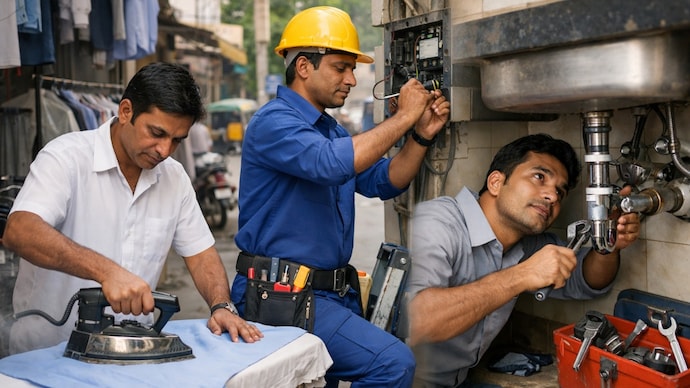
An electrician has to physically locate a fault. A mechanic has to listen to an engine that is behaving strangely. A plumber has to deal with the actual pipe in front of them. A technician has to repair a machine that may not be behaving exactly like the textbook says it should.
AI can assist these workers. It can offer instructions, diagnose patterns and improve efficiency.
But it cannot simply teleport into a broken transformer, crawl under a sink or repair a machine on a factory floor.
That physical, hands-on element is becoming a career advantage in an economy where many digital tasks are increasingly being automated.
India currently has 13,888 ITIs and more than 23.8 lakh ITI trainees, according to the Directorate General of Training. The country's designated trade apprenticeship system also has over 2.1 lakh apprentices listed on the DGT portal.
ITI IS NO LONGER JUST 'THE OPTION AFTER CLASS 10'
The biggest change may be happening inside the system itself.
Under PM SETU, the government is upgrading 1,000 government ITIs in a hub-and-spoke model. The plan includes modern laboratories, smart classrooms, digital content, industry-aligned courses and stronger links with employers. The scheme aims to skill 20 lakh young people over five years.
The message is clear: an ITI cannot train students on outdated equipment and then send them into a job market built around electric vehicles, advanced manufacturing, renewable energy and automation.
For a student, the pathway can also be much shorter than the traditional degree route. Trade requirements vary. Electrician is a two-year course requiring Class 10 with Science and Mathematics, while several trades such as plumber and welder can be entered after Class 8 in some ITIs.
After training, students can enter jobs, apprenticeships or continue building technical qualifications.
INDIA'S BIGGEST PROBLEM MAY BE OUR EGO
Here is the uncomfortable part that most of us don’t like to think about.
Many Indian families still hear 'ITI' and imagine a student who could not get into college. On the other hand, we hear 'engineer' and immediately think success.
But a degree is not a job. And a job title is not job security.
For years, blue-collar work has been treated as socially inferior to white-collar work. Parents would rather see their child struggle through an overcrowded degree than proudly say they are training to become an electrician, technician or mechanic.
That mindset is now becoming economically dangerous.
India needs people who can build, repair, install and maintain the physical systems behind its growth. A country cannot run on coders and managers alone.
So perhaps the IIT versus ITI debate is the wrong one.
India needs both. But in a shaky job market, students may need to stop asking which career looks more impressive and start asking a harder question: which skill will still be useful when the economy changes again?
The answer may not always lie in a classroom for four years.
Sometimes, it may be in a workshop, with a tool in hand.
India does not need to choose between IITs and ITIs. But it may finally need to stop treating one as the dream and the other as a fallback.
Because as AI increasingly writes code, analyses data and automates desk work, the person who can install, repair, maintain and operate the physical world may hold a very different kind of career advantage.
The future may not belong to ITIs instead of IITs.
But for the first time, it may be time to ask why we ever treated them as opposites.
For decades, Indian parents had one answer to the career question: IIT.
A good rank, a prestigious degree and, hopefully, a white-collar job.
But on World Youth Skills Day 2026, celebrated under the theme 'Skills for a Shared Future', an uncomfortable question is staring young Indians in the face: what if the safest job of the future is not sitting behind a laptop?
As AI shakes up tech careers and even highly educated professionals face an increasingly uncertain job market, an unlikely question is beginning to surface: Are ITIs the new IITs?
It may sound provocative. But look at where the job market is moving.
AI is changing the world of work at a speed that colleges are struggling to match. Tech companies are cutting jobs even as they invest heavily in AI, and the old promise that a computer science degree automatically leads to a stable career looks increasingly shaky.
Even IITians are not completely insulated. A prestigious degree may open the door, but it cannot guarantee that the job waiting on the other side will exist in the same form five years from now.
And this is where India's much-mocked ITI ecosystem suddenly becomes interesting.
THE JOBS AI STILL CANNOT DO WITH A LAPTOP
An electrician has to physically locate a fault. A mechanic has to listen to an engine that is behaving strangely. A plumber has to deal with the actual pipe in front of them. A technician has to repair a machine that may not be behaving exactly like the textbook says it should.
AI can assist these workers. It can offer instructions, diagnose patterns and improve efficiency.
But it cannot simply teleport into a broken transformer, crawl under a sink or repair a machine on a factory floor.
That physical, hands-on element is becoming a career advantage in an economy where many digital tasks are increasingly being automated.
India currently has 13,888 ITIs and more than 23.8 lakh ITI trainees, according to the Directorate General of Training. The country's designated trade apprenticeship system also has over 2.1 lakh apprentices listed on the DGT portal.
ITI IS NO LONGER JUST 'THE OPTION AFTER CLASS 10'
The biggest change may be happening inside the system itself.
Under PM SETU, the government is upgrading 1,000 government ITIs in a hub-and-spoke model. The plan includes modern laboratories, smart classrooms, digital content, industry-aligned courses and stronger links with employers. The scheme aims to skill 20 lakh young people over five years.
The message is clear: an ITI cannot train students on outdated equipment and then send them into a job market built around electric vehicles, advanced manufacturing, renewable energy and automation.
For a student, the pathway can also be much shorter than the traditional degree route. Trade requirements vary. Electrician is a two-year course requiring Class 10 with Science and Mathematics, while several trades such as plumber and welder can be entered after Class 8 in some ITIs.
After training, students can enter jobs, apprenticeships or continue building technical qualifications.
INDIA'S BIGGEST PROBLEM MAY BE OUR EGO
Here is the uncomfortable part that most of us don’t like to think about.
Many Indian families still hear 'ITI' and imagine a student who could not get into college. On the other hand, we hear 'engineer' and immediately think success.
But a degree is not a job. And a job title is not job security.
For years, blue-collar work has been treated as socially inferior to white-collar work. Parents would rather see their child struggle through an overcrowded degree than proudly say they are training to become an electrician, technician or mechanic.
That mindset is now becoming economically dangerous.
India needs people who can build, repair, install and maintain the physical systems behind its growth. A country cannot run on coders and managers alone.
So perhaps the IIT versus ITI debate is the wrong one.
India needs both. But in a shaky job market, students may need to stop asking which career looks more impressive and start asking a harder question: which skill will still be useful when the economy changes again?
The answer may not always lie in a classroom for four years.
Sometimes, it may be in a workshop, with a tool in hand.
India does not need to choose between IITs and ITIs. But it may finally need to stop treating one as the dream and the other as a fallback.
Because as AI increasingly writes code, analyses data and automates desk work, the person who can install, repair, maintain and operate the physical world may hold a very different kind of career advantage.
The future may not belong to ITIs instead of IITs.
But for the first time, it may be time to ask why we ever treated them as opposites.

