Two jobs, Rs 7 lakh salary and Rs 82 lakh savings: Inside India's moonlighting trend
A 29-year-old Indian techie earning Rs 7 lakh monthly through two full-time jobs says financial insecurity drives him, reflecting the growing trend of moonlighting among professionals seeking higher income and career security.
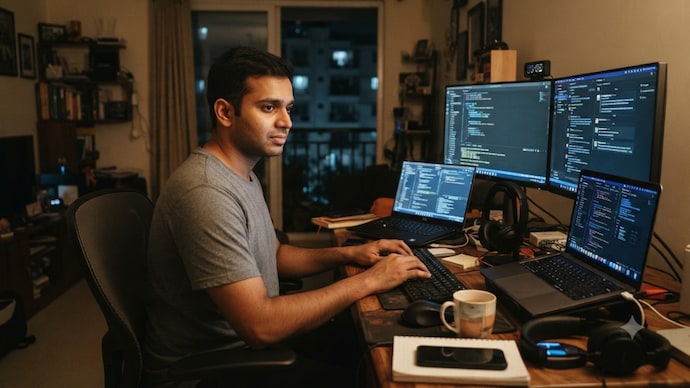
A 29-year-old Indian software engineer has revealed that he earns around 7 lakh a month by juggling two full-time IT jobs. Yet despite his high income, he says he constantly worries about financial security and the impact of artificial intelligence on future employment.
Speaking on the personal finance podcast Fix Your Finance, hosted by mutual fund adviser Anshuman Sharma, Rohit said he works nearly 16 hours a day, splitting his time between two companies, one during the day and another at night. One of the roles is with a US-based company.
"I'm working for two companies; one in the day and one at night," Rohit said.
Explaining why he continues with the demanding schedule, he said his family's financial struggles during childhood have left him determined to build a strong financial cushion.
During the conversation, Rohit also disclosed the extent of his savings and investments.
"My mutual funds crossed 70 lakh yesterday. I have around 2 lakh in the stock market and 10 lakh in fixed deposits," he said.
In total, he has accumulated savings of around 82 lakh. However, he expects his monthly expenses to rise significantly in the coming years. Once he takes possession of his flat, he estimates paying a 60,000 home loan EMI, along with a 28,000 car loan EMI, taking his projected monthly expenses to around 1.3 lakh-1.4 lakh.
MOONLIGHTING IS ON THE RISE
Rohit's story reflects a broader shift taking place in India's workforce. Once viewed as a controversial practice, moonlighting is increasingly becoming a way for professionals to boost their income, build new skills, and safeguard themselves against an uncertain job market.
Several workforce surveys and hiring reports suggest that nearly one in five Indian employees is interested in taking upside-down gigs alongside their primary job. Younger professionals, particularly Gen Z, are driving this trend, with surveys indicating that more than 70% believe moonlighting helps them enhance both their skills and earnings.
Industry reports tracking the technology and gig economy have also pointed to a 25–30% increase in moonlighting activity in recent years, fuelled by remote work, flexible employment, and growing access to global freelance opportunities.
Ground reports among technology professionals further indicate that a sizeable number have either moonlighted in the past or are currently working multiple jobs, suggesting that the practice is steadily moving from the margins to the mainstream.
HOW INDIA COMPARES WITH GLOBAL TRENDS
India is not alone in witnessing this shift. Across the world, the expansion of the gig economy, remote work, and rising living costs has encouraged more professionals to pursue multiple income streams.
Workforce researchers now describe moonlighting as a defining feature of the modern workplace, driven by digital platforms, flexible work arrangements, and the growing acceptance of portfolio careers.
In countries such as the US and across Europe, side hustles ranging from freelancing and consulting to content creation have become a routine part of professional life. India appears to be following a similar path, although many professionals here are motivated not just by additional income but also by career security and future-proofing their skills in an AI-driven economy.
As remote work continues to erase geographical boundaries and companies become increasingly global, moonlighting is evolving from an exception into a growing workplace reality for many Indian professionals.
A 29-year-old Indian software engineer has revealed that he earns around 7 lakh a month by juggling two full-time IT jobs. Yet despite his high income, he says he constantly worries about financial security and the impact of artificial intelligence on future employment.
Speaking on the personal finance podcast Fix Your Finance, hosted by mutual fund adviser Anshuman Sharma, Rohit said he works nearly 16 hours a day, splitting his time between two companies, one during the day and another at night. One of the roles is with a US-based company.
"I'm working for two companies; one in the day and one at night," Rohit said.
Explaining why he continues with the demanding schedule, he said his family's financial struggles during childhood have left him determined to build a strong financial cushion.
During the conversation, Rohit also disclosed the extent of his savings and investments.
"My mutual funds crossed 70 lakh yesterday. I have around 2 lakh in the stock market and 10 lakh in fixed deposits," he said.
In total, he has accumulated savings of around 82 lakh. However, he expects his monthly expenses to rise significantly in the coming years. Once he takes possession of his flat, he estimates paying a 60,000 home loan EMI, along with a 28,000 car loan EMI, taking his projected monthly expenses to around 1.3 lakh-1.4 lakh.
MOONLIGHTING IS ON THE RISE
Rohit's story reflects a broader shift taking place in India's workforce. Once viewed as a controversial practice, moonlighting is increasingly becoming a way for professionals to boost their income, build new skills, and safeguard themselves against an uncertain job market.
Several workforce surveys and hiring reports suggest that nearly one in five Indian employees is interested in taking upside-down gigs alongside their primary job. Younger professionals, particularly Gen Z, are driving this trend, with surveys indicating that more than 70% believe moonlighting helps them enhance both their skills and earnings.
Industry reports tracking the technology and gig economy have also pointed to a 25–30% increase in moonlighting activity in recent years, fuelled by remote work, flexible employment, and growing access to global freelance opportunities.
Ground reports among technology professionals further indicate that a sizeable number have either moonlighted in the past or are currently working multiple jobs, suggesting that the practice is steadily moving from the margins to the mainstream.
HOW INDIA COMPARES WITH GLOBAL TRENDS
India is not alone in witnessing this shift. Across the world, the expansion of the gig economy, remote work, and rising living costs has encouraged more professionals to pursue multiple income streams.
Workforce researchers now describe moonlighting as a defining feature of the modern workplace, driven by digital platforms, flexible work arrangements, and the growing acceptance of portfolio careers.
In countries such as the US and across Europe, side hustles ranging from freelancing and consulting to content creation have become a routine part of professional life. India appears to be following a similar path, although many professionals here are motivated not just by additional income but also by career security and future-proofing their skills in an AI-driven economy.
As remote work continues to erase geographical boundaries and companies become increasingly global, moonlighting is evolving from an exception into a growing workplace reality for many Indian professionals.

