When stoppage of Indus waters canal spooked Pakistan; Nehru called act inhuman
Nearly eight decades before the PM Narendra Modi-led government suspended the 1960s Indus Waters Treaty, the government of East Punjab in 1948 stopped the headworks at the Upper Bari Doab Canal, part of the Indus system. The crisis forced the architect of Pakistan, Muhammad Ali Jinnah, to negotiate with India.
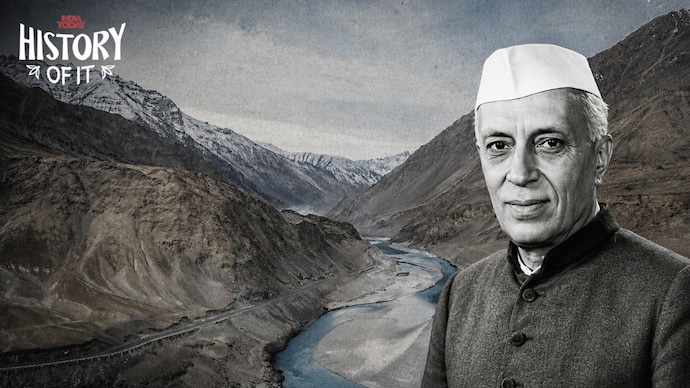
On the first morning of April 1948, the Upper Bari Doab Canal, which cut through Lahore, became a surface of cracked earth. The canal, which sustained the agricultural fields of Pakistani Punjab, had been shining with flowing water just days earlier. But, now the canal's bed had developed cracks as it baked under the relentless summer sun. Farmers watched helplessly as water disappeared from their channels. Engineers rushed upstream to understand why the lifeline of an entire region had suddenly been severed.
For 30 days, the government of East Punjab (led by CM Gopichand Bhargava) stopped the headworks at the Upper Bari Doab Canal, part of the Indus system. Barely eight months after the Partition, India and Pakistan stumbled into the modern world's first interstate water dispute. The violence of 1947 had divided Punjab, but the rivers and canals still flowed as a single interconnected system built during British rule. So, when the Bhargava government stopped the headworks, the government of newly independent Pakistan, led by Muhammad Ali Jinnah, was left panicking. More on that later.
When the boundary was drawn, India inherited the strategically crucial headworks at Madhopur and Ferozepur that regulated the flow of water into canals irrigating vast stretches of Pakistan's Punjab province. So, the Partition and geography, overnight, gave upstream nation India control over the taps that sustained nearly 5.5% of Pakistan's cultivated land in Punjab.
It is important to note that the move was not an "unambiguously national" action initiated by Prime Minister Jawaharlal Nehru or the Union government. The action was taken by the newly established province of Punjab, led by CM Bhargava. In fact, Nehru called the stoppage of water for agriculture "rather an inhuman act".
Nearly eight decades later, the battle for water between India and Pakistan has again acquired renewed relevance. This time, however, the scenario is different, and so are the stakeholders. Also, back then, the Indus Waters Treaty (IWT) hadn't come into effect, which India says disproportionately aided Pakistan, and gave the latter a bigger share of water from the five rivers of the Indus system.
After Pakistan-sponsored terrorists killed 26 civilians in Jammu and Kashmir's Pahalgam in April 2025, the Centre announced that it was keeping the IWT of 1960 in abeyance. The decision marked the first time New Delhi formally suspended cooperation under a treaty that had survived wars in 1965, 1971 and 1999, military standoffs, and decades of terror-backing by Islamabad.
After the IWT was put on hold, Pakistan has repeatedly appealed to India to restore the treaty. Islamabad has also warned of war against New Delhi and is also holding international conferences to reach out to the world, saying that millions depend on the waters of the Indus system.
While the IWT doesn't mean that New Delhi can turn the taps off for Islamabad, back in 1948, Pakistan experienced what it meant when water from upstream stopped flowing. It's perhaps Pakistan has still not forgotten the jitters from the late 1940s.
Now, let's dive into the story the right way. Here's what the situation was that forced the Bhargava government to stop the headworks at the Upper Bari Doab Canal. How was it done? How did Pakistan react? And why didn't it wage a war on India?
WHY EAST PUNJAB GOVT STOPPED CANAL WATER FOR PAKISTAN
According to an expert of transboundary rivers, Uttam Kumar Sinha, April 1, 1948 marked the first dispute over the Indus basin between two sovereign states. India possessed virtually every strategic advantage. The critical canal headworks that controlled irrigation supplies to West Punjab (In Pakistan) was inside Indian territory after the Partition, leaving Pakistan, the lower riparian state, acutely vulnerable.
In his book, Indus Basin Uninterrupted, Uttam Kumar Sinha noted that around 5.5% of Pakistan's cultivated land depended on these canals, making negotiations, rather than military confrontation, Islamabad's only realistic option.
The roots of this crisis lay in the hurried Partition of British India.
Partition had split Punjab into East Punjab in India and West Punjab in Pakistan, but the vast irrigation network built during British rule remained physically interconnected. To prevent chaos between the two states, engineers from both dominions signed a Standstill Agreement in December 1947, maintaining existing water supply arrangements until March 31, 1948. Meanwhile, it was devised that the political leaders would negotiate a permanent arrangement to manage the waters of the transboundary rivers.
But, the negotiations between the political leaders of both sides never happened.
When the Standstill Agreement expired, East Punjab declined to renew it. On April 1, East Punjab's government, headed by Chief Minister Gopichand Bhargava, stopped water flowing from the Ferozepur headworks into Pakistan's Dipalpur Canal and the main branch of the Upper Bari Doab Canal.
"...In the absence of an agreement and with no initiatives by West Punjab to enter into negotiations, India, now an independent country, in its interest, established legal rights to the waters flowing from its territory," Sinha wrote in his book.
Pakistan viewed the move very differently, and called it an act of "Machiavellian duplicity", Sinha noted.
"The world often looks at East Punjab's discontinuation of waters to the canals in West Punjab as Machiavellian duplicity or as a costless strategy," wrote Sinha in his book.
The disagreement evolved into a strategic, constitutional, and legal confrontation.
East Punjab's government maintained that sovereignty over territory also meant sovereignty over the waters originating within that territory. On the other hand, Pakistan claimed that irrigation rights established before Partition could not simply disappear because the political boundaries had shifted.
These two competing doctrines would dominate negotiations for the next twelve years before engineers, diplomats, and eventually the World Bank-brokered IWT in 1960.
This water stoppage by East Pakistan's government exposed Pakistan's strategic vulnerability almost overnight.
LAHORE'S CANAL TURNED DRY WHEN INDIA STOPPED PAK'S WATER
American historian David Gilmartin, in his book Blood and Water: The Indus River Basin in Modern History, wrote that the episode of water stoppage in East Punjab was a "national emergency" and a "national ordeal" in Pakistan.
"During the nearly five weeks without water, what should have been green fields had shimmered barrenly in the merciless sun. When water gurgled once again in the canal on May 5 (after the announcement of an Inter-Dominion conference to be held at Delhi to deal with the issue), Gilmartin, citing an editorial piece in the Pakistan Times, wrote in his book.
The editorial piece added that the effect of the move by East Punjab was seen "nowhere on more immediate display than in the Punjab provincial capital of Lahore," where the Lahore branch of the Upper Bari Doab canal "ran dry", noted Gilmartin.
Contemporary estimates cited by him suggested that nearly 5.5% of Pakistan's cropland stood at immediate risk, while economic losses were pegged at around two crore rupees (in that time's value).
The crisis also transformed water into a question of national survival for Pakistan.
The anxiety of water stoppage and understanding India's advantage in Indus waters made Pakistan in its Punjab province rapidly construct the Bambanwala-Ravi-Bedian-Dipalpur (BRBD) Link Canal. The major goal of this plan was to reduce dependence on Indian-controlled headworks. Thousands of volunteers joined construction efforts, which were portrayed as a "patriotic mission" to make Pakistan water-secure, according to Gilmartin's book.
Interestingly, now in 2026, after India kept the IWT in abeyance, Pakistan's military-civilian hybrid regime, which earlier inclined to adopt an Arabic identity, has also gone to the extent of claiming its Pre-Islamic roots. It's now invoking Indus Valley Civilisation and its Gandhara roots.
WHY JINNAH-LED PAKISTAN DIDN'T WAGE WAR AGAINST INDIA OVER WATER?
Pakistan's leadership, under its founder and first Governor-General Muhammad Ali Jinnah, recognised that war against India was not a viable option. This was because it was clear to the Pakistani regime that New Delhi's upstream geographical advantage meant any military escalation could have proved catastrophic for the newly created state. Months back, the Pakistan-backed mujaheedeens had invaded Kashmir in October 1947, which the Indian Army had repelled in a fierce counterattack.
While the East Punjab had decided to stop the flow of water, the Union government in New Delhi, led by PM Nehru, had a different view of what was done and what shouldn't have been done.
Nehru was "infuriated" with East Punjab's unilateral decision. In a letter to Bhargava on April 28, 1948, Nehru warned that "whatever the legal and technical merits may be, there is little doubt this act will injure us greatly in the world's eyes," noted Uttam Kumar Sinha wrote in his book, Indus Basin Uninterrupted.
Nehru even further wrote that stopping water for agriculture was "rather an inhuman act" and argued that such actions should occur only during an actual war.
For Nehru, the perspective was from New Delhi's lens. For him, as the Prime Minister, the issue carried diplomatic and moral implications. For East Punjab's political leadership, the calculation was shaped by local realities such as the Partition trauma, displaced communities, and the desire to establish control over resources lying within Indian borders.
WHY INDIA RESUMED WATER FLOW TO PAKISTAN AFTER FIVE WEEKS
After five weeks of the stoppage of the flow of water, it took an Inter-Dominion conference in New Delhi in May 1948, to end.
The Delhi Agreement signed during this conference restored water supplies and also introduced an idea that would later become the cornerstone of the Indus Waters Treaty.
India, under Nehru's leadership, assured Pakistan that it would not suddenly stop water again without allowing sufficient time to develop alternative sources. The principle of "replacement" was born, which later led India to pay $174 million ($1.6 billion today) to Pakistan as part of the IWT. This meant that "Pakistan would gradually build new infrastructure while India continued temporary supplies," Uttam Kumar Sinha wrote in his book.
Finally, India resumed the flow of water to Pakistan on May 5, 1948, exactly 35 days after Lahore's canals turned dry. This event was met with great excitement in Pakistan as water once again "flocked" to Pakistan, according to Gilmartin.
But the "residue of apprehension" in Pakistan profoundly influenced the IWT eventually signed in 1960 by the two neighbours.
HOW 1948 WATER STOPPAGE TO PAK LED TO SIGNING OF INDUS WATERS TREATY
It was the 1948 crisis that made Pakistan understand that physical dependence on Indian headworks had to end permanently, according to Sinha. It accelerated the construction of link canals, encouraged third-party mediation after bilateral talks repeatedly failed, and ultimately led to the functional division of the basin itself.
The IWT was signed on September 19, 1960, in Karachi by PM Jawaharlal Nehru and Pakistani President Ayub Khan. Under the treaty brokered by the World Bank, India received unrestricted rights over the eastern rivers like Ravi, Beas and Sutlej, while Pakistan secured the western rivers like the Indus, Jhelum and Chenab.
Rather than resolving competing legal claims, the treaty effectively engineered a "divorce settlement" of the river system, Sinha noted in his book.
For more than six decades, the engineering solution brokered by the President of the World Bank, Eugene Black, who was also one of the signatories of the treaty, between the two countries, proved durable even as it faced accusations of being unjust to India.
The treaty was intact because of India, and not Pakistan. Even after facing repeated backstabbing by Pakistan in the form of full-scale wars, insurgencies, and repeated terror attacks, India still abided by the rule on the grounds of humanity. The Indus Waters Treaty became one of the world's most enduring examples of transboundary water cooperation between hostile neighbours. But that changed as it had to.
When Pakistan first confronted reality, in 1948, the crisis produced one of the world's most enduring water-sharing agreements. But Pakistan couldn't keep itself away from the temptation of waging relentless terror on India. This is what led India to take a clear stance. "Blood and water cannot flow together."
On the first morning of April 1948, the Upper Bari Doab Canal, which cut through Lahore, became a surface of cracked earth. The canal, which sustained the agricultural fields of Pakistani Punjab, had been shining with flowing water just days earlier. But, now the canal's bed had developed cracks as it baked under the relentless summer sun. Farmers watched helplessly as water disappeared from their channels. Engineers rushed upstream to understand why the lifeline of an entire region had suddenly been severed.
For 30 days, the government of East Punjab (led by CM Gopichand Bhargava) stopped the headworks at the Upper Bari Doab Canal, part of the Indus system. Barely eight months after the Partition, India and Pakistan stumbled into the modern world's first interstate water dispute. The violence of 1947 had divided Punjab, but the rivers and canals still flowed as a single interconnected system built during British rule. So, when the Bhargava government stopped the headworks, the government of newly independent Pakistan, led by Muhammad Ali Jinnah, was left panicking. More on that later.
When the boundary was drawn, India inherited the strategically crucial headworks at Madhopur and Ferozepur that regulated the flow of water into canals irrigating vast stretches of Pakistan's Punjab province. So, the Partition and geography, overnight, gave upstream nation India control over the taps that sustained nearly 5.5% of Pakistan's cultivated land in Punjab.
It is important to note that the move was not an "unambiguously national" action initiated by Prime Minister Jawaharlal Nehru or the Union government. The action was taken by the newly established province of Punjab, led by CM Bhargava. In fact, Nehru called the stoppage of water for agriculture "rather an inhuman act".
Nearly eight decades later, the battle for water between India and Pakistan has again acquired renewed relevance. This time, however, the scenario is different, and so are the stakeholders. Also, back then, the Indus Waters Treaty (IWT) hadn't come into effect, which India says disproportionately aided Pakistan, and gave the latter a bigger share of water from the five rivers of the Indus system.
After Pakistan-sponsored terrorists killed 26 civilians in Jammu and Kashmir's Pahalgam in April 2025, the Centre announced that it was keeping the IWT of 1960 in abeyance. The decision marked the first time New Delhi formally suspended cooperation under a treaty that had survived wars in 1965, 1971 and 1999, military standoffs, and decades of terror-backing by Islamabad.
After the IWT was put on hold, Pakistan has repeatedly appealed to India to restore the treaty. Islamabad has also warned of war against New Delhi and is also holding international conferences to reach out to the world, saying that millions depend on the waters of the Indus system.
While the IWT doesn't mean that New Delhi can turn the taps off for Islamabad, back in 1948, Pakistan experienced what it meant when water from upstream stopped flowing. It's perhaps Pakistan has still not forgotten the jitters from the late 1940s.
Now, let's dive into the story the right way. Here's what the situation was that forced the Bhargava government to stop the headworks at the Upper Bari Doab Canal. How was it done? How did Pakistan react? And why didn't it wage a war on India?
WHY EAST PUNJAB GOVT STOPPED CANAL WATER FOR PAKISTAN
According to an expert of transboundary rivers, Uttam Kumar Sinha, April 1, 1948 marked the first dispute over the Indus basin between two sovereign states. India possessed virtually every strategic advantage. The critical canal headworks that controlled irrigation supplies to West Punjab (In Pakistan) was inside Indian territory after the Partition, leaving Pakistan, the lower riparian state, acutely vulnerable.
In his book, Indus Basin Uninterrupted, Uttam Kumar Sinha noted that around 5.5% of Pakistan's cultivated land depended on these canals, making negotiations, rather than military confrontation, Islamabad's only realistic option.
The roots of this crisis lay in the hurried Partition of British India.
Partition had split Punjab into East Punjab in India and West Punjab in Pakistan, but the vast irrigation network built during British rule remained physically interconnected. To prevent chaos between the two states, engineers from both dominions signed a Standstill Agreement in December 1947, maintaining existing water supply arrangements until March 31, 1948. Meanwhile, it was devised that the political leaders would negotiate a permanent arrangement to manage the waters of the transboundary rivers.
But, the negotiations between the political leaders of both sides never happened.
When the Standstill Agreement expired, East Punjab declined to renew it. On April 1, East Punjab's government, headed by Chief Minister Gopichand Bhargava, stopped water flowing from the Ferozepur headworks into Pakistan's Dipalpur Canal and the main branch of the Upper Bari Doab Canal.
"...In the absence of an agreement and with no initiatives by West Punjab to enter into negotiations, India, now an independent country, in its interest, established legal rights to the waters flowing from its territory," Sinha wrote in his book.
Pakistan viewed the move very differently, and called it an act of "Machiavellian duplicity", Sinha noted.
"The world often looks at East Punjab's discontinuation of waters to the canals in West Punjab as Machiavellian duplicity or as a costless strategy," wrote Sinha in his book.
The disagreement evolved into a strategic, constitutional, and legal confrontation.
East Punjab's government maintained that sovereignty over territory also meant sovereignty over the waters originating within that territory. On the other hand, Pakistan claimed that irrigation rights established before Partition could not simply disappear because the political boundaries had shifted.
These two competing doctrines would dominate negotiations for the next twelve years before engineers, diplomats, and eventually the World Bank-brokered IWT in 1960.
This water stoppage by East Pakistan's government exposed Pakistan's strategic vulnerability almost overnight.
LAHORE'S CANAL TURNED DRY WHEN INDIA STOPPED PAK'S WATER
American historian David Gilmartin, in his book Blood and Water: The Indus River Basin in Modern History, wrote that the episode of water stoppage in East Punjab was a "national emergency" and a "national ordeal" in Pakistan.
"During the nearly five weeks without water, what should have been green fields had shimmered barrenly in the merciless sun. When water gurgled once again in the canal on May 5 (after the announcement of an Inter-Dominion conference to be held at Delhi to deal with the issue), Gilmartin, citing an editorial piece in the Pakistan Times, wrote in his book.
The editorial piece added that the effect of the move by East Punjab was seen "nowhere on more immediate display than in the Punjab provincial capital of Lahore," where the Lahore branch of the Upper Bari Doab canal "ran dry", noted Gilmartin.
Contemporary estimates cited by him suggested that nearly 5.5% of Pakistan's cropland stood at immediate risk, while economic losses were pegged at around two crore rupees (in that time's value).
The crisis also transformed water into a question of national survival for Pakistan.
The anxiety of water stoppage and understanding India's advantage in Indus waters made Pakistan in its Punjab province rapidly construct the Bambanwala-Ravi-Bedian-Dipalpur (BRBD) Link Canal. The major goal of this plan was to reduce dependence on Indian-controlled headworks. Thousands of volunteers joined construction efforts, which were portrayed as a "patriotic mission" to make Pakistan water-secure, according to Gilmartin's book.
Interestingly, now in 2026, after India kept the IWT in abeyance, Pakistan's military-civilian hybrid regime, which earlier inclined to adopt an Arabic identity, has also gone to the extent of claiming its Pre-Islamic roots. It's now invoking Indus Valley Civilisation and its Gandhara roots.
WHY JINNAH-LED PAKISTAN DIDN'T WAGE WAR AGAINST INDIA OVER WATER?
Pakistan's leadership, under its founder and first Governor-General Muhammad Ali Jinnah, recognised that war against India was not a viable option. This was because it was clear to the Pakistani regime that New Delhi's upstream geographical advantage meant any military escalation could have proved catastrophic for the newly created state. Months back, the Pakistan-backed mujaheedeens had invaded Kashmir in October 1947, which the Indian Army had repelled in a fierce counterattack.
While the East Punjab had decided to stop the flow of water, the Union government in New Delhi, led by PM Nehru, had a different view of what was done and what shouldn't have been done.
Nehru was "infuriated" with East Punjab's unilateral decision. In a letter to Bhargava on April 28, 1948, Nehru warned that "whatever the legal and technical merits may be, there is little doubt this act will injure us greatly in the world's eyes," noted Uttam Kumar Sinha wrote in his book, Indus Basin Uninterrupted.
Nehru even further wrote that stopping water for agriculture was "rather an inhuman act" and argued that such actions should occur only during an actual war.
For Nehru, the perspective was from New Delhi's lens. For him, as the Prime Minister, the issue carried diplomatic and moral implications. For East Punjab's political leadership, the calculation was shaped by local realities such as the Partition trauma, displaced communities, and the desire to establish control over resources lying within Indian borders.
WHY INDIA RESUMED WATER FLOW TO PAKISTAN AFTER FIVE WEEKS
After five weeks of the stoppage of the flow of water, it took an Inter-Dominion conference in New Delhi in May 1948, to end.
The Delhi Agreement signed during this conference restored water supplies and also introduced an idea that would later become the cornerstone of the Indus Waters Treaty.
India, under Nehru's leadership, assured Pakistan that it would not suddenly stop water again without allowing sufficient time to develop alternative sources. The principle of "replacement" was born, which later led India to pay $174 million ($1.6 billion today) to Pakistan as part of the IWT. This meant that "Pakistan would gradually build new infrastructure while India continued temporary supplies," Uttam Kumar Sinha wrote in his book.
Finally, India resumed the flow of water to Pakistan on May 5, 1948, exactly 35 days after Lahore's canals turned dry. This event was met with great excitement in Pakistan as water once again "flocked" to Pakistan, according to Gilmartin.
But the "residue of apprehension" in Pakistan profoundly influenced the IWT eventually signed in 1960 by the two neighbours.
HOW 1948 WATER STOPPAGE TO PAK LED TO SIGNING OF INDUS WATERS TREATY
It was the 1948 crisis that made Pakistan understand that physical dependence on Indian headworks had to end permanently, according to Sinha. It accelerated the construction of link canals, encouraged third-party mediation after bilateral talks repeatedly failed, and ultimately led to the functional division of the basin itself.
The IWT was signed on September 19, 1960, in Karachi by PM Jawaharlal Nehru and Pakistani President Ayub Khan. Under the treaty brokered by the World Bank, India received unrestricted rights over the eastern rivers like Ravi, Beas and Sutlej, while Pakistan secured the western rivers like the Indus, Jhelum and Chenab.
Rather than resolving competing legal claims, the treaty effectively engineered a "divorce settlement" of the river system, Sinha noted in his book.
For more than six decades, the engineering solution brokered by the President of the World Bank, Eugene Black, who was also one of the signatories of the treaty, between the two countries, proved durable even as it faced accusations of being unjust to India.
The treaty was intact because of India, and not Pakistan. Even after facing repeated backstabbing by Pakistan in the form of full-scale wars, insurgencies, and repeated terror attacks, India still abided by the rule on the grounds of humanity. The Indus Waters Treaty became one of the world's most enduring examples of transboundary water cooperation between hostile neighbours. But that changed as it had to.
When Pakistan first confronted reality, in 1948, the crisis produced one of the world's most enduring water-sharing agreements. But Pakistan couldn't keep itself away from the temptation of waging relentless terror on India. This is what led India to take a clear stance. "Blood and water cannot flow together."

