After Pradhan, is Gadkari in the crosshairs as E20 protest loads in Delhi?
The protests over ethanol-blending were drowned out by the paper leak agitation that ended in Dharmendra Pradhan's resignation. Emboldened, E20 protesters are now planning a march to Parliament Street. A recent survey claims 60% of pre-2023 vehicle owners are facing issues.
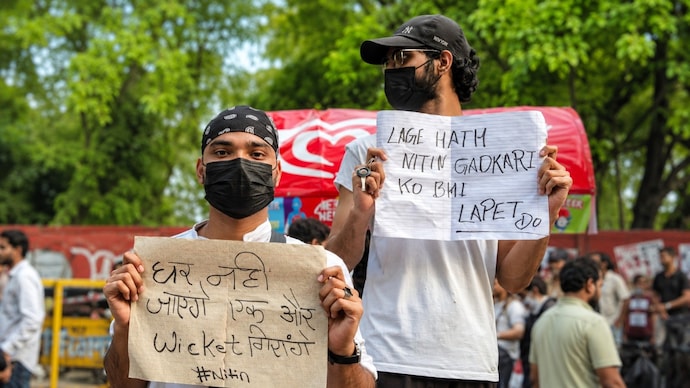
The resignation of Union Education Minister Dharmendra Pradhan might have brought the curtains down on the month-long Cockroach Janta Party (CJP) protests at New Delhi's Jantar Mantar, but it appears to have opened the door for the next agitation waiting in the wings. The protests were already on, but the NEET-UG paper leak agitation drowned it for a month. Now, it's back, and back with renewed spirit.
The sparks were visible even during the final days of the CJP's protest. The site at Jantar Mantar was no longer occupied solely by students demanding accountability and the resignation of Pradhan over the NEET controversy. One after another, activists and groups raised concerns ranging from women's reservation in Parliament and unemployment to an issue that until recently had largely remained confined to automobile forums and transport associations, the Centre's Ethanol Blended Petrol (EBP) programme.
With the CJP claiming victory after Pradhan's resignation on Saturday (July 25), activists opposing mandatory ethanol blending believe they have found both momentum and a template.
Their central demand is not the withdrawal of ethanol-blended fuel altogether. Instead, they want consumers to be given a choice — E20 for compatible vehicles, E10 for older compliant vehicles and pure petrol (E0) for those who prefer it.
Multiple signs indicate that the ethanol-blended petrol issue might only gather more steam in the coming days. An E20 Janta Party has come up on the lines of the Cockroach Janta Party. Team Bharat, led by activist Tehseen Poonawalla, has planned a march to Parliament Street on July 31. Delhi Taxi and Tourist Transporters and Tour Operators Association has announced a march to Parliament on the issue on August 4. This even as a survey by LocalCircles claims that 60% of pre-2023 vehicle owners are reporting a mileage-drop issue.
Aam Aadmi Party's (AAP) National Convener Arvind Kejriwal has also announced that the party would be holding a 'National Townhall Against E20' movement against the ethanol blending policy on August 1.
Protesters are seeking the resignations of Union Road Transport and Highways Minister Nitin Gadkari, who has become the face of the ethanol policy, and Petroleum and Natural Gas Minister Hardeep Singh Puri, under whom the policy is being initiated.
On Monday, Gadkari approached the Bombay High Court against alleged defamatory posts and deepfake content linking him and his family to profits from the E20 ethanol programme.
In his Opinion piece, our in-house columnist, Kamlesh Singh, wrote that the Millennials can't meme and shame like Gen Z does, and asked if the government will hear their ethanol pain.
NO END TO PROTESTS IN DELHI, ETHANOL ONES ARE READY
Many issue-based campaigns struggle to move beyond social media. The opposition to ethanol blending has already taken shape on the streets earlier. Now, after the CJP's success, there is growing confidence among the E20 protesters.
The first visible agitation took place on July 5 at Jantar Mantar, even as the CJP protest was ongoing. The demonstration was led by Team Bharat, demanding that the government make all policy documents related to the Ethanol Blended Petrol programme public and restore the availability of pure petrol.
Though attendance was sparse, the campaign could now escalate.
Team Bharat has announced 'The Gaadi March' near Parliament Street on July 31, while the Delhi Taxi and Tourist Transporters and Tour Operators Association has called for another march to Parliament on August 4, indicating that multiple organisations are converging on the same issue.
The transporters' association says operators from across the country have complained of declining mileage, rising maintenance costs and engine-performance issues after the introduction of E20 fuel.
Holding sugarcane stalks during a press conference on July 24 (Friday), association president Sanjay Samrat argued that many vehicles manufactured before 2015 were never designed to run on 20% ethanol blends.
"Transport operators and vehicle owners from different parts of the country have reported reduced fuel efficiency, higher maintenance costs, and concerns regarding engine performance after the introduction of E20 fuel. Many vehicles manufactured before 2015 are not designed for 20 percent ethanol blended petrol. This form of fuel is actually fit for new model vehicles," he said.
The association said it would also demand an independent scientific review of the ethanol blending policy involving transport operators, consumers, automobile manufacturers and technical experts.
SIX OUT OF TEN PRE-2023 VEHICLES FACE MILEAGE DROP: LOCALCIRCLES SURVEY
Fuel economy and maintenance have emerged as the biggest talking points for protesters as they plan a full-scale agitation.
A LocalCircles survey released on Sunday (July 26) found that more than a year after India achieved nationwide rollout of E20 petrol in April 2025, dissatisfaction among owners of older petrol vehicles remains widespread.
According to the survey of owners of pre-2023 petrol vehicles, 67% reported that fuel efficiency had fallen by more than 10% since early 2025. Around 45% said they had experienced unusually high wear and tear or increased repair requirements.
The survey also noted that these figures have remained virtually unchanged compared with the previous month (June), suggesting that the problems are becoming structural rather than temporary.
The findings of the survey have quickly become a rallying point for campaigners who argue that consumers were never adequately informed about the long-term implications of mandatory E20 availability.
Earlier, on July 17, LocalCircles published a survey report in which 45% of the vehicle owners who claimed that their vehicles had a mileage drop after using E20 petrol indicated they would take the legal route to get compensation for their loss.
The Centre has repeatedly maintained that E20 petrol is safe for use in all petrol vehicles, stating that extensive scientific studies, field validation and real-world operating data have found no evidence of widespread engine damage, abnormal wear or deterioration in vehicle performance due to the higher ethanol blend.
In a written reply in the Lok Sabha on July 23 (Thursday), Minister of State for Petroleum and Natural Gas Suresh Gopi said the Ethanol Blended Petrol Programme was implemented through a phased and scientifically validated process involving Niti Aayog, the Automotive Research Association of India (ARAI), the Society of Indian Automobile Manufacturers (SIAM), oil marketing companies (OMCs), automobile manufacturers and other technical institutions.
The government also added that it had not received any widespread or substantiated complaints from vehicle manufacturers, automobile associations or consumer organisations regarding E20 fuel in relation to fuel efficiency, engine performance, maintenance costs or the overall driving experience.
NITIN GADKARI MUST BE HELD ACCOUNTABLE, SAYS TEHSEEN POONAWALLA
Among the loudest voices against the policy has been Tehseen Poonawalla, who has directly questioned Nitin Gadkari over his earlier advocacy of ethanol blending.
"Many people are asking us why we are questioning Nitin Gadkari ji. He was lying that petrol would be available at Rs 15 per litre, but that's not happened, and he needs to be held accountable. Today he can't play the victim card and say I'm not the Petroleum Minister. Did Gadkari not know that he was not designated to make these big talks?" Poonawalla told India Today Digital.
Poonawalla said protesters were seeking Gadkari's resignation.
He also questioned the economics of the policy.
"Now the question is, we know that petrol costs India less than what ethanol costs. Petrol costs about Rs 50 to Rs 55 per litre and ethanol costs Rs 70 to Rs 72 per litre. Even if you assume petrol costs Rs 60 per litre after including cost and taxes, why are we forcefully blending ethanol and providing distilleries subsidies? This is the biggest scam in India, and that is why I'm questioning Nitin Gadkari," Poonawalla said.
He further alleged that coordinated online attacks were being launched against him over the campaign.
"These trends Nitin Gadkari or his team are doing against me must stop. I don't bother about whatever names and shame you do. Fact is we want accountability for ethanol and the documents of the policy must be made public," he told India Today Digital.
Poonwalla clarified that his campaign is not seeking a rollback of ethanol blending altogether.
"E10 should be available for cars and bikes that are compliant. Pure petrol must be available for less than Rs 100 per litre. These are our demands. We also need a solution for vehicles that are damaged," he added.
FOLLOWING THE CJP PATTERN, THE ENTRY OF E20 JANTA PARTY
The clearest sign that ethanol could become the next social-media-driven political issue is the emergence of another satirical online outfit modelled on the CJP phenomenon.
The E20 Janta Party, which traces its X account back to May 2024 but recently adopted its current name, has rapidly gained traction following the CJP campaign.
The account had gained more than 50,000 followers by Monday, and its Instagram page crossed 2,00,000 followers.
Like the CJP, the group employs satire and meme culture to amplify its message. But unlike the student-led movement against the Education Ministry, the E20 Janta Party says it is not demanding subsidies, free fuel or withdrawal of ethanol-blended petrol.
Instead, it says consumers should be free to choose between E20, E10 and pure petrol. It has also demanded the resignations of Union ministers Nitin Gadkari and Hardeep Singh Puri.
Motor enthusiast and member of Team Bharat Ratan Dhillon alleged that the E20 Janta Party is reportedly being "operated from Malaysia" and is "using our pictures just to chase views".
WILL ETHANOL ISSUE BECOME AS BIG AS PAPER LEAK PROTESTS?
The Centre has consistently defended the Ethanol Blended Petrol programme, describing it as a major step towards reducing India's dependence on imported crude oil, lowering vehicular emissions and boosting farmers' incomes by creating demand for sugarcane and other feedstocks.
E20 fuel is a blend of 20% ethanol and 80% petrol, and India achieved its nationwide E20 rollout in April 2025, five years ahead of its original target.
However, anti-ethanol activists argue that the transition has imposed costs on owners of older vehicles that were not engineered for higher ethanol blends. They point to lower mileage, increased maintenance, possible engine compatibility issues and concerns over the large quantities of water required for ethanol production.
Whether the ethanol campaign grows into a nationwide movement as it happened in the case of students remains uncertain.
But protesting outfits believe it touches a far larger constituency, millions of vehicle owners who buy petrol. The upcoming marches on July 31 and August 4 will test whether consumer grievances over fuel choice can translate into sustained street mobilisation.
If the CJP movement demonstrated that a social-media-led campaign can eventually force political concessions, those opposing mandatory ethanol blending now hope that the slogan has changed, but the playbook remains the same: organise online, occupy a protest site, march to Parliament and push for policy change. Their immediate demand is modest but politically significant. They are not demanding an end to ethanol blending, but the freedom to choose what goes into the fuel tank of their vehicles.
The resignation of Union Education Minister Dharmendra Pradhan might have brought the curtains down on the month-long Cockroach Janta Party (CJP) protests at New Delhi's Jantar Mantar, but it appears to have opened the door for the next agitation waiting in the wings. The protests were already on, but the NEET-UG paper leak agitation drowned it for a month. Now, it's back, and back with renewed spirit.
The sparks were visible even during the final days of the CJP's protest. The site at Jantar Mantar was no longer occupied solely by students demanding accountability and the resignation of Pradhan over the NEET controversy. One after another, activists and groups raised concerns ranging from women's reservation in Parliament and unemployment to an issue that until recently had largely remained confined to automobile forums and transport associations, the Centre's Ethanol Blended Petrol (EBP) programme.
With the CJP claiming victory after Pradhan's resignation on Saturday (July 25), activists opposing mandatory ethanol blending believe they have found both momentum and a template.
Their central demand is not the withdrawal of ethanol-blended fuel altogether. Instead, they want consumers to be given a choice — E20 for compatible vehicles, E10 for older compliant vehicles and pure petrol (E0) for those who prefer it.
Multiple signs indicate that the ethanol-blended petrol issue might only gather more steam in the coming days. An E20 Janta Party has come up on the lines of the Cockroach Janta Party. Team Bharat, led by activist Tehseen Poonawalla, has planned a march to Parliament Street on July 31. Delhi Taxi and Tourist Transporters and Tour Operators Association has announced a march to Parliament on the issue on August 4. This even as a survey by LocalCircles claims that 60% of pre-2023 vehicle owners are reporting a mileage-drop issue.
Aam Aadmi Party's (AAP) National Convener Arvind Kejriwal has also announced that the party would be holding a 'National Townhall Against E20' movement against the ethanol blending policy on August 1.
Protesters are seeking the resignations of Union Road Transport and Highways Minister Nitin Gadkari, who has become the face of the ethanol policy, and Petroleum and Natural Gas Minister Hardeep Singh Puri, under whom the policy is being initiated.
On Monday, Gadkari approached the Bombay High Court against alleged defamatory posts and deepfake content linking him and his family to profits from the E20 ethanol programme.
In his Opinion piece, our in-house columnist, Kamlesh Singh, wrote that the Millennials can't meme and shame like Gen Z does, and asked if the government will hear their ethanol pain.
NO END TO PROTESTS IN DELHI, ETHANOL ONES ARE READY
Many issue-based campaigns struggle to move beyond social media. The opposition to ethanol blending has already taken shape on the streets earlier. Now, after the CJP's success, there is growing confidence among the E20 protesters.
The first visible agitation took place on July 5 at Jantar Mantar, even as the CJP protest was ongoing. The demonstration was led by Team Bharat, demanding that the government make all policy documents related to the Ethanol Blended Petrol programme public and restore the availability of pure petrol.
Though attendance was sparse, the campaign could now escalate.
Team Bharat has announced 'The Gaadi March' near Parliament Street on July 31, while the Delhi Taxi and Tourist Transporters and Tour Operators Association has called for another march to Parliament on August 4, indicating that multiple organisations are converging on the same issue.
The transporters' association says operators from across the country have complained of declining mileage, rising maintenance costs and engine-performance issues after the introduction of E20 fuel.
Holding sugarcane stalks during a press conference on July 24 (Friday), association president Sanjay Samrat argued that many vehicles manufactured before 2015 were never designed to run on 20% ethanol blends.
"Transport operators and vehicle owners from different parts of the country have reported reduced fuel efficiency, higher maintenance costs, and concerns regarding engine performance after the introduction of E20 fuel. Many vehicles manufactured before 2015 are not designed for 20 percent ethanol blended petrol. This form of fuel is actually fit for new model vehicles," he said.
The association said it would also demand an independent scientific review of the ethanol blending policy involving transport operators, consumers, automobile manufacturers and technical experts.
SIX OUT OF TEN PRE-2023 VEHICLES FACE MILEAGE DROP: LOCALCIRCLES SURVEY
Fuel economy and maintenance have emerged as the biggest talking points for protesters as they plan a full-scale agitation.
A LocalCircles survey released on Sunday (July 26) found that more than a year after India achieved nationwide rollout of E20 petrol in April 2025, dissatisfaction among owners of older petrol vehicles remains widespread.
According to the survey of owners of pre-2023 petrol vehicles, 67% reported that fuel efficiency had fallen by more than 10% since early 2025. Around 45% said they had experienced unusually high wear and tear or increased repair requirements.
The survey also noted that these figures have remained virtually unchanged compared with the previous month (June), suggesting that the problems are becoming structural rather than temporary.
The findings of the survey have quickly become a rallying point for campaigners who argue that consumers were never adequately informed about the long-term implications of mandatory E20 availability.
Earlier, on July 17, LocalCircles published a survey report in which 45% of the vehicle owners who claimed that their vehicles had a mileage drop after using E20 petrol indicated they would take the legal route to get compensation for their loss.
The Centre has repeatedly maintained that E20 petrol is safe for use in all petrol vehicles, stating that extensive scientific studies, field validation and real-world operating data have found no evidence of widespread engine damage, abnormal wear or deterioration in vehicle performance due to the higher ethanol blend.
In a written reply in the Lok Sabha on July 23 (Thursday), Minister of State for Petroleum and Natural Gas Suresh Gopi said the Ethanol Blended Petrol Programme was implemented through a phased and scientifically validated process involving Niti Aayog, the Automotive Research Association of India (ARAI), the Society of Indian Automobile Manufacturers (SIAM), oil marketing companies (OMCs), automobile manufacturers and other technical institutions.
The government also added that it had not received any widespread or substantiated complaints from vehicle manufacturers, automobile associations or consumer organisations regarding E20 fuel in relation to fuel efficiency, engine performance, maintenance costs or the overall driving experience.
NITIN GADKARI MUST BE HELD ACCOUNTABLE, SAYS TEHSEEN POONAWALLA
Among the loudest voices against the policy has been Tehseen Poonawalla, who has directly questioned Nitin Gadkari over his earlier advocacy of ethanol blending.
"Many people are asking us why we are questioning Nitin Gadkari ji. He was lying that petrol would be available at Rs 15 per litre, but that's not happened, and he needs to be held accountable. Today he can't play the victim card and say I'm not the Petroleum Minister. Did Gadkari not know that he was not designated to make these big talks?" Poonawalla told India Today Digital.
Poonawalla said protesters were seeking Gadkari's resignation.
He also questioned the economics of the policy.
"Now the question is, we know that petrol costs India less than what ethanol costs. Petrol costs about Rs 50 to Rs 55 per litre and ethanol costs Rs 70 to Rs 72 per litre. Even if you assume petrol costs Rs 60 per litre after including cost and taxes, why are we forcefully blending ethanol and providing distilleries subsidies? This is the biggest scam in India, and that is why I'm questioning Nitin Gadkari," Poonawalla said.
He further alleged that coordinated online attacks were being launched against him over the campaign.
"These trends Nitin Gadkari or his team are doing against me must stop. I don't bother about whatever names and shame you do. Fact is we want accountability for ethanol and the documents of the policy must be made public," he told India Today Digital.
Poonwalla clarified that his campaign is not seeking a rollback of ethanol blending altogether.
"E10 should be available for cars and bikes that are compliant. Pure petrol must be available for less than Rs 100 per litre. These are our demands. We also need a solution for vehicles that are damaged," he added.
FOLLOWING THE CJP PATTERN, THE ENTRY OF E20 JANTA PARTY
The clearest sign that ethanol could become the next social-media-driven political issue is the emergence of another satirical online outfit modelled on the CJP phenomenon.
The E20 Janta Party, which traces its X account back to May 2024 but recently adopted its current name, has rapidly gained traction following the CJP campaign.
The account had gained more than 50,000 followers by Monday, and its Instagram page crossed 2,00,000 followers.
Like the CJP, the group employs satire and meme culture to amplify its message. But unlike the student-led movement against the Education Ministry, the E20 Janta Party says it is not demanding subsidies, free fuel or withdrawal of ethanol-blended petrol.
Instead, it says consumers should be free to choose between E20, E10 and pure petrol. It has also demanded the resignations of Union ministers Nitin Gadkari and Hardeep Singh Puri.
Motor enthusiast and member of Team Bharat Ratan Dhillon alleged that the E20 Janta Party is reportedly being "operated from Malaysia" and is "using our pictures just to chase views".
WILL ETHANOL ISSUE BECOME AS BIG AS PAPER LEAK PROTESTS?
The Centre has consistently defended the Ethanol Blended Petrol programme, describing it as a major step towards reducing India's dependence on imported crude oil, lowering vehicular emissions and boosting farmers' incomes by creating demand for sugarcane and other feedstocks.
E20 fuel is a blend of 20% ethanol and 80% petrol, and India achieved its nationwide E20 rollout in April 2025, five years ahead of its original target.
However, anti-ethanol activists argue that the transition has imposed costs on owners of older vehicles that were not engineered for higher ethanol blends. They point to lower mileage, increased maintenance, possible engine compatibility issues and concerns over the large quantities of water required for ethanol production.
Whether the ethanol campaign grows into a nationwide movement as it happened in the case of students remains uncertain.
But protesting outfits believe it touches a far larger constituency, millions of vehicle owners who buy petrol. The upcoming marches on July 31 and August 4 will test whether consumer grievances over fuel choice can translate into sustained street mobilisation.
If the CJP movement demonstrated that a social-media-led campaign can eventually force political concessions, those opposing mandatory ethanol blending now hope that the slogan has changed, but the playbook remains the same: organise online, occupy a protest site, march to Parliament and push for policy change. Their immediate demand is modest but politically significant. They are not demanding an end to ethanol blending, but the freedom to choose what goes into the fuel tank of their vehicles.
The resignation of Union Education Minister Dharmendra Pradhan might have brought the curtains down on the month-long Cockroach Janta Party (CJP) protests at New Delhi's Jantar Mantar, but it appears to have opened the door for the next agitation waiting in the wings. The protests were already on, but the NEET-UG paper leak agitation drowned it for a month. Now, it's back, and back with renewed spirit.
The sparks were visible even during the final days of the CJP's protest. The site at Jantar Mantar was no longer occupied solely by students demanding accountability and the resignation of Pradhan over the NEET controversy. One after another, activists and groups raised concerns ranging from women's reservation in Parliament and unemployment to an issue that until recently had largely remained confined to automobile forums and transport associations, the Centre's Ethanol Blended Petrol (EBP) programme.
With the CJP claiming victory after Pradhan's resignation on Saturday (July 25), activists opposing mandatory ethanol blending believe they have found both momentum and a template.
Their central demand is not the withdrawal of ethanol-blended fuel altogether. Instead, they want consumers to be given a choice — E20 for compatible vehicles, E10 for older compliant vehicles and pure petrol (E0) for those who prefer it.
Multiple signs indicate that the ethanol-blended petrol issue might only gather more steam in the coming days. An E20 Janta Party has come up on the lines of the Cockroach Janta Party. Team Bharat, led by activist Tehseen Poonawalla, has planned a march to Parliament Street on July 31. Delhi Taxi and Tourist Transporters and Tour Operators Association has announced a march to Parliament on the issue on August 4. This even as a survey by LocalCircles claims that 60% of pre-2023 vehicle owners are reporting a mileage-drop issue.
Aam Aadmi Party's (AAP) National Convener Arvind Kejriwal has also announced that the party would be holding a 'National Townhall Against E20' movement against the ethanol blending policy on August 1.
Protesters are seeking the resignations of Union Road Transport and Highways Minister Nitin Gadkari, who has become the face of the ethanol policy, and Petroleum and Natural Gas Minister Hardeep Singh Puri, under whom the policy is being initiated.
On Monday, Gadkari approached the Bombay High Court against alleged defamatory posts and deepfake content linking him and his family to profits from the E20 ethanol programme.
In his Opinion piece, our in-house columnist, Kamlesh Singh, wrote that the Millennials can't meme and shame like Gen Z does, and asked if the government will hear their ethanol pain.
NO END TO PROTESTS IN DELHI, ETHANOL ONES ARE READY
Many issue-based campaigns struggle to move beyond social media. The opposition to ethanol blending has already taken shape on the streets earlier. Now, after the CJP's success, there is growing confidence among the E20 protesters.
The first visible agitation took place on July 5 at Jantar Mantar, even as the CJP protest was ongoing. The demonstration was led by Team Bharat, demanding that the government make all policy documents related to the Ethanol Blended Petrol programme public and restore the availability of pure petrol.
Though attendance was sparse, the campaign could now escalate.
Team Bharat has announced 'The Gaadi March' near Parliament Street on July 31, while the Delhi Taxi and Tourist Transporters and Tour Operators Association has called for another march to Parliament on August 4, indicating that multiple organisations are converging on the same issue.
The transporters' association says operators from across the country have complained of declining mileage, rising maintenance costs and engine-performance issues after the introduction of E20 fuel.
Holding sugarcane stalks during a press conference on July 24 (Friday), association president Sanjay Samrat argued that many vehicles manufactured before 2015 were never designed to run on 20% ethanol blends.
"Transport operators and vehicle owners from different parts of the country have reported reduced fuel efficiency, higher maintenance costs, and concerns regarding engine performance after the introduction of E20 fuel. Many vehicles manufactured before 2015 are not designed for 20 percent ethanol blended petrol. This form of fuel is actually fit for new model vehicles," he said.
The association said it would also demand an independent scientific review of the ethanol blending policy involving transport operators, consumers, automobile manufacturers and technical experts.
SIX OUT OF TEN PRE-2023 VEHICLES FACE MILEAGE DROP: LOCALCIRCLES SURVEY
Fuel economy and maintenance have emerged as the biggest talking points for protesters as they plan a full-scale agitation.
A LocalCircles survey released on Sunday (July 26) found that more than a year after India achieved nationwide rollout of E20 petrol in April 2025, dissatisfaction among owners of older petrol vehicles remains widespread.
According to the survey of owners of pre-2023 petrol vehicles, 67% reported that fuel efficiency had fallen by more than 10% since early 2025. Around 45% said they had experienced unusually high wear and tear or increased repair requirements.
The survey also noted that these figures have remained virtually unchanged compared with the previous month (June), suggesting that the problems are becoming structural rather than temporary.
The findings of the survey have quickly become a rallying point for campaigners who argue that consumers were never adequately informed about the long-term implications of mandatory E20 availability.
Earlier, on July 17, LocalCircles published a survey report in which 45% of the vehicle owners who claimed that their vehicles had a mileage drop after using E20 petrol indicated they would take the legal route to get compensation for their loss.
The Centre has repeatedly maintained that E20 petrol is safe for use in all petrol vehicles, stating that extensive scientific studies, field validation and real-world operating data have found no evidence of widespread engine damage, abnormal wear or deterioration in vehicle performance due to the higher ethanol blend.
In a written reply in the Lok Sabha on July 23 (Thursday), Minister of State for Petroleum and Natural Gas Suresh Gopi said the Ethanol Blended Petrol Programme was implemented through a phased and scientifically validated process involving Niti Aayog, the Automotive Research Association of India (ARAI), the Society of Indian Automobile Manufacturers (SIAM), oil marketing companies (OMCs), automobile manufacturers and other technical institutions.
The government also added that it had not received any widespread or substantiated complaints from vehicle manufacturers, automobile associations or consumer organisations regarding E20 fuel in relation to fuel efficiency, engine performance, maintenance costs or the overall driving experience.
NITIN GADKARI MUST BE HELD ACCOUNTABLE, SAYS TEHSEEN POONAWALLA
Among the loudest voices against the policy has been Tehseen Poonawalla, who has directly questioned Nitin Gadkari over his earlier advocacy of ethanol blending.
"Many people are asking us why we are questioning Nitin Gadkari ji. He was lying that petrol would be available at Rs 15 per litre, but that's not happened, and he needs to be held accountable. Today he can't play the victim card and say I'm not the Petroleum Minister. Did Gadkari not know that he was not designated to make these big talks?" Poonawalla told India Today Digital.
Poonawalla said protesters were seeking Gadkari's resignation.
He also questioned the economics of the policy.
"Now the question is, we know that petrol costs India less than what ethanol costs. Petrol costs about Rs 50 to Rs 55 per litre and ethanol costs Rs 70 to Rs 72 per litre. Even if you assume petrol costs Rs 60 per litre after including cost and taxes, why are we forcefully blending ethanol and providing distilleries subsidies? This is the biggest scam in India, and that is why I'm questioning Nitin Gadkari," Poonawalla said.
He further alleged that coordinated online attacks were being launched against him over the campaign.
"These trends Nitin Gadkari or his team are doing against me must stop. I don't bother about whatever names and shame you do. Fact is we want accountability for ethanol and the documents of the policy must be made public," he told India Today Digital.
Poonwalla clarified that his campaign is not seeking a rollback of ethanol blending altogether.
"E10 should be available for cars and bikes that are compliant. Pure petrol must be available for less than Rs 100 per litre. These are our demands. We also need a solution for vehicles that are damaged," he added.
FOLLOWING THE CJP PATTERN, THE ENTRY OF E20 JANTA PARTY
The clearest sign that ethanol could become the next social-media-driven political issue is the emergence of another satirical online outfit modelled on the CJP phenomenon.
The E20 Janta Party, which traces its X account back to May 2024 but recently adopted its current name, has rapidly gained traction following the CJP campaign.
The account had gained more than 50,000 followers by Monday, and its Instagram page crossed 2,00,000 followers.
Like the CJP, the group employs satire and meme culture to amplify its message. But unlike the student-led movement against the Education Ministry, the E20 Janta Party says it is not demanding subsidies, free fuel or withdrawal of ethanol-blended petrol.
Instead, it says consumers should be free to choose between E20, E10 and pure petrol. It has also demanded the resignations of Union ministers Nitin Gadkari and Hardeep Singh Puri.
Motor enthusiast and member of Team Bharat Ratan Dhillon alleged that the E20 Janta Party is reportedly being "operated from Malaysia" and is "using our pictures just to chase views".
WILL ETHANOL ISSUE BECOME AS BIG AS PAPER LEAK PROTESTS?
The Centre has consistently defended the Ethanol Blended Petrol programme, describing it as a major step towards reducing India's dependence on imported crude oil, lowering vehicular emissions and boosting farmers' incomes by creating demand for sugarcane and other feedstocks.
E20 fuel is a blend of 20% ethanol and 80% petrol, and India achieved its nationwide E20 rollout in April 2025, five years ahead of its original target.
However, anti-ethanol activists argue that the transition has imposed costs on owners of older vehicles that were not engineered for higher ethanol blends. They point to lower mileage, increased maintenance, possible engine compatibility issues and concerns over the large quantities of water required for ethanol production.
Whether the ethanol campaign grows into a nationwide movement as it happened in the case of students remains uncertain.
But protesting outfits believe it touches a far larger constituency, millions of vehicle owners who buy petrol. The upcoming marches on July 31 and August 4 will test whether consumer grievances over fuel choice can translate into sustained street mobilisation.
If the CJP movement demonstrated that a social-media-led campaign can eventually force political concessions, those opposing mandatory ethanol blending now hope that the slogan has changed, but the playbook remains the same: organise online, occupy a protest site, march to Parliament and push for policy change. Their immediate demand is modest but politically significant. They are not demanding an end to ethanol blending, but the freedom to choose what goes into the fuel tank of their vehicles.

