Hero or headache? How Indian employers view Gen Z's protest culture
Young protesters marched against an education system they felt failed them, then returned to offices. Some were welcomed, some were not. Their activism has sparked a new workplace debate: Where should employer authority end, and where do an employee's constitutional rights as a citizen begin?
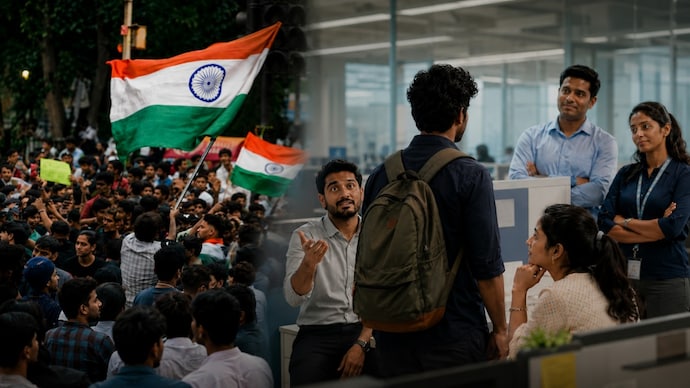


Every protest has two endings. The first ends when the slogans die down, the police barricades disappear and the last water bottle is picked up from the road. The second begins at 9 am the next morning.
That is when the software developer opens Microsoft Teams and notices colleagues asking, "So... did Parliament listen?" That is when the marketing executive finds a manager waiting with a stiff upper lip which feels like a warning is coming your way.
For weeks, thousands of students and young professionals poured into Delhi's Jantar Mantar demanding an overhaul of India's examination system. They came carrying placards, sleeping bags, umbrellas and hope. Many took leave from work, others travelled across the states believing that standing on the street was as important as sitting for an exam.
The protest ended, and life moved on. Monday morning arrived with attendance sheets, appraisal meetings, client presentations and semester lectures.
Some returned as heroes, some returned as troublemakers. Most returned wondering whether they had unknowingly carried the protest inside the office.
"My manager didn't ask how the protest went. He simply smiled and said, 'Back from changing the country?' Everyone laughed. I laughed too. But I knew the joke was really about me," says Deepali Kapoor, an employee at an advertising agency in Gurugram.
A Reddit user had posted a question online enquiring if it was legal for an employer to fire an employee just because he or she was a part of student activism. The post received a lot of upvotes but no one attempted to answer the simple question. Maybe because the law is an open-ended one when it comes to company contracts and student activism laws.
WHEN THE PROTEST ENTERS THE OFFICE
There was a time when employers knew little about what employees did after office hours. Today, every photograph, tweet, reel and tagged Instagram post can become part of someone's digital identity. For many young professionals, attending a protest is no different from volunteering at an NGO or donating blood. They see it as participation in democracy.
For some employers, however, the same images raise different questions. Will this employee become controversial? Or will clients object? Could social media drag the company into an unnecessary debate? Could today's activist become tomorrow's HR crisis?
Most organisations will never ask these questions aloud. That doesn't mean they aren't being asked. One young communications executive remembers colleagues welcoming her back with applause after they saw her photographs from the protest. "They said it took courage. One senior even told me he wished more young people cared about public issues," says Diksha Sharma, who works in Marketing in Ghaziabad.
Another employee, however, had an entirely different experience.
"Nobody told me I had done anything wrong. But my reporting manager spent twenty minutes explaining why employees should stay away from politics. It wasn't a disciplinary meeting. It was worse. It was a lecture," says Sakshi, (name changed upon request) who is a sales person working in Gurugram.
The difference between those two workplaces says less about the employees than it does about the changing identity of Indian organisations. Some companies increasingly celebrate employees who volunteer, mentor children or participate in social causes. Others remain deeply uncomfortable when those causes become political.
The result is an invisible workplace lottery. Two employees may attend the same protest, one returns to appreciation and the other returns to suspicion.
A GENERATION THAT DOESN'T LEAVE ITS OPINIONS AT THE OFFICE GATE
Older workplaces often drew a clear line. Do your job, meet deadlines and leave politics outside. The younger generation, however, has grown up in a world where personal identity and professional identity constantly overlap.
The same LinkedIn profile that announces a promotion may also carry photographs from a protest and the same Instagram account that celebrates a work anniversary may also criticise public policy. To many young professionals, this isn't activism but it's authenticity. However, employers are still deciding whether they agree.
Anil Agarwal, Co-founder and CEO of InCruiter, believes hiring itself has become more complicated because the internet remembers everything. "In a fair and structured hiring process, a candidate's activism or personal views should not influence hiring decisions. Most employers today focus on skills, experience, cultural fit, and the ability to perform the role effectively," he says.
"Organisations are actively working to reduce unconscious bias in hiring, and being vocal about social issues is generally not considered a deciding factor unless it directly impacts professional conduct or job responsibilities," he adds.
According to Agarwal, screening a candidate's public footprint has quietly become standard practice.
He says, "It changes what gets checked, more than what gets valued. Screening a candidate's public footprint is now standard practice rather than an exception, and we often see someone dropping candidates over something they found online. In India, the check is usually informal. Someone on the panel opens the profile before the interview."
The concern is rarely activism itself. Instead, hiring managers often form opinions about temperament.
"The reaction is rarely, 'This person is an activist, reject.' It is more that a hiring manager forms a view about temperament, and that view quietly shapes the reference conversation. And when the cause touches the employer's customers, regulators or politics, hiring managers get cautious without saying so," he adds.
That distinction may explain why many young professionals leave interviews wondering whether they were rejected because of their resume, or because of something they once posted online.
THE HR TIGHTROPE
The modern HR department isn't merely hiring talent any more. It is constantly balancing culture, compliance, employee rights and corporate reputation. That balancing act has become harder as employees have become more vocal outside the workplace.
Agarwal believes companies today appreciate employees who challenge ideas, but only in the right way. "Most modern organisations value employees who can think critically, ask questions and challenge ideas constructively. Innovation and growth often come from people who are willing to share different perspectives and identify opportunities for improvement," he says.
It sounds encouraging. But inside many offices, there remains an invisible line between constructive disagreement and public dissent. Where that line sits often depends entirely on the manager.
Ankur Agrawal, Founder and CEO of The LHR Group, believes the distinction isn't between obedient employees and outspoken ones.
It's between those who disagree privately and those who do so publicly.
"In my experience, the distinction that actually operates is not compliant versus outspoken. It is whether the person challenges upward in private and commits in public, or the reverse. Managers reward the first and quietly sideline the second, even when the second person is right," he says.
He says the irony becomes sharper as careers progress.
He adds, "At the 15-to-20-year mark, challenging your CEO is called executive presence. Two months into your first job, the same behaviour gets labelled attitude. That gap is a management failure more than a Gen Z problem, but it is real, and young professionals should know it exists."
It is perhaps one of the greatest contradictions of corporate life. Leadership programmes encourage employees to "speak up." Performance reviews praise "critical thinking." Innovation workshops ask teams to "challenge the status quo."
Yet, when disagreement leaves the conference room and enters the public square, the applause often becomes noticeably quieter.
"In all my years in HR, I've never seen a company policy that outright bans employees from attending peaceful protests in their personal time. Most organisations rely on codes of conduct and social media policies instead. The concern isn't the protest itself, it's whether an employee's actions create legal, reputational or business risks for the company," says Anushka Bharadwaj, a former HR executive.
Agarwal also explains that most companies focus on behaviour rather than the protest itself.
"Generally, what employees choose to do during their personal time, including holidays or approved leave, is their own decision, provided their actions are lawful and do not violate any contractual obligations. Employers are typically concerned with an employee's professional responsibilities and workplace conduct rather than how they spend their time outside work," he says.
THE FINE PRINT MOST EMPLOYEES NEVER READ
Every employee remembers signing dozens of documents on joining. Few remember reading them. Somewhere between the confidentiality agreement, leave policy and IT declaration sits another document that is suddenly attracting fresh attention. The Code of Conduct. For years, it mostly gathered digital dust. Now, HR teams are reading it much more carefully.
The experts we spoke to say most companies don't have a specific "protest policy." But they already possess documents that cover similar situations.
"Many organisations do not have specific policies focused solely on protests. However, most companies have broader codes of conduct, social media policies and workplace ethics guidelines. These policies usually encourage employees to express personal opinions responsibly while making it clear that individual views should not be presented as the official position of the company," he says.
They also remind employees not to disclose confidential information, misuse company branding or create conflicts of interest.
Ankur believes many organisations that don't yet have explicit guidance may soon feel compelled to create one.
"I think even if they don't have one, they must be seriously thinking about having one now. What almost all mid-size and larger companies have is a code of conduct plus a social media or external communications policy, and those are what get applied," he says.
He points out that multinational companies and technology firms often include additional clauses because of global compliance standards.
THE NEW BATTLE BETWEEN WORK AND CITIZENSHIP
The debate surrounding the CJP protest is bigger than one movement. It is forcing companies to confront an uncomfortable reality. Employees no longer stop being citizens when they swipe their access cards.
Likewise, citizenship doesn't end because someone has an office ID around their neck. That overlap is only going to become more common. The challenge for organisations is deciding whether they see that as a threat or as evidence of engaged, thoughtful employees.
Every company says it wants employees who care, the real question is what happens when they care loudly.
Every protest has two endings. The first ends when the slogans die down, the police barricades disappear and the last water bottle is picked up from the road. The second begins at 9 am the next morning.
That is when the software developer opens Microsoft Teams and notices colleagues asking, "So... did Parliament listen?" That is when the marketing executive finds a manager waiting with a stiff upper lip which feels like a warning is coming your way.
For weeks, thousands of students and young professionals poured into Delhi's Jantar Mantar demanding an overhaul of India's examination system. They came carrying placards, sleeping bags, umbrellas and hope. Many took leave from work, others travelled across the states believing that standing on the street was as important as sitting for an exam.
The protest ended, and life moved on. Monday morning arrived with attendance sheets, appraisal meetings, client presentations and semester lectures.
Some returned as heroes, some returned as troublemakers. Most returned wondering whether they had unknowingly carried the protest inside the office.
"My manager didn't ask how the protest went. He simply smiled and said, 'Back from changing the country?' Everyone laughed. I laughed too. But I knew the joke was really about me," says Deepali Kapoor, an employee at an advertising agency in Gurugram.
A Reddit user had posted a question online enquiring if it was legal for an employer to fire an employee just because he or she was a part of student activism. The post received a lot of upvotes but no one attempted to answer the simple question. Maybe because the law is an open-ended one when it comes to company contracts and student activism laws.
WHEN THE PROTEST ENTERS THE OFFICE
There was a time when employers knew little about what employees did after office hours. Today, every photograph, tweet, reel and tagged Instagram post can become part of someone's digital identity. For many young professionals, attending a protest is no different from volunteering at an NGO or donating blood. They see it as participation in democracy.
For some employers, however, the same images raise different questions. Will this employee become controversial? Or will clients object? Could social media drag the company into an unnecessary debate? Could today's activist become tomorrow's HR crisis?
Most organisations will never ask these questions aloud. That doesn't mean they aren't being asked. One young communications executive remembers colleagues welcoming her back with applause after they saw her photographs from the protest. "They said it took courage. One senior even told me he wished more young people cared about public issues," says Diksha Sharma, who works in Marketing in Ghaziabad.
Another employee, however, had an entirely different experience.
"Nobody told me I had done anything wrong. But my reporting manager spent twenty minutes explaining why employees should stay away from politics. It wasn't a disciplinary meeting. It was worse. It was a lecture," says Sakshi, (name changed upon request) who is a sales person working in Gurugram.
The difference between those two workplaces says less about the employees than it does about the changing identity of Indian organisations. Some companies increasingly celebrate employees who volunteer, mentor children or participate in social causes. Others remain deeply uncomfortable when those causes become political.
The result is an invisible workplace lottery. Two employees may attend the same protest, one returns to appreciation and the other returns to suspicion.
A GENERATION THAT DOESN'T LEAVE ITS OPINIONS AT THE OFFICE GATE
Older workplaces often drew a clear line. Do your job, meet deadlines and leave politics outside. The younger generation, however, has grown up in a world where personal identity and professional identity constantly overlap.
The same LinkedIn profile that announces a promotion may also carry photographs from a protest and the same Instagram account that celebrates a work anniversary may also criticise public policy. To many young professionals, this isn't activism but it's authenticity. However, employers are still deciding whether they agree.
Anil Agarwal, Co-founder and CEO of InCruiter, believes hiring itself has become more complicated because the internet remembers everything. "In a fair and structured hiring process, a candidate's activism or personal views should not influence hiring decisions. Most employers today focus on skills, experience, cultural fit, and the ability to perform the role effectively," he says.
"Organisations are actively working to reduce unconscious bias in hiring, and being vocal about social issues is generally not considered a deciding factor unless it directly impacts professional conduct or job responsibilities," he adds.
According to Agarwal, screening a candidate's public footprint has quietly become standard practice.
He says, "It changes what gets checked, more than what gets valued. Screening a candidate's public footprint is now standard practice rather than an exception, and we often see someone dropping candidates over something they found online. In India, the check is usually informal. Someone on the panel opens the profile before the interview."
The concern is rarely activism itself. Instead, hiring managers often form opinions about temperament.
"The reaction is rarely, 'This person is an activist, reject.' It is more that a hiring manager forms a view about temperament, and that view quietly shapes the reference conversation. And when the cause touches the employer's customers, regulators or politics, hiring managers get cautious without saying so," he adds.
That distinction may explain why many young professionals leave interviews wondering whether they were rejected because of their resume, or because of something they once posted online.
THE HR TIGHTROPE
The modern HR department isn't merely hiring talent any more. It is constantly balancing culture, compliance, employee rights and corporate reputation. That balancing act has become harder as employees have become more vocal outside the workplace.
Agarwal believes companies today appreciate employees who challenge ideas, but only in the right way. "Most modern organisations value employees who can think critically, ask questions and challenge ideas constructively. Innovation and growth often come from people who are willing to share different perspectives and identify opportunities for improvement," he says.
It sounds encouraging. But inside many offices, there remains an invisible line between constructive disagreement and public dissent. Where that line sits often depends entirely on the manager.
Ankur Agrawal, Founder and CEO of The LHR Group, believes the distinction isn't between obedient employees and outspoken ones.
It's between those who disagree privately and those who do so publicly.
"In my experience, the distinction that actually operates is not compliant versus outspoken. It is whether the person challenges upward in private and commits in public, or the reverse. Managers reward the first and quietly sideline the second, even when the second person is right," he says.
He says the irony becomes sharper as careers progress.
He adds, "At the 15-to-20-year mark, challenging your CEO is called executive presence. Two months into your first job, the same behaviour gets labelled attitude. That gap is a management failure more than a Gen Z problem, but it is real, and young professionals should know it exists."
It is perhaps one of the greatest contradictions of corporate life. Leadership programmes encourage employees to "speak up." Performance reviews praise "critical thinking." Innovation workshops ask teams to "challenge the status quo."
Yet, when disagreement leaves the conference room and enters the public square, the applause often becomes noticeably quieter.
"In all my years in HR, I've never seen a company policy that outright bans employees from attending peaceful protests in their personal time. Most organisations rely on codes of conduct and social media policies instead. The concern isn't the protest itself, it's whether an employee's actions create legal, reputational or business risks for the company," says Anushka Bharadwaj, a former HR executive.
Agarwal also explains that most companies focus on behaviour rather than the protest itself.
"Generally, what employees choose to do during their personal time, including holidays or approved leave, is their own decision, provided their actions are lawful and do not violate any contractual obligations. Employers are typically concerned with an employee's professional responsibilities and workplace conduct rather than how they spend their time outside work," he says.
THE FINE PRINT MOST EMPLOYEES NEVER READ
Every employee remembers signing dozens of documents on joining. Few remember reading them. Somewhere between the confidentiality agreement, leave policy and IT declaration sits another document that is suddenly attracting fresh attention. The Code of Conduct. For years, it mostly gathered digital dust. Now, HR teams are reading it much more carefully.
The experts we spoke to say most companies don't have a specific "protest policy." But they already possess documents that cover similar situations.
"Many organisations do not have specific policies focused solely on protests. However, most companies have broader codes of conduct, social media policies and workplace ethics guidelines. These policies usually encourage employees to express personal opinions responsibly while making it clear that individual views should not be presented as the official position of the company," he says.
They also remind employees not to disclose confidential information, misuse company branding or create conflicts of interest.
Ankur believes many organisations that don't yet have explicit guidance may soon feel compelled to create one.
"I think even if they don't have one, they must be seriously thinking about having one now. What almost all mid-size and larger companies have is a code of conduct plus a social media or external communications policy, and those are what get applied," he says.
He points out that multinational companies and technology firms often include additional clauses because of global compliance standards.
THE NEW BATTLE BETWEEN WORK AND CITIZENSHIP
The debate surrounding the CJP protest is bigger than one movement. It is forcing companies to confront an uncomfortable reality. Employees no longer stop being citizens when they swipe their access cards.
Likewise, citizenship doesn't end because someone has an office ID around their neck. That overlap is only going to become more common. The challenge for organisations is deciding whether they see that as a threat or as evidence of engaged, thoughtful employees.
Every company says it wants employees who care, the real question is what happens when they care loudly.
Every protest has two endings. The first ends when the slogans die down, the police barricades disappear and the last water bottle is picked up from the road. The second begins at 9 am the next morning.
That is when the software developer opens Microsoft Teams and notices colleagues asking, "So... did Parliament listen?" That is when the marketing executive finds a manager waiting with a stiff upper lip which feels like a warning is coming your way.
For weeks, thousands of students and young professionals poured into Delhi's Jantar Mantar demanding an overhaul of India's examination system. They came carrying placards, sleeping bags, umbrellas and hope. Many took leave from work, others travelled across the states believing that standing on the street was as important as sitting for an exam.
The protest ended, and life moved on. Monday morning arrived with attendance sheets, appraisal meetings, client presentations and semester lectures.
Some returned as heroes, some returned as troublemakers. Most returned wondering whether they had unknowingly carried the protest inside the office.
"My manager didn't ask how the protest went. He simply smiled and said, 'Back from changing the country?' Everyone laughed. I laughed too. But I knew the joke was really about me," says Deepali Kapoor, an employee at an advertising agency in Gurugram.
A Reddit user had posted a question online enquiring if it was legal for an employer to fire an employee just because he or she was a part of student activism. The post received a lot of upvotes but no one attempted to answer the simple question. Maybe because the law is an open-ended one when it comes to company contracts and student activism laws.
WHEN THE PROTEST ENTERS THE OFFICE
There was a time when employers knew little about what employees did after office hours. Today, every photograph, tweet, reel and tagged Instagram post can become part of someone's digital identity. For many young professionals, attending a protest is no different from volunteering at an NGO or donating blood. They see it as participation in democracy.
For some employers, however, the same images raise different questions. Will this employee become controversial? Or will clients object? Could social media drag the company into an unnecessary debate? Could today's activist become tomorrow's HR crisis?
Most organisations will never ask these questions aloud. That doesn't mean they aren't being asked. One young communications executive remembers colleagues welcoming her back with applause after they saw her photographs from the protest. "They said it took courage. One senior even told me he wished more young people cared about public issues," says Diksha Sharma, who works in Marketing in Ghaziabad.
Another employee, however, had an entirely different experience.
"Nobody told me I had done anything wrong. But my reporting manager spent twenty minutes explaining why employees should stay away from politics. It wasn't a disciplinary meeting. It was worse. It was a lecture," says Sakshi, (name changed upon request) who is a sales person working in Gurugram.
The difference between those two workplaces says less about the employees than it does about the changing identity of Indian organisations. Some companies increasingly celebrate employees who volunteer, mentor children or participate in social causes. Others remain deeply uncomfortable when those causes become political.
The result is an invisible workplace lottery. Two employees may attend the same protest, one returns to appreciation and the other returns to suspicion.
A GENERATION THAT DOESN'T LEAVE ITS OPINIONS AT THE OFFICE GATE
Older workplaces often drew a clear line. Do your job, meet deadlines and leave politics outside. The younger generation, however, has grown up in a world where personal identity and professional identity constantly overlap.
The same LinkedIn profile that announces a promotion may also carry photographs from a protest and the same Instagram account that celebrates a work anniversary may also criticise public policy. To many young professionals, this isn't activism but it's authenticity. However, employers are still deciding whether they agree.
Anil Agarwal, Co-founder and CEO of InCruiter, believes hiring itself has become more complicated because the internet remembers everything. "In a fair and structured hiring process, a candidate's activism or personal views should not influence hiring decisions. Most employers today focus on skills, experience, cultural fit, and the ability to perform the role effectively," he says.
"Organisations are actively working to reduce unconscious bias in hiring, and being vocal about social issues is generally not considered a deciding factor unless it directly impacts professional conduct or job responsibilities," he adds.
According to Agarwal, screening a candidate's public footprint has quietly become standard practice.
He says, "It changes what gets checked, more than what gets valued. Screening a candidate's public footprint is now standard practice rather than an exception, and we often see someone dropping candidates over something they found online. In India, the check is usually informal. Someone on the panel opens the profile before the interview."
The concern is rarely activism itself. Instead, hiring managers often form opinions about temperament.
"The reaction is rarely, 'This person is an activist, reject.' It is more that a hiring manager forms a view about temperament, and that view quietly shapes the reference conversation. And when the cause touches the employer's customers, regulators or politics, hiring managers get cautious without saying so," he adds.
That distinction may explain why many young professionals leave interviews wondering whether they were rejected because of their resume, or because of something they once posted online.
THE HR TIGHTROPE
The modern HR department isn't merely hiring talent any more. It is constantly balancing culture, compliance, employee rights and corporate reputation. That balancing act has become harder as employees have become more vocal outside the workplace.
Agarwal believes companies today appreciate employees who challenge ideas, but only in the right way. "Most modern organisations value employees who can think critically, ask questions and challenge ideas constructively. Innovation and growth often come from people who are willing to share different perspectives and identify opportunities for improvement," he says.
It sounds encouraging. But inside many offices, there remains an invisible line between constructive disagreement and public dissent. Where that line sits often depends entirely on the manager.
Ankur Agrawal, Founder and CEO of The LHR Group, believes the distinction isn't between obedient employees and outspoken ones.
It's between those who disagree privately and those who do so publicly.
"In my experience, the distinction that actually operates is not compliant versus outspoken. It is whether the person challenges upward in private and commits in public, or the reverse. Managers reward the first and quietly sideline the second, even when the second person is right," he says.
He says the irony becomes sharper as careers progress.
He adds, "At the 15-to-20-year mark, challenging your CEO is called executive presence. Two months into your first job, the same behaviour gets labelled attitude. That gap is a management failure more than a Gen Z problem, but it is real, and young professionals should know it exists."
It is perhaps one of the greatest contradictions of corporate life. Leadership programmes encourage employees to "speak up." Performance reviews praise "critical thinking." Innovation workshops ask teams to "challenge the status quo."
Yet, when disagreement leaves the conference room and enters the public square, the applause often becomes noticeably quieter.
"In all my years in HR, I've never seen a company policy that outright bans employees from attending peaceful protests in their personal time. Most organisations rely on codes of conduct and social media policies instead. The concern isn't the protest itself, it's whether an employee's actions create legal, reputational or business risks for the company," says Anushka Bharadwaj, a former HR executive.
Agarwal also explains that most companies focus on behaviour rather than the protest itself.
"Generally, what employees choose to do during their personal time, including holidays or approved leave, is their own decision, provided their actions are lawful and do not violate any contractual obligations. Employers are typically concerned with an employee's professional responsibilities and workplace conduct rather than how they spend their time outside work," he says.
THE FINE PRINT MOST EMPLOYEES NEVER READ
Every employee remembers signing dozens of documents on joining. Few remember reading them. Somewhere between the confidentiality agreement, leave policy and IT declaration sits another document that is suddenly attracting fresh attention. The Code of Conduct. For years, it mostly gathered digital dust. Now, HR teams are reading it much more carefully.
The experts we spoke to say most companies don't have a specific "protest policy." But they already possess documents that cover similar situations.
"Many organisations do not have specific policies focused solely on protests. However, most companies have broader codes of conduct, social media policies and workplace ethics guidelines. These policies usually encourage employees to express personal opinions responsibly while making it clear that individual views should not be presented as the official position of the company," he says.
They also remind employees not to disclose confidential information, misuse company branding or create conflicts of interest.
Ankur believes many organisations that don't yet have explicit guidance may soon feel compelled to create one.
"I think even if they don't have one, they must be seriously thinking about having one now. What almost all mid-size and larger companies have is a code of conduct plus a social media or external communications policy, and those are what get applied," he says.
He points out that multinational companies and technology firms often include additional clauses because of global compliance standards.
THE NEW BATTLE BETWEEN WORK AND CITIZENSHIP
The debate surrounding the CJP protest is bigger than one movement. It is forcing companies to confront an uncomfortable reality. Employees no longer stop being citizens when they swipe their access cards.
Likewise, citizenship doesn't end because someone has an office ID around their neck. That overlap is only going to become more common. The challenge for organisations is deciding whether they see that as a threat or as evidence of engaged, thoughtful employees.
Every company says it wants employees who care, the real question is what happens when they care loudly.

