BJP in West Bengal | Historic conquest
As the Prime Minister Narendra Modi-led BJP vanquishes Mamata to take Bengal, the inside story of the relentless determination, deliberate strategy and flawless execution that led to the saffron sweep
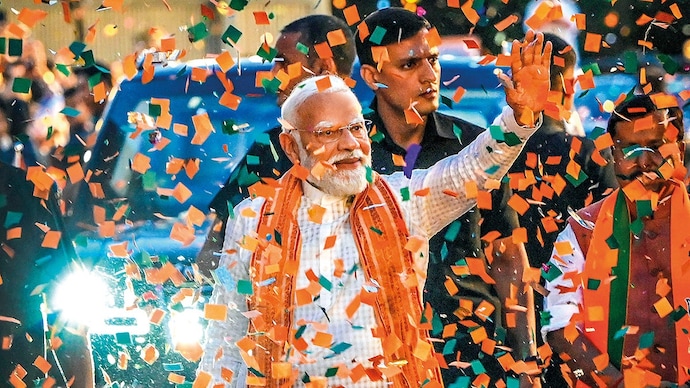


To celebrate the BJP’s historic conquest of West Bengal, Prime Minister Narendra Modi arrived at the party headquarters in Delhi on May 4 dressed in traditional Bengali attire—a dhuti-panjabi. Addressing the ecstatic party workers assembled before him, PM Modi spoke to them with the satisfaction of a leader who had waited nearly a decade for this moment. “From Gangotri to Gangasagar,” he proclaimed, “the lotus has bloomed everywhere.” Then, pausing over each state as though marking milestones in a long political journey, he traced the BJP’s sweep across the Ganga’s riverine course: Uttarakhand, Uttar Pradesh, Bihar and now, finally, West Bengal. The entire Gangetic heartland, he declared, was now in the BJP-NDA fold.
To celebrate the BJP’s historic conquest of West Bengal, Prime Minister Narendra Modi arrived at the party headquarters in Delhi on May 4 dressed in traditional Bengali attire—a dhuti-panjabi. Addressing the ecstatic party workers assembled before him, PM Modi spoke to them with the satisfaction of a leader who had waited nearly a decade for this moment. “From Gangotri to Gangasagar,” he proclaimed, “the lotus has bloomed everywhere.” Then, pausing over each state as though marking milestones in a long political journey, he traced the BJP’s sweep across the Ganga’s riverine course: Uttarakhand, Uttar Pradesh, Bihar and now, finally, West Bengal. The entire Gangetic heartland, he declared, was now in the BJP-NDA fold.
To celebrate the BJP’s historic conquest of West Bengal, Prime Minister Narendra Modi arrived at the party headquarters in Delhi on May 4 dressed in traditional Bengali attire—a dhuti-panjabi. Addressing the ecstatic party workers assembled before him, PM Modi spoke to them with the satisfaction of a leader who had waited nearly a decade for this moment. “From Gangotri to Gangasagar,” he proclaimed, “the lotus has bloomed everywhere.” Then, pausing over each state as though marking milestones in a long political journey, he traced the BJP’s sweep across the Ganga’s riverine course: Uttarakhand, Uttar Pradesh, Bihar and now, finally, West Bengal. The entire Gangetic heartland, he declared, was now in the BJP-NDA fold.
Just a fortnight ago, a seamless coup had been executed in Bihar, which saw Samrat Chaudhary becoming the BJP’s first-ever chief minister of the state after incumbent Nitish Kumar resigned following an elevation to the Rajya Sabha. Two years earlier, the party had ousted five-time chief minister Naveen Patnaik in Odisha and installed the first BJP chief minister in the state. But its biggest breakthrough has been Bengal this summer, where the BJP stunned everyone by winning 207 out of the 294 seats in the assembly, securing a vote share of 45.9 per cent and breaching the formidable citadel chief minister Mamata Banerjee and her party, the Trinamool Congress (TMC), had built over three consecutive terms. The TMC was reduced to 80 seats despite a 40.8 per cent vote share, with the remaining six seats going to other Opposition parties.
The win in Bengal has helped the BJP complete what Union minister Dharmendra Pradhan called the Anga-Banga-Kalinga, or Bihar, Bengal and Odisha, rendered in the old Puranic vocabulary. In Assam, the BJP, along with its National Democratic Alliance (NDA) partners, struck a creditable hat-trick, winning 102 out of the state’s 126 seats. It also found small consolation in the South, where the NDA retained power in Puducherry.
Bengal, though, is undoubtedly the biggest prize. For the BJP and its ideological fountainhead, the Rashtriya Swayamsevak Sangh (RSS), Bengal is the homeland of Syama Prasad Mookerjee, founder of the Bharatiya Jana Sangh, progenitor of the BJP. For seven decades, the organisation he built contested every election in the state, with little success, but with the patience of a movement that treats history in longer arcs than electoral cycles. That Bengal had for decades been governed first by the Left and then by a leader it accused of practising ‘Muslim appeasement’ to retain power was, in its view, a stark anomaly waiting to be corrected. As a BJP leader put it, “To win Bengal is not merely to win power. It is to come home.”
THE ROAD TO VICTORY
In retrospect, there was no single defining moment, no dramatic wave, no visible rupture to suggest the BJP would win so emphatically. The party had spent a decade building something that would remain invisible until it was already done. To understand the scale of that transformation, consider that the BJP won just three seats and a vote share of barely 10 per cent in the 2016 assembly election. In contrast, the TMC won a staggering 211 seats and a 44.9 per cent vote share. The first inkling of change came in 2019, when the BJP emerged as Mamata’s principal challenger in the state, winning 18 out of Bengal’s 42 seats in the general election, 16 more than its 2014 tally. The TMC’s tally, meanwhile, dropped by 12, from 34 to 22. Yet Mamata proved to be a doughty fighter, reaffirming her reputation as the Bengal tigress when her party won an astonishing 215 seats in the 2021 assembly polls, with a vote share of 48.5 per cent. However, the BJP, too, substantially improved its tally to 77 seats with an impressive vote share of 38.4 per cent, though much of the gains came from the Left cadre tactically shifting its vote, and a Congress wipeout, rather than any denting of Mamata’s core base.
That momentum received a setback in 2024, when the BJP’s tally dropped from 18 Lok Sabha seats to 12 in Bengal, even as the TMC’s rose from 22 to 29. Worse, the BJP’s national tally fell from 303 seats in 2019 to 240, forcing it to rely on NDA allies, such as Chandrababu Naidu’s Telugu Desam Party and Nitish Kumar’s Janata Dal (United), to cross the majority mark of 272. Never one to give up, the party returned to the drawing board and decided to completely revamp its playbook in West Bengal. Boosting its confidence was the series of electoral wins in states following the 240-seat shocker in the Lok Sabha election. First, it snatched Haryana back from the jaws of defeat in the October 2024 assembly election. A month later, it engineered a massive victory in Maharashtra alongside its NDA allies. In February 2025 came the resounding win in Delhi, ousting Aam Aadmi Party chief Arvind Kejriwal. By year-end, Bihar, too, was in. With every victory, the BJP edged closer to its final frontier—Mamata’s Bengal.
The target was clear: to win the 148 seats required for a simple majority, not through the bluster that characterised its 2021 campaign, but with a quieter, more localised and methodical plan. The BJP that entered the 2026 campaign was very different from the one that had run ‘Didi O Didi’ or ‘Pishi Jao’ rallies in 2021. Back then, the saffron attacks had turned intensely personal, allowing Mamata to weaponise the BJP’s barbs and campaign on a wheelchair, displaying her injured leg, amplifying her own ‘Khela Hobe’ narrative, driving minority consolidation in some constituencies to as high as 85-90 per cent.
DIAGNOSIS, AND CURE
Its electoral performances in Bengal since 2021 forced the BJP central leadership to introspect deeply, and come up with an unusually candid diagnosis. Three major problems were identified. First, the cadre in Bengal was demoralised. Years of political violence, booth-level intimidation and post-poll attacks had taken their toll, and party workers felt the central leadership had not stood firmly enough with them when it mattered most. Second, the party’s organisational structure was hollow at the grassroots. The BJP had become excessively dependent on turncoats, part-time politicians and celebrities to contest. These candidates brought visibility and, occasionally, votes, but they lacked booth networks, local credibility and any long-term stake in organisation-building. Third, factionalism had quietly eroded any semblance of structural coherence. Local units were divided, loyalties were personal rather than institutional and coordination between the state leadership and district units was frequently dysfunctional.
Modi then asked Union home minister Amit Shah to personally anchor the Bengal campaign. Shah understood that Bengal could not be fought like a conventional election; it needed a multi-layered command operation, centralised in vision but decentralised in execution. He brought in one of his most trusted aides, BJP general secretary Sunil Bansal, who had previously overseen the party’s organisation-building in Uttar Pradesh and delivered Odisha in 2024. Bansal was asked to focus exclusively on Bengal and rebuild the organisation from the ground up. His first step was diagnostic: travelling extensively across districts, holding closed-door meetings and mapping organisational gaps at the booth and mandal levels.
Bansal understood from the outset that Bengal’s problem was not one of messaging or resources. It was structural, and it could only be addressed through the Sangh’s deep volunteer network. From the RSS to the Vishwa Hindu Parishad, Bajrang Dal to the Vanvasi Kalyan Ashram, Bharatiya Mazdoor Sangh to student organisations operating across university campuses in the state, every affiliate was brought into a single coordinated framework. The RSS deputed joint general secretary Alok Kumar in August 2024 to work closely with Bansal. The Sangh was not asked merely to campaign, affiliates were involved in designing the campaign, identifying booth-level weaknesses, selecting candidates and, crucially, executing the campaign strategy on the ground in the months leading up to polling day.
Under Modi-Shah’s direction, Bansal then launched the Sadasyata Abhiyan in October 2024, with the ambitious target of enrolling 10 million members. Transforming the exercise into a tool for organisational layering, Bansal introduced the concept of “active members”—those responsible for enrolling at least 100 primary members—and created a middle tier of accountable grassroots leadership. This ensured the expansion was not merely numerical but structurally embedded. By poll day, the party claimed to have around 60,000 active members who had collectively enrolled nearly 8 million primary members.
Geographically, the campaign was divided into five zones, each monitored by a Union minister paired with a veteran organisational hand. Across the state, the BJP deployed nearly 950,000 booth-level karyakartas, averaging roughly a dozen workers per booth. Alongside them were more than 300,000 panna pramukhs, each assigned a list of 60-70 voters, creating a direct line of contact that extended deep into households. In the most competitive booths, this translated into roughly one worker per 50-60 voters. Equally significant was Bansal’s emphasis on monitoring and discipline. Daily reporting via late-night video conferences introduced a corporate-style review mechanism. His message was unequivocal: advancement would depend on measurable performance, not proximity to leadership.
Simultaneously, the BJP’s Bengal unit built a granular electoral machine around the state’s 78,903 polling booths, treating each not as an administrative unit but as a self-contained battlefield. Spread across 294 constituencies, these booths averaged about 260-270 per seat. BJP planners mapped each one using election data from 2019, 2021 and 2024 to create a constantly updated grid of political behaviour. The party then categorised the 294 constituencies according to winnability. Around 70 were designated Category A+ and another 100 as Category A, where victory prospects were considered high. The remaining constituencies were placed in Categories B, C and D. Campaign resources were allocated accordingly, with Category A and A+ seats receiving maximum attention in terms of manpower and finances.
HANDOUTS AND HINDUTVA
At the apex stood Modi, the campaign’s chief force multiplier. His appeal among women, Scheduled Castes and tribal communities—amplified by the narrative of direct benefit transfers and governance delivery—allowed the BJP to reframe the contest as one of delivery versus distribution, efficiency versus patronage. Alongside, the party adopted a twin-track strategy of Hindu consolidation and minority vote fragmentation. With Muslims accounting for nearly 30 per cent of Bengal’s population and forming Mamata’s most reliable support base, ‘consolidating the Hindu vote’ became central to the BJP’s strategy.
The groundwork for this mobilisation was laid not merely in rallies but through a carefully choreographed sant pravas—public appearances by Hindu seers designed to spiritually legitimise what was, in effect, a political mission. The Sangh and its affiliates also leveraged the regime change in Bangladesh in August 2024 and the reported attacks on the Hindu minority there to consolidate the Hindu vote. Shah’s call to “detect, delete and deport” alleged infiltrators appeared to resonate with voters, packaging Hindutva not as ideology but as a question of survival. As a result, nearly 65 per cent of Hindu votes reportedly consolidated in the BJP’s favour.
SPLIT AND CONQUER
When it came to fragmenting Mamata’s substantial Muslim support base, the BJP adopted a multi-pronged strategy. Bengal’s Muslim population is regionally concentrated, forming a majority in districts such as Murshidabad (66 per cent), Malda (51 per cent) and Uttar Dinajpur (nearly 50 per cent), while remaining a decisive bloc in districts like South 24 Parganas (35 per cent), Nadia (around 27 per cent) and North 24 Parganas (about 25 per cent). A key factor here was the Special Intensive Revision (SIR) of electoral rolls by the Election Commission of India. The process reduced the voter list from 76,637,529 to 68,251,002, including 2.7 million names, many from Muslim-dominated districts, kept in suspension by the Supreme Court. Combined with visible discontent towards the TMC among sections of the Muslim community, this created electoral openings for the BJP.
The party’s strategy was to reshape the electoral balance around these Muslim concentrations through two parallel moves. First, it sought to align Hindu votes across caste lines, particularly among SC, ST and OBC communities that together form 35-40 per cent of the electorate in many constituencies. In belts like Birbhum, Nadia and North 24 Parganas, this involved targeted outreach to Namasudra Dalits, Rajbongshis, tribal groups and agrarian OBCs, along with welfare messaging and representation in local leadership structures.
The BJP’s second approach was to capitalise on fragmentation within the Opposition space in these regions. While Mamata continued to command overwhelming Muslim support, the Congress and the Left still retained a 5-10 per cent vote share in several minority-dominated seats. According to the BJP’s internal assessment, even a 5-7 per cent split in minority votes among the Congress, the CPI(M)-led Left, the Indian Secular Front and the All India Majlis-e-Ittehadul Muslimeen could neutralise the consolidation that had powered the TMC in 2021. A partial “U-turn” and “surrender” on the Waqf amendment bill and slapdash courtship through hasty but “lazy” OBC classifications angered some Muslim segments. The fragmentation of the Muslim vote was a natural corollary.
Simultaneously, the BJP worked toward consolidating the non-minority vote beyond the 50-55 per cent threshold. Much of this strategy focused on securing OBC support through promised benefits while embedding a communal edge into that package. When the TMC government expanded the state’s OBC list in 2025, 76 new communities were added, of which 67 were Muslim—accounting for nearly 88 per cent of the additions. The BJP weaponised this issue with clinical precision, redefining OBC as “One-Sided Beneficiary Classes” and framing every Mahishya, Teli and Saha left outside the quota system as a victim of Muslim appeasement rather than administrative neglect.
Polarisation along Hindu-Muslim lines proved decisive, particularly among urban men. With the Muslim population disproportionately concentrated in the rural borderlands, the BJP created an outsized electoral advantage everywhere else on the electoral map, including urban seats. It won an overwhelming majority of the 68 SC-reserved seats and 16 ST-reserved seats, reflecting the depth of the Dalit, tribal and OBC coalition it had painstakingly built over two years. Its booth-management architecture—knowing which communities lived where, which grievances resonated with them, which workers could reach them credibly—all that came into play.
OTHER WEAPONS IN THE BJP ARMOURY
Union minister Bhupender Yadav, who was appointed central observer and played a key role in the victory, identified agrarian distress as a major electoral issue. His interactions with farmers in Hooghly and Bardhaman revealed widespread anger, particularly among potato farmers suffering repeated losses. The issue soon became central to campaign speeches by Modi and Shah. The BJP subsequently swept 16 out of 18 seats in Hooghly and 14 out of 16 seats in Purba Bardhaman.
Another strategic move was the preparation of constituency-based chargesheets. Led by BJP spokesperson Keya Ghosh, party workers conducted extensive outreach across 229 constituencies, gathering local grievances and documenting allegations against the ruling establishment. The 65 constituencies represented by BJP MLAs were excluded from the exercise. “We worked for five months compiling the data. Then, a team of 10-12 people at the state level worked on presentation and verification,” says Ghosh.
The BJP leadership believes this personalised approach proved electorally advantageous and helped it fine-tune micro-strategies to attract different voter segments. In slums, the party highlighted promises such as monthly allowances of Rs 3,000 for women and unemployed youth, along with Rs 50,000 assistance for girls’ education. In highrise residential areas, the focus shifted to employment, safety and civic amenities. The R.G. Kar case further consolidated women voters behind the BJP after Shah framed the incident as evidence that “women are not safe in Bengal”. The BJP also pushed for polling booths within residential complexes to increase voter turnout, resulting in 69 such booths across 20 constituencies.
The cumulative effect of these efforts was to substantially erode the so-called “3 Ms” that had long sustained the TMC’s dominance: Mamata, Mahila and Muslims. For Didi, the defeat marks the collapse of a political fortress that she thought was unassailable. But, for the BJP, Bengal is far more than an electoral trophy, it is a culmination of a decade-long ideological, organisational and political project to redraw the electoral map of eastern India. By completing its sweep across the Gangetic belt—from Uttarakhand to Bengal—the party has demonstrated an ability not merely to win elections but also the patience to reshape political ecosystems through relentless cadre-building, social engineering and narrative control. The Bengal victory will now be projected by the party as proof that no regional bastion is invincible and no political order permanent. It also poses a larger question for Indian politics: is it the end of the era of powerful regional satraps standing up to the BJP’s unrelenting electoral juggernaut?

