One sky, two infernos: Canada's wildfires revive a stunning aurora photo
Canada is battling nearly 800 wildfires this July, and an old viral photo of the northern lights beside a Yukon blaze is resurfacing online. Here is the science behind both, and why Canada's fires keep getting worse.
Canada is battling one of its toughest wildfire seasons in years, with nearly 800 fires burning nationally this July, according to the Government of Canada's latest update.
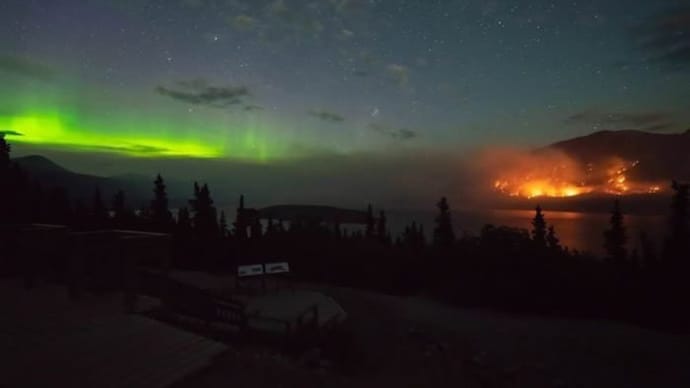
As smoke drifts across the country and into the United States, an old photograph is doing fresh rounds online: Jason Gendron's 2018 shot of the aurora borealis rippling green beside a raging wildfire on Yukon's Windy Arm, a narrow, north-south extension of Tagish Lake in Canada.
This is a striking reminder of how closely fire and sky have always been linked in the north.
WHY ARE SO MANY WILDFIRES BURNING ACROSS CANADA?
More than 3,100 fires have broken out so far this season, with the Northwest Territories, Nunavut and northern Manitoba facing the highest danger through the rest of summer, the government says.
Above-average temperatures and dry conditions are driving the risk, and smoke has already drifted as far as New York and Boston, according to the CIRA Satellite Library.
WHY DOES THE AURORA GLOW GREEN?
Gendron's photograph, taken near Tagish Lake about 85 kilometres south of Whitehorse, went viral within days of capture.
The northern lights in it begin on the Sun, which constantly releases a stream of charged particles called the solar wind. Earth's magnetic field, or magnetosphere, shields the planet from most of this stream but funnels some particles toward the poles.
There, roughly 100 to 150 kilometres up, in a layer of the atmosphere called the thermosphere, the particles strike oxygen atoms. This excites the atoms, and as they settle back down, they release the extra energy as light, a process called fluorescence.
Oxygen glows mainly green at this height, which is why green is the aurora's signature colour.
WHAT MAKES A WILDFIRE BURN SO FIERCELY?
A wildfire is combustion, a fast chemical reaction between fuel, oxygen and heat. In Yukon's boreal forest, dry spruce, moss and peat provide the fuel.
As it burns, tiny soot particles heat to several hundred degrees Celsius and glow, producing the fire's orange light, the same basic principle that makes a stove's heating coil turn red.
The Windy Arm fire in Gendron's photograph was sparked by lightning on August 6, 2018.
CAN WILDFIRE SMOKE BLOCK OUT THE NORTHERN LIGHTS?
Yes. Thick smoke scatters and absorbs light, which can dim or redden the aurora, or hide it completely.
That both phenomena appear clearly in Gendron's frame suggests the smoke stayed close to the fire that night, a stroke of luck that is becoming rarer as Canada's fire seasons grow longer and smokier.
Canada is battling one of its toughest wildfire seasons in years, with nearly 800 fires burning nationally this July, according to the Government of Canada's latest update.
As smoke drifts across the country and into the United States, an old photograph is doing fresh rounds online: Jason Gendron's 2018 shot of the aurora borealis rippling green beside a raging wildfire on Yukon's Windy Arm, a narrow, north-south extension of Tagish Lake in Canada.
This is a striking reminder of how closely fire and sky have always been linked in the north.
WHY ARE SO MANY WILDFIRES BURNING ACROSS CANADA?
More than 3,100 fires have broken out so far this season, with the Northwest Territories, Nunavut and northern Manitoba facing the highest danger through the rest of summer, the government says.
Above-average temperatures and dry conditions are driving the risk, and smoke has already drifted as far as New York and Boston, according to the CIRA Satellite Library.
WHY DOES THE AURORA GLOW GREEN?
Gendron's photograph, taken near Tagish Lake about 85 kilometres south of Whitehorse, went viral within days of capture.
The northern lights in it begin on the Sun, which constantly releases a stream of charged particles called the solar wind. Earth's magnetic field, or magnetosphere, shields the planet from most of this stream but funnels some particles toward the poles.
There, roughly 100 to 150 kilometres up, in a layer of the atmosphere called the thermosphere, the particles strike oxygen atoms. This excites the atoms, and as they settle back down, they release the extra energy as light, a process called fluorescence.
Oxygen glows mainly green at this height, which is why green is the aurora's signature colour.
WHAT MAKES A WILDFIRE BURN SO FIERCELY?
A wildfire is combustion, a fast chemical reaction between fuel, oxygen and heat. In Yukon's boreal forest, dry spruce, moss and peat provide the fuel.
As it burns, tiny soot particles heat to several hundred degrees Celsius and glow, producing the fire's orange light, the same basic principle that makes a stove's heating coil turn red.
The Windy Arm fire in Gendron's photograph was sparked by lightning on August 6, 2018.
CAN WILDFIRE SMOKE BLOCK OUT THE NORTHERN LIGHTS?
Yes. Thick smoke scatters and absorbs light, which can dim or redden the aurora, or hide it completely.
That both phenomena appear clearly in Gendron's frame suggests the smoke stayed close to the fire that night, a stroke of luck that is becoming rarer as Canada's fire seasons grow longer and smokier.
Canada is battling one of its toughest wildfire seasons in years, with nearly 800 fires burning nationally this July, according to the Government of Canada's latest update.
As smoke drifts across the country and into the United States, an old photograph is doing fresh rounds online: Jason Gendron's 2018 shot of the aurora borealis rippling green beside a raging wildfire on Yukon's Windy Arm, a narrow, north-south extension of Tagish Lake in Canada.
This is a striking reminder of how closely fire and sky have always been linked in the north.
WHY ARE SO MANY WILDFIRES BURNING ACROSS CANADA?
More than 3,100 fires have broken out so far this season, with the Northwest Territories, Nunavut and northern Manitoba facing the highest danger through the rest of summer, the government says.
Above-average temperatures and dry conditions are driving the risk, and smoke has already drifted as far as New York and Boston, according to the CIRA Satellite Library.
WHY DOES THE AURORA GLOW GREEN?
Gendron's photograph, taken near Tagish Lake about 85 kilometres south of Whitehorse, went viral within days of capture.
The northern lights in it begin on the Sun, which constantly releases a stream of charged particles called the solar wind. Earth's magnetic field, or magnetosphere, shields the planet from most of this stream but funnels some particles toward the poles.
There, roughly 100 to 150 kilometres up, in a layer of the atmosphere called the thermosphere, the particles strike oxygen atoms. This excites the atoms, and as they settle back down, they release the extra energy as light, a process called fluorescence.
Oxygen glows mainly green at this height, which is why green is the aurora's signature colour.
WHAT MAKES A WILDFIRE BURN SO FIERCELY?
A wildfire is combustion, a fast chemical reaction between fuel, oxygen and heat. In Yukon's boreal forest, dry spruce, moss and peat provide the fuel.
As it burns, tiny soot particles heat to several hundred degrees Celsius and glow, producing the fire's orange light, the same basic principle that makes a stove's heating coil turn red.
The Windy Arm fire in Gendron's photograph was sparked by lightning on August 6, 2018.
CAN WILDFIRE SMOKE BLOCK OUT THE NORTHERN LIGHTS?
Yes. Thick smoke scatters and absorbs light, which can dim or redden the aurora, or hide it completely.
That both phenomena appear clearly in Gendron's frame suggests the smoke stayed close to the fire that night, a stroke of luck that is becoming rarer as Canada's fire seasons grow longer and smokier.

