A new growth model | Viksit Gujarat Industrial Policy 2026
Gujarat's new industrial policy marks a shift from labour-intensive manufacturing to high-tech industries, betting on semiconductors, green energy and aerospace while confronting the challenge of creating enough quality jobs
For decades, Gujarat built its reputation as India’s factory floor. From textile mills in Surat and engineering workshops in Rajkot to ceramics in Morbi, pharmaceuticals in Ahmedabad and thousands of Micro, Small and Medium Enterprises (MSMEs), the state created jobs and built one of India’s strongest manufacturing economies. Now, the Viksit Gujarat Industrial Policy 2026 signals a decisive shift—from making more products to making more sophisticated products, reflecting a transition from labour-intensive to technology-intensive manufacturing.
For decades, Gujarat built its reputation as India’s factory floor. From textile mills in Surat and engineering workshops in Rajkot to ceramics in Morbi, pharmaceuticals in Ahmedabad and thousands of Micro, Small and Medium Enterprises (MSMEs), the state created jobs and built one of India’s strongest manufacturing economies. Now, the Viksit Gujarat Industrial Policy 2026 signals a decisive shift—from making more products to making more sophisticated products, reflecting a transition from labour-intensive to technology-intensive manufacturing.
For decades, Gujarat built its reputation as India’s factory floor. From textile mills in Surat and engineering workshops in Rajkot to ceramics in Morbi, pharmaceuticals in Ahmedabad and thousands of Micro, Small and Medium Enterprises (MSMEs), the state created jobs and built one of India’s strongest manufacturing economies. Now, the Viksit Gujarat Industrial Policy 2026 signals a decisive shift—from making more products to making more sophisticated products, reflecting a transition from labour-intensive to technology-intensive manufacturing.
The policy aims to attract Rs 10 lakh crore in investments over five years and contribute to Gujarat’s ambition of becoming a $3.5 trillion (Rs 338 lakh crore) economy by 2047. “With this policy, we are taking a decisive step towards building globally competitive industries, attracting next-generation investments and strengthening our integration with global value chains,” said chief minister Bhupendra Patel, while releasing the new industrial policy last month.
THE BIG SHIFT
Gujarat, which accounts for 8.2 per cent of India’s GDP, is among the country’s wealthiest large states, with a per capita income of Rs 3.27 lakh in FY25, against a national average of Rs 2.05 lakh. Manufacturing is the single largest contributor to the state’s economy, generating Rs 7.90 lakh crore, or 32.8 per cent of gross state value added, down from 36.8 per cent in FY22. Much of the decline, as per the Gujarat Socio-Economic Review 2025-26, reflects the normalisation of refining and chemical prices after the FY22 peak, alongside a prolonged slump in diamonds, textiles and chemicals since 2023. The state’s Annual Survey of Industries estimates that nearly 2.6 million people are employed in the manufacturing sector. The challenge now is to ensure that employment growth is broad-based.
The new policy focuses on 21 thrust sectors, spanning advanced manufacturing, clean energy like green hydrogen, semiconductors, aerospace and traditional strengths such as textiles, pharmaceuticals, chemicals, food processing and engineering, while retaining support for small businesses. At the heart of this move is the creation of a new Ultra Mega Project category. Under this, companies investing at least Rs 10,000 crore and generating 3,000 jobs in the thrust sectors will qualify for customised incentive packages rather than fixed subsidies. The initiative gives Gujarat greater flexibility to negotiate with global manufacturers competing across countries and neighbouring states for large investments. Achal Bakeri, chairman of CII Gujarat State Council, and chairman and MD, Symphony Ltd, lauds the policy as comprehensive, laying as much emphasis on its actual implementation. “The state lacked a laid-out policy to compete and attract large investments,” he says. “These investments were coming through on a case-to-case basis. Now, the policy gives coherence to the state’s pitch.”
That pitch, industry insiders say, is reinforced by Gujarat’s reputation for efficient governance and speedy approvals. Anuj Jain, proprietor of Ahmedabad-based financial advisory firm Artha Capital Partners, says Gujarat’s biggest advantage in attracting investment has long been its ease of doing business, driven by streamlined online approvals, compliance systems and subsidy disbursal mechanisms. “The new policy seeks to further simplify and accelerate these processes. International companies value the transparency offered by the state’s online approval, compliance and subsidy availing systems.”
SPREADING THE GROWTH
Much of the investment is expected to flow into Gujarat’s emerging technology corridors. Dholera has become the centrepiece of India’s semiconductor ambitions, with Tata Electronics’ fabrication plant, supporting chip units and an electronics manufacturing ecosystem already taking shape. Sanand, once an automobile hub, is rapidly attracting electronics and precision manufacturing. Dahej, leveraging its petrochemical infrastructure and Petroleum, Chemicals and Petrochemicals Investment Region (PCPIR), is well placed to emerge as a centre for green hydrogen and specialty chemicals manufacturing. Meanwhile, GIFT City is expected to anchor financial services, fintech, global capability centres and other technology-driven services that complement the state’s industrial base.
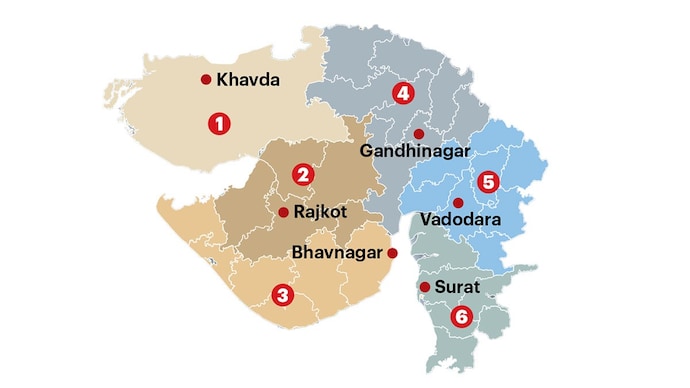
But concentrated investment also brings concentrated costs—soaring land prices, urban sprawl, pressure on civic infrastructure and pollution. While the current push is centred on North Gujarat and parts of Saurashtra, the new policy envisages specialised industrial clusters across the state (see map) to spread the benefits of growth more evenly, creating jobs across regions instead of fuelling distress migration to a handful of industrial hubs.
Officials acknowledge the imbalance but say the answer lies in regional specialisation. To that end, Gujarat has, over the past year, hosted four Vibrant Gujarat Regional Conferences ahead of the Vibrant Gujarat Global Summit in January 2027. The idea is to market each region as a distinct industrial ecosystem, showcasing its existing strengths and attracting investments best suited to its infrastructure, workforce and natural advantages. “If land, labour and infrastructure are available, industry will go anywhere,” says Bakeri.
As manufacturing becomes increasingly automated through artificial intelligence, robotics and smart factories, specialised skills will be in demand. A semiconductor fabrication plant may attract billions of rupees in investment while employing far fewer people than a comparable investment in textiles or garments. To meet the demand for such high-skilled jobs, the policy proposes stronger industry-academia partnerships, research and development support, incubation centres, technology commercialisation and startup promotion. Yet the state’s ability to equip local youth with advanced skills require remains a work in progress. Ultimately, the policy’s success may hinge on how quickly that skills gap is bridged.
THE FUTURE OF MSMES
Where does this leave Gujarat’s famed MSME sector, which accounts for the overwhelming majority of industrial units and a large share of manufacturing employment? The policy does not abandon MSMEs; it redefines their role. Instead of positioning them as standalone engines of growth, it seeks to integrate them into larger industrial value chains. MSMEs are expected to emerge as component manufacturers, specialised suppliers, exporters and service providers to semiconductor fabs, electric vehicle makers, renewable energy companies and advanced manufacturing firms.
Sandeep Engineer, president of the Gujarat Chamber of Commerce and Industry, says the MSMEs are happy with the policy. “In addition to plugging into the supply chain, large projects also mobilise trained labour and an ecosystem from which MSMEs benefit over a period of time.” Moreover, the government has independent policies for several employment-intensive industries like textiles, IT & ITeS, biotechnology, space tech, tourism, to name a few, in which industry-specific subsidies are provided and compliances eased, Engineer explains.
Jain of Artha Capital Partners, who helps MSMEs avail government subsidies, believes the policy’s core benefit is in the redefinition of MSMEs, which expands the scope of units that can avail its benefits. The ceiling for micro enterprises has increased from Rs 1 crore to Rs 2.5 crore, for small enterprises from Rs 10 crore to Rs 25 crore, and for medium enterprises from Rs 50 crore to Rs 125 crore. “MSMEs generate 60-70 per cent of Gujarat’s employment. The industries included in that additional Rs 75 crore are the largest employment generators. This will fuel employment,” he says.
On paper, Viksit Gujarat Industrial Policy 2026 looks impressive. But whether it delivers broad-based prosperity will depend on how effectively the state enables its small businesses, entrepreneurs and workforce to participate in—and benefit from—the high-tech economy it is trying to build.

