No azadi in Pak-occupied J&K | Viewpoint by Sharat Sabharwal
Pakistan responds to protests in POJK demanding economic and political justice with an iron fist. India, in a measured reaction, calls out the brutality and reiterates its claim over the region
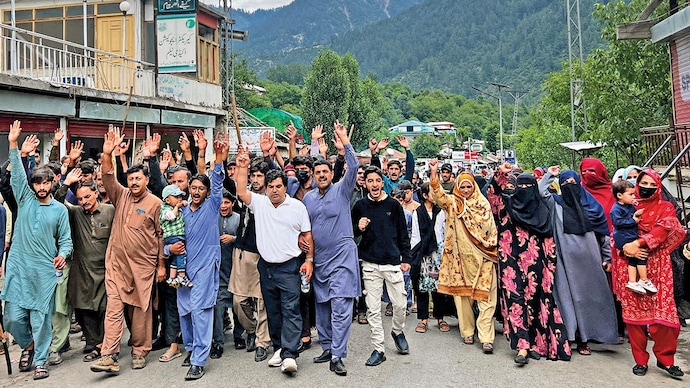
Pakistan’s Punjabi establishment is getting singed by the intensifying fires of defiance and violence in Balochistan, the tribal belt and of late in the so-called ‘Azad Jammu and Kashmir (AJK)’ or what India terms Pakistan-occupied Jammu and Kashmir (POJK). With violent protests breaking out days before the AJK assembly election scheduled for July 27, the fraught security situation forced the Pakistan government to split it into three phases, ending now on August 10.
Pakistan’s Punjabi establishment is getting singed by the intensifying fires of defiance and violence in Balochistan, the tribal belt and of late in the so-called ‘Azad Jammu and Kashmir (AJK)’ or what India terms Pakistan-occupied Jammu and Kashmir (POJK). With violent protests breaking out days before the AJK assembly election scheduled for July 27, the fraught security situation forced the Pakistan government to split it into three phases, ending now on August 10.
Pakistan’s Punjabi establishment is getting singed by the intensifying fires of defiance and violence in Balochistan, the tribal belt and of late in the so-called ‘Azad Jammu and Kashmir (AJK)’ or what India terms Pakistan-occupied Jammu and Kashmir (POJK). With violent protests breaking out days before the AJK assembly election scheduled for July 27, the fraught security situation forced the Pakistan government to split it into three phases, ending now on August 10.
While Rawalakot has remained the protest epicentre, large parts of the territory have witnessed sit-ins, protest marches and shutter-down strikes by the Jammu and Kashmir Joint Awami Action Committee (JAAC). The JAAC is an umbrella group of civil rights groups of lawyers, traders, transporters and students who came together in 2023 to push, inter alia, for governance reforms, accountability, cheaper electricity and wheat, as well as elimination of perks and privileges for the elite. The government responded with an iron fist approach.
In the run up to the assembly polls, government forces resorted to firing on protesters, arrest of JKAAC leaders for sedition, internet bans and closure of main roads. Sketchy information coming out suggests multiple casualties among civilians and security forces. A JAAC leader has claimed that 25 civilians were killed in police firing on July 27 and 28 after it announced a protest march on Muzaffarabad. There is no end in sight to the agitation.
Ever since Pakistan constituted the areas of Jammu and Kashmir illegally occupied in 1947 into two units, AJK and the so-called Gilgit-Baltistan, both have been governed like virtual colonies. AJK was given a veneer of constitutional governance with a parliamentary system only in 1974. However, elections to its 53-member legislative assembly have been rigged all along. Twelve seats, reserved for the refugees from J&K on the Indian side, have been used by the Pakistani establishment to manipulate numbers in the assembly. One of the demands of the JAAC before the assembly polls was to abolish these 12 ‘refugee’ seats.
The AJK Council, headed by the prime minister of Pakistan, exercises control over all critical governance issues, including the natural resources of the territory that have been exploited with little benefit to the local people. Top AJK functionaries have to express loyalty to Pakistan and the accession of J&K to it. Pakistan has all along employed a heavy-handed approach, entailing gross human rights violations to sustain its stranglehold over AJK.
Agitation by the people for their constitutional rights and better governance has not been unknown in AJK. But the sustained protests spearheaded by JAAC in the past three years to press for its demands have been the most serious in recent memory. The trigger for the latest round of agitation was the death of a trader in Rawalakot in confrontation with security forces and the banning of the JAAC in early June.
With Pakistan Tehreek-e-Insaf (PTI) headed by the jailed former prime minister, Imran Khan, boycotting the polls in sympathy with the people, the ruling Pakistan Muslim League Nawaz (PML-N) and the Pakistan’s People’s Party (PPP)—both allies of the army—are the main contenders. However, due to the widespread unrest and allegations of rigging, the election will carry little credibility.
The public ire at Pakistan does not necessarily imply love for India. Social media footage of sporadic appeals for help to India by some local activists does not establish this. Governance reforms remain the core agitation agenda. JAAC leaders have rejected the Pakistani allegation of their links to India.
In a measured reaction, India has reiterated its claim over PoJK, rejected Pakistan’s allegation of its involvement in the turmoil, taken note of the police brutality and expressed the hope that the international community would hold Pakistan accountable for its misdeeds. India has also described the ongoing election as a cosmetic exercise to camouflage Pakistan’s illegal occupation and grave human rights violations.
India’s cautious approach is understandable in view of the evolving situation. However, there is a case for India to at the very least leverage the ongoing AJK events forcefully at international forums to expose the utter hypocrisy of Pakistan’s dubious Kashmir agenda.
—Sharat Sabharwal is a former high commissioner to Pakistan and author of India’s Pakistan Conundrum: Managing a Complex Relationship

