Why Shabana Azmi's critics keep forgetting her four decades of activism
Shabana Azmi joined students during the CJP's Chalo Sansad march in Delhi on July 20. Her presence drew attention because it echoed a decades-long record of public activism.
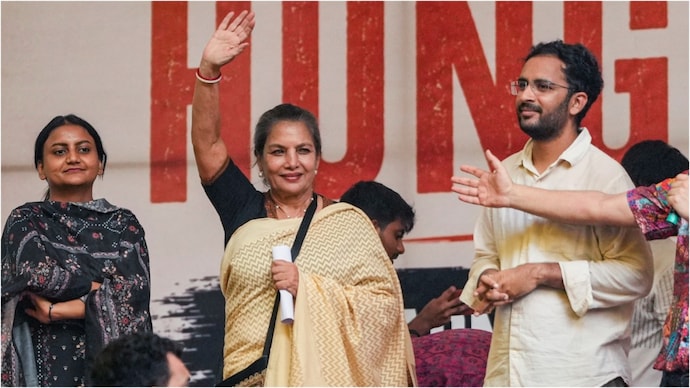
On July 20, somewhere in the middle of a crowd marching towards Parliament, a 75-year-old woman pulled out her phone, held hands with strangers and ran. No bodyguards, no entourage, no carefully worded Instagram post from the safety of a Mumbai home. Just Shabana Azmi, in the humidity and chaos of Delhi, marching towards Parliament, standing with students demanding accountability over NEET irregularities during the Chalo Sansad rally at Jantar Mantar.
She got caught in a tear gas attack. She had an asthma attack. She kept going. But why?
There have been questions, as there always are when a celebrity steps into politics. Social media was quick to ask - What does she gain from this? Is it a publicity stunt? Is she doing it for attention? While some questioned her intent, others wondered whether her presence was taking the focus away from the actual cause.
When she spoke to India Today's Rajdeep Sardesai about it later, she became emotional while recalling the events of that day. Despite those emotions, the fire kept burning within her. As the next day approached, she was at it again: standing up with students, releasing videos from the protest site and doing everything to voice the dissent. Azmi didn't observe these moments from a distance, she walked into them.
At 75, she has been doing exactly this for four decades.
A tweet would have done it
Let's be honest about what most Bollywood celebrities do when something uncomfortable happens. They post. A story, a reel, a carefully worded statement that says enough to show they care but not enough to upset anyone. Then they move on.
Azmi flew from Mumbai to Delhi - outside the comfort of her luxurious home.
This is not a woman who discovered activism last week. This is someone who has been doing this since before most of the students at Jantar Mantar were born. Azmi has once again emerged as one of the few Bollywood voices willing to step into uncomfortable conversations. It is a role she has embraced for nearly four decades.
When she skipped Cannes for slum-dwellers' rights
For Azmi, daughter of Indian Urdu poet, political and social activist Kaifi Azmi, activism has never been separate from her identity as an artist. Long before celebrities routinely spoke about social causes on social media, she was out on the streets protesting, campaigning and, at times, putting her own career on hold.
One of the defining moments came in 1986. The actor was supposed to leave for Cannes with filmmaker Mrinal Sen for Genesis. Instead, she cancelled the trip and sat on a five-day indefinite hunger strike with filmmaker Anand Patwardhan and members of housing rights group Nivara Hakk after families from Mumbai's Sanjay Gandhi Nagar slum were evicted.
The protest eventually forced the Maharashtra government to provide alternative land to the displaced residents. Years later, Azmi recalled how actor Shashi Kapoor intervened by speaking to the then Chief Minister SB Chavan, helping bring the standoff to an end. She has often described that campaign as one of the most meaningful experiences of her life.
Housing rights were only the beginning.
Speaking truth to power
In January 1989 at the International Film Festival of India, New Delhi. Shabana Azmi was called to the stage at the opening ceremony to speak about filmmakers who had influenced her. Sitting in the front row was HKL Bhagat, a Congress leader accused of being connected to the attack that had killed street theatre activist Safdar Hashmi just days earlier.
Hashmi and his theatre group, Jan Natya Manch, had been performing a play called Halla Bol in Sahibabad during municipal elections on January 1 when a mob set upon them. He died from his injuries the next day.
With Bhagat seated in the front row, Azmi took the microphone and condemned the system that had "connived in the murder of a cultural activist." She did not soften it. She did not save it for a safer moment. She said it there, in that room, to that audience.
Fourteen years later, in 2003, ten people were convicted for Hashmi's murder.
That same year, she led a march for communal harmony from Delhi to Meerut demanding justice for the victims of the Malliana and Hashimpura massacres, walking alongside social activist Asghar Ali Engineer and Swami Agnivesh. When policemen accused in the Hashimpura killings were eventually convicted years later, Azmi welcomed the verdict, recalling the campaign for justice that had begun decades earlier.
The causes she has been vocal about
Over the years, Azmi has worked extensively on issues ranging from women's reproductive health and HIV/AIDS awareness to communal harmony and freedom of expression. She served as a goodwill ambassador for the United Nations Population Fund (UNFPA) and SAARC, using her public profile to campaign for reproductive rights and against the stigma surrounding HIV.
Her willingness to speak out has often placed her at the centre of political debates.
She has also spoken in favour of criminalising instant triple talaq, saying the practice had been used to commit atrocities against Muslim women and was against the spirit of the Constitution.
Her activism has continued across governments and across issues, often inviting criticism from one side or another. Yet, unlike many public figures who weigh every statement against possible backlash, Azmi has rarely appeared concerned about political convenience.
That perhaps explains why her presence at the recent student protest resonated with many.
After the march, a young woman shared a heartfelt note on Instagram, describing the actor as someone she had always wanted to grow up to be. She wrote about watching Azmi leave behind the comfort and distance that often come with celebrity, moving through the crowd, holding hands with strangers, feeding students who had been on hunger strike and standing shoulder to shoulder with protesters.
The post quickly found an audience online because it reflected what many at the protest had witnessed. Azmi was not there as a star making a symbolic appearance. She was there as a participant.
That image has stayed with many people because it feels consistent with the Shabana Azmi they have known for years.
Whether it was giving up a Cannes appearance for a hunger strike, speaking out after Safdar Hashmi's murder, campaigning for housing rights, advocating for women and marginalised communities or joining students on the streets at 75, Azmi has repeatedly chosen to show up rather than simply speak up.
In an industry where silence is often seen as the safer option, Shabana Azmi has built a reputation for doing the opposite. For more than four decades, she has remained one of Bollywood's most unwavering voices of dissent, using not just her words, but her presence, to stand by the causes she believes in.
On July 20, somewhere in the middle of a crowd marching towards Parliament, a 75-year-old woman pulled out her phone, held hands with strangers and ran. No bodyguards, no entourage, no carefully worded Instagram post from the safety of a Mumbai home. Just Shabana Azmi, in the humidity and chaos of Delhi, marching towards Parliament, standing with students demanding accountability over NEET irregularities during the Chalo Sansad rally at Jantar Mantar.
She got caught in a tear gas attack. She had an asthma attack. She kept going. But why?
There have been questions, as there always are when a celebrity steps into politics. Social media was quick to ask - What does she gain from this? Is it a publicity stunt? Is she doing it for attention? While some questioned her intent, others wondered whether her presence was taking the focus away from the actual cause.
When she spoke to India Today's Rajdeep Sardesai about it later, she became emotional while recalling the events of that day. Despite those emotions, the fire kept burning within her. As the next day approached, she was at it again: standing up with students, releasing videos from the protest site and doing everything to voice the dissent. Azmi didn't observe these moments from a distance, she walked into them.
At 75, she has been doing exactly this for four decades.
A tweet would have done it
Let's be honest about what most Bollywood celebrities do when something uncomfortable happens. They post. A story, a reel, a carefully worded statement that says enough to show they care but not enough to upset anyone. Then they move on.
Azmi flew from Mumbai to Delhi - outside the comfort of her luxurious home.
This is not a woman who discovered activism last week. This is someone who has been doing this since before most of the students at Jantar Mantar were born. Azmi has once again emerged as one of the few Bollywood voices willing to step into uncomfortable conversations. It is a role she has embraced for nearly four decades.
When she skipped Cannes for slum-dwellers' rights
For Azmi, daughter of Indian Urdu poet, political and social activist Kaifi Azmi, activism has never been separate from her identity as an artist. Long before celebrities routinely spoke about social causes on social media, she was out on the streets protesting, campaigning and, at times, putting her own career on hold.
One of the defining moments came in 1986. The actor was supposed to leave for Cannes with filmmaker Mrinal Sen for Genesis. Instead, she cancelled the trip and sat on a five-day indefinite hunger strike with filmmaker Anand Patwardhan and members of housing rights group Nivara Hakk after families from Mumbai's Sanjay Gandhi Nagar slum were evicted.
The protest eventually forced the Maharashtra government to provide alternative land to the displaced residents. Years later, Azmi recalled how actor Shashi Kapoor intervened by speaking to the then Chief Minister SB Chavan, helping bring the standoff to an end. She has often described that campaign as one of the most meaningful experiences of her life.
Housing rights were only the beginning.
Speaking truth to power
In January 1989 at the International Film Festival of India, New Delhi. Shabana Azmi was called to the stage at the opening ceremony to speak about filmmakers who had influenced her. Sitting in the front row was HKL Bhagat, a Congress leader accused of being connected to the attack that had killed street theatre activist Safdar Hashmi just days earlier.
Hashmi and his theatre group, Jan Natya Manch, had been performing a play called Halla Bol in Sahibabad during municipal elections on January 1 when a mob set upon them. He died from his injuries the next day.
With Bhagat seated in the front row, Azmi took the microphone and condemned the system that had "connived in the murder of a cultural activist." She did not soften it. She did not save it for a safer moment. She said it there, in that room, to that audience.
Fourteen years later, in 2003, ten people were convicted for Hashmi's murder.
That same year, she led a march for communal harmony from Delhi to Meerut demanding justice for the victims of the Malliana and Hashimpura massacres, walking alongside social activist Asghar Ali Engineer and Swami Agnivesh. When policemen accused in the Hashimpura killings were eventually convicted years later, Azmi welcomed the verdict, recalling the campaign for justice that had begun decades earlier.
The causes she has been vocal about
Over the years, Azmi has worked extensively on issues ranging from women's reproductive health and HIV/AIDS awareness to communal harmony and freedom of expression. She served as a goodwill ambassador for the United Nations Population Fund (UNFPA) and SAARC, using her public profile to campaign for reproductive rights and against the stigma surrounding HIV.
Her willingness to speak out has often placed her at the centre of political debates.
She has also spoken in favour of criminalising instant triple talaq, saying the practice had been used to commit atrocities against Muslim women and was against the spirit of the Constitution.
Her activism has continued across governments and across issues, often inviting criticism from one side or another. Yet, unlike many public figures who weigh every statement against possible backlash, Azmi has rarely appeared concerned about political convenience.
That perhaps explains why her presence at the recent student protest resonated with many.
After the march, a young woman shared a heartfelt note on Instagram, describing the actor as someone she had always wanted to grow up to be. She wrote about watching Azmi leave behind the comfort and distance that often come with celebrity, moving through the crowd, holding hands with strangers, feeding students who had been on hunger strike and standing shoulder to shoulder with protesters.
The post quickly found an audience online because it reflected what many at the protest had witnessed. Azmi was not there as a star making a symbolic appearance. She was there as a participant.
That image has stayed with many people because it feels consistent with the Shabana Azmi they have known for years.
Whether it was giving up a Cannes appearance for a hunger strike, speaking out after Safdar Hashmi's murder, campaigning for housing rights, advocating for women and marginalised communities or joining students on the streets at 75, Azmi has repeatedly chosen to show up rather than simply speak up.
In an industry where silence is often seen as the safer option, Shabana Azmi has built a reputation for doing the opposite. For more than four decades, she has remained one of Bollywood's most unwavering voices of dissent, using not just her words, but her presence, to stand by the causes she believes in.
On July 20, somewhere in the middle of a crowd marching towards Parliament, a 75-year-old woman pulled out her phone, held hands with strangers and ran. No bodyguards, no entourage, no carefully worded Instagram post from the safety of a Mumbai home. Just Shabana Azmi, in the humidity and chaos of Delhi, marching towards Parliament, standing with students demanding accountability over NEET irregularities during the Chalo Sansad rally at Jantar Mantar.
She got caught in a tear gas attack. She had an asthma attack. She kept going. But why?
There have been questions, as there always are when a celebrity steps into politics. Social media was quick to ask - What does she gain from this? Is it a publicity stunt? Is she doing it for attention? While some questioned her intent, others wondered whether her presence was taking the focus away from the actual cause.
When she spoke to India Today's Rajdeep Sardesai about it later, she became emotional while recalling the events of that day. Despite those emotions, the fire kept burning within her. As the next day approached, she was at it again: standing up with students, releasing videos from the protest site and doing everything to voice the dissent. Azmi didn't observe these moments from a distance, she walked into them.
At 75, she has been doing exactly this for four decades.
A tweet would have done it
Let's be honest about what most Bollywood celebrities do when something uncomfortable happens. They post. A story, a reel, a carefully worded statement that says enough to show they care but not enough to upset anyone. Then they move on.
Azmi flew from Mumbai to Delhi - outside the comfort of her luxurious home.
This is not a woman who discovered activism last week. This is someone who has been doing this since before most of the students at Jantar Mantar were born. Azmi has once again emerged as one of the few Bollywood voices willing to step into uncomfortable conversations. It is a role she has embraced for nearly four decades.
When she skipped Cannes for slum-dwellers' rights
For Azmi, daughter of Indian Urdu poet, political and social activist Kaifi Azmi, activism has never been separate from her identity as an artist. Long before celebrities routinely spoke about social causes on social media, she was out on the streets protesting, campaigning and, at times, putting her own career on hold.
One of the defining moments came in 1986. The actor was supposed to leave for Cannes with filmmaker Mrinal Sen for Genesis. Instead, she cancelled the trip and sat on a five-day indefinite hunger strike with filmmaker Anand Patwardhan and members of housing rights group Nivara Hakk after families from Mumbai's Sanjay Gandhi Nagar slum were evicted.
The protest eventually forced the Maharashtra government to provide alternative land to the displaced residents. Years later, Azmi recalled how actor Shashi Kapoor intervened by speaking to the then Chief Minister SB Chavan, helping bring the standoff to an end. She has often described that campaign as one of the most meaningful experiences of her life.
Housing rights were only the beginning.
Speaking truth to power
In January 1989 at the International Film Festival of India, New Delhi. Shabana Azmi was called to the stage at the opening ceremony to speak about filmmakers who had influenced her. Sitting in the front row was HKL Bhagat, a Congress leader accused of being connected to the attack that had killed street theatre activist Safdar Hashmi just days earlier.
Hashmi and his theatre group, Jan Natya Manch, had been performing a play called Halla Bol in Sahibabad during municipal elections on January 1 when a mob set upon them. He died from his injuries the next day.
With Bhagat seated in the front row, Azmi took the microphone and condemned the system that had "connived in the murder of a cultural activist." She did not soften it. She did not save it for a safer moment. She said it there, in that room, to that audience.
Fourteen years later, in 2003, ten people were convicted for Hashmi's murder.
That same year, she led a march for communal harmony from Delhi to Meerut demanding justice for the victims of the Malliana and Hashimpura massacres, walking alongside social activist Asghar Ali Engineer and Swami Agnivesh. When policemen accused in the Hashimpura killings were eventually convicted years later, Azmi welcomed the verdict, recalling the campaign for justice that had begun decades earlier.
The causes she has been vocal about
Over the years, Azmi has worked extensively on issues ranging from women's reproductive health and HIV/AIDS awareness to communal harmony and freedom of expression. She served as a goodwill ambassador for the United Nations Population Fund (UNFPA) and SAARC, using her public profile to campaign for reproductive rights and against the stigma surrounding HIV.
Her willingness to speak out has often placed her at the centre of political debates.
She has also spoken in favour of criminalising instant triple talaq, saying the practice had been used to commit atrocities against Muslim women and was against the spirit of the Constitution.
Her activism has continued across governments and across issues, often inviting criticism from one side or another. Yet, unlike many public figures who weigh every statement against possible backlash, Azmi has rarely appeared concerned about political convenience.
That perhaps explains why her presence at the recent student protest resonated with many.
After the march, a young woman shared a heartfelt note on Instagram, describing the actor as someone she had always wanted to grow up to be. She wrote about watching Azmi leave behind the comfort and distance that often come with celebrity, moving through the crowd, holding hands with strangers, feeding students who had been on hunger strike and standing shoulder to shoulder with protesters.
The post quickly found an audience online because it reflected what many at the protest had witnessed. Azmi was not there as a star making a symbolic appearance. She was there as a participant.
That image has stayed with many people because it feels consistent with the Shabana Azmi they have known for years.
Whether it was giving up a Cannes appearance for a hunger strike, speaking out after Safdar Hashmi's murder, campaigning for housing rights, advocating for women and marginalised communities or joining students on the streets at 75, Azmi has repeatedly chosen to show up rather than simply speak up.
In an industry where silence is often seen as the safer option, Shabana Azmi has built a reputation for doing the opposite. For more than four decades, she has remained one of Bollywood's most unwavering voices of dissent, using not just her words, but her presence, to stand by the causes she believes in.

