India rerouted its oil, cooking gas, and LNG. Qatar now sends almost nothing
This is the second in a two-part story about how the war in West Asia has affected oil routes — again and again.
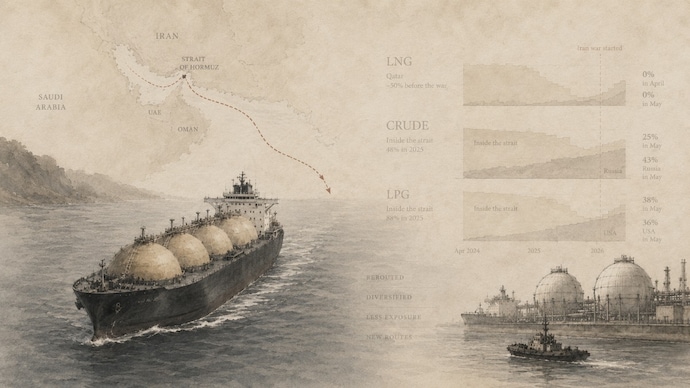
India spent the first months of this war moving its oil away from the Strait of Hormuz. Its cooking gas followed. Its LNG has gone further than either.
Qatar, which supplied nearly half of India's liquefied natural gas before the war, sent none in April and May, according to customs data from the Directorate General of Commercial Intelligence and Statistics. Suppliers loading inside the strait sent 61 per cent of India's LNG in 2025. In May, they sent two per cent.
India did not buy less gas. It bought $1,360 million of LNG in May, more than in most months of 2025, from the United States, Oman, Nigeria, Trinidad, and Angola instead.
WHAT THE MINISTER SAID, AND WHAT CUSTOMS DATA SHOWS
Petroleum Minister Hardeep Singh Puri told Parliament in March that about 70 per cent of India's crude was arriving by routes that avoid Hormuz, up from about 55 per cent before the war. He said India imports about 60 per cent of the LPG it burns, and that about 90 per cent of that came through the strait. The customs data support both figures, and show what has happened since.
For crude, suppliers inside the strait sent 48 per cent of India's imports by value in 2025 and 25 per cent by May 2026. Read the other way: 52 per cent avoided the strait before the war, close to the minister's 55 per cent, and 75 per cent avoided it in May.
Russia took the load, rising from 19 per cent of India's crude in January to 43 per cent in May, worth $8,089 million in that month alone.
The customs data end in May, and ship-tracking suggests the Gulf has begun to return. Saudi supplies rebounded to 586,000 barrels a day through July 19, double the 293,000 of all June, lifting Riyadh back to about 10 per cent of India's imports, according to Kpler data. Those barrels increasingly leave from Yanbu, on the Red Sea route the Houthis have just declared closed.
COOKING GAS MOVED LAST
Liquefied petroleum gas was the exposure the minister named, and it was real: Gulf suppliers inside the strait sent 88 per cent of India's imports by value through 2025, and 87 per cent as late as January 2026. Then it fell: 84 per cent in February, the month the war began, 69 per cent in March, 62 per cent in April and 38 per cent in May. The United States is now the largest supplier of India's LPG at 36 per cent by value, ahead of the United Arab Emirates at 20 per cent. The mix moved; the quantity did not, at $1,058 million in May.
Refiners were also ordered to divert propane, butane and related streams into the LPG pool, lifting domestic output about 25 per cent, all of it going to households, according to the ministry.
THE STRAIT THEY LEFT
Hormuz traffic is down 93 per cent, to 3.9 oil tankers a day in the week to 19 July against a 2025 norm of 51, according to PortWatch. The risk to gas carriers is not hypothetical. One of the three ships attacked on 7 July, the day the US Navy-led Joint Maritime Information Centre raised its Hormuz threat level to "severe", was the Qatari-owned LPG carrier Al Rekayyat.
Some Gulf sellers stopped rather than tapered. Kuwait sent India $630 million of crude in January and nothing in May; Iraq sent $1,701 million and then $131 million.
Indian refiners stopped going to fetch it. Indian Oil abandoned plans to load the supertanker Lila Jamnagar, judging a laden Hormuz crossing too risky after several freighters were struck, and Mangalore Refinery has also suspended Iraqi liftings, according to people familiar with the matter. Neither company nor the ministry commented.
WHAT THIS FINDING CANNOT SAY
The trade data count LPG as propane and butane. Some is cooking gas for household cylinders, some is feedstock for petrochemical plants, and American propane serves both. So a 38 per cent Hormuz share for LPG trade is not the same statement as a 38 per cent share for the cooking-gas pool.
The shares are of value, not volume, and India's crude bill rose 85 per cent between January and May, from $10,274 million to $18,979 million. A shrinking band is not always a smaller cargo: American crude fell from 6.8 per cent of imports to 5.4 per cent while the dollar it earned rose 46 per cent.
May 2026 is a single month, and the Directorate General of Commercial Intelligence and Statistics marks it provisional. The direction across four months is unambiguous; the level in any one month is not.
So far, the damage is to cost, not supply. "There is no immediate disruption to India's crude imports," said Sumit Ritolia of Kpler, with the impact "largely limited to higher freight, insurance costs and market volatility".
WHAT IT COSTS, AND WHAT TO WATCH
Brent rose above $91 a barrel on Tuesday before easing past the $82 the US Energy Information Administration had forecast for 2026, when June's agreement to reopen Hormuz still held. India's crude basket reached $85.51 a barrel on July 20, from $68.21 on July 3, and every $10 adds roughly $42 million a day to the import bill. A voyage from the US Gulf Coast also costs more than a short haul from Ras Laffan, and for subsidised cylinders that land on the exchequer before the consumer.
The government has chosen to absorb that. When crude spiked in March, oil companies were losing about Rs 24 a litre on petrol and Rs 30 on diesel, and the government took the hit on its tax revenue rather than raise pump prices, Hardeep Puri said in March. It has not said what happens if the bill stays high.
June and July customs data will show whether the American share holds. If Hormuz reopens, the cheaper short haul returns. As the Red Sea closes too, with the Houthis declaring a blockade of Saudi Arabia, the barrels India moved to Yanbu have no way out either.
India spent the first months of this war moving its oil away from the Strait of Hormuz. Its cooking gas followed. Its LNG has gone further than either.
Qatar, which supplied nearly half of India's liquefied natural gas before the war, sent none in April and May, according to customs data from the Directorate General of Commercial Intelligence and Statistics. Suppliers loading inside the strait sent 61 per cent of India's LNG in 2025. In May, they sent two per cent.
India did not buy less gas. It bought $1,360 million of LNG in May, more than in most months of 2025, from the United States, Oman, Nigeria, Trinidad, and Angola instead.
WHAT THE MINISTER SAID, AND WHAT CUSTOMS DATA SHOWS
Petroleum Minister Hardeep Singh Puri told Parliament in March that about 70 per cent of India's crude was arriving by routes that avoid Hormuz, up from about 55 per cent before the war. He said India imports about 60 per cent of the LPG it burns, and that about 90 per cent of that came through the strait. The customs data support both figures, and show what has happened since.
For crude, suppliers inside the strait sent 48 per cent of India's imports by value in 2025 and 25 per cent by May 2026. Read the other way: 52 per cent avoided the strait before the war, close to the minister's 55 per cent, and 75 per cent avoided it in May.
Russia took the load, rising from 19 per cent of India's crude in January to 43 per cent in May, worth $8,089 million in that month alone.
The customs data end in May, and ship-tracking suggests the Gulf has begun to return. Saudi supplies rebounded to 586,000 barrels a day through July 19, double the 293,000 of all June, lifting Riyadh back to about 10 per cent of India's imports, according to Kpler data. Those barrels increasingly leave from Yanbu, on the Red Sea route the Houthis have just declared closed.
COOKING GAS MOVED LAST
Liquefied petroleum gas was the exposure the minister named, and it was real: Gulf suppliers inside the strait sent 88 per cent of India's imports by value through 2025, and 87 per cent as late as January 2026. Then it fell: 84 per cent in February, the month the war began, 69 per cent in March, 62 per cent in April and 38 per cent in May. The United States is now the largest supplier of India's LPG at 36 per cent by value, ahead of the United Arab Emirates at 20 per cent. The mix moved; the quantity did not, at $1,058 million in May.
Refiners were also ordered to divert propane, butane and related streams into the LPG pool, lifting domestic output about 25 per cent, all of it going to households, according to the ministry.
THE STRAIT THEY LEFT
Hormuz traffic is down 93 per cent, to 3.9 oil tankers a day in the week to 19 July against a 2025 norm of 51, according to PortWatch. The risk to gas carriers is not hypothetical. One of the three ships attacked on 7 July, the day the US Navy-led Joint Maritime Information Centre raised its Hormuz threat level to "severe", was the Qatari-owned LPG carrier Al Rekayyat.
Some Gulf sellers stopped rather than tapered. Kuwait sent India $630 million of crude in January and nothing in May; Iraq sent $1,701 million and then $131 million.
Indian refiners stopped going to fetch it. Indian Oil abandoned plans to load the supertanker Lila Jamnagar, judging a laden Hormuz crossing too risky after several freighters were struck, and Mangalore Refinery has also suspended Iraqi liftings, according to people familiar with the matter. Neither company nor the ministry commented.
WHAT THIS FINDING CANNOT SAY
The trade data count LPG as propane and butane. Some is cooking gas for household cylinders, some is feedstock for petrochemical plants, and American propane serves both. So a 38 per cent Hormuz share for LPG trade is not the same statement as a 38 per cent share for the cooking-gas pool.
The shares are of value, not volume, and India's crude bill rose 85 per cent between January and May, from $10,274 million to $18,979 million. A shrinking band is not always a smaller cargo: American crude fell from 6.8 per cent of imports to 5.4 per cent while the dollar it earned rose 46 per cent.
May 2026 is a single month, and the Directorate General of Commercial Intelligence and Statistics marks it provisional. The direction across four months is unambiguous; the level in any one month is not.
So far, the damage is to cost, not supply. "There is no immediate disruption to India's crude imports," said Sumit Ritolia of Kpler, with the impact "largely limited to higher freight, insurance costs and market volatility".
WHAT IT COSTS, AND WHAT TO WATCH
Brent rose above $91 a barrel on Tuesday before easing past the $82 the US Energy Information Administration had forecast for 2026, when June's agreement to reopen Hormuz still held. India's crude basket reached $85.51 a barrel on July 20, from $68.21 on July 3, and every $10 adds roughly $42 million a day to the import bill. A voyage from the US Gulf Coast also costs more than a short haul from Ras Laffan, and for subsidised cylinders that land on the exchequer before the consumer.
The government has chosen to absorb that. When crude spiked in March, oil companies were losing about Rs 24 a litre on petrol and Rs 30 on diesel, and the government took the hit on its tax revenue rather than raise pump prices, Hardeep Puri said in March. It has not said what happens if the bill stays high.
June and July customs data will show whether the American share holds. If Hormuz reopens, the cheaper short haul returns. As the Red Sea closes too, with the Houthis declaring a blockade of Saudi Arabia, the barrels India moved to Yanbu have no way out either.
India spent the first months of this war moving its oil away from the Strait of Hormuz. Its cooking gas followed. Its LNG has gone further than either.
Qatar, which supplied nearly half of India's liquefied natural gas before the war, sent none in April and May, according to customs data from the Directorate General of Commercial Intelligence and Statistics. Suppliers loading inside the strait sent 61 per cent of India's LNG in 2025. In May, they sent two per cent.
India did not buy less gas. It bought $1,360 million of LNG in May, more than in most months of 2025, from the United States, Oman, Nigeria, Trinidad, and Angola instead.
WHAT THE MINISTER SAID, AND WHAT CUSTOMS DATA SHOWS
Petroleum Minister Hardeep Singh Puri told Parliament in March that about 70 per cent of India's crude was arriving by routes that avoid Hormuz, up from about 55 per cent before the war. He said India imports about 60 per cent of the LPG it burns, and that about 90 per cent of that came through the strait. The customs data support both figures, and show what has happened since.
For crude, suppliers inside the strait sent 48 per cent of India's imports by value in 2025 and 25 per cent by May 2026. Read the other way: 52 per cent avoided the strait before the war, close to the minister's 55 per cent, and 75 per cent avoided it in May.
Russia took the load, rising from 19 per cent of India's crude in January to 43 per cent in May, worth $8,089 million in that month alone.
The customs data end in May, and ship-tracking suggests the Gulf has begun to return. Saudi supplies rebounded to 586,000 barrels a day through July 19, double the 293,000 of all June, lifting Riyadh back to about 10 per cent of India's imports, according to Kpler data. Those barrels increasingly leave from Yanbu, on the Red Sea route the Houthis have just declared closed.
COOKING GAS MOVED LAST
Liquefied petroleum gas was the exposure the minister named, and it was real: Gulf suppliers inside the strait sent 88 per cent of India's imports by value through 2025, and 87 per cent as late as January 2026. Then it fell: 84 per cent in February, the month the war began, 69 per cent in March, 62 per cent in April and 38 per cent in May. The United States is now the largest supplier of India's LPG at 36 per cent by value, ahead of the United Arab Emirates at 20 per cent. The mix moved; the quantity did not, at $1,058 million in May.
Refiners were also ordered to divert propane, butane and related streams into the LPG pool, lifting domestic output about 25 per cent, all of it going to households, according to the ministry.
THE STRAIT THEY LEFT
Hormuz traffic is down 93 per cent, to 3.9 oil tankers a day in the week to 19 July against a 2025 norm of 51, according to PortWatch. The risk to gas carriers is not hypothetical. One of the three ships attacked on 7 July, the day the US Navy-led Joint Maritime Information Centre raised its Hormuz threat level to "severe", was the Qatari-owned LPG carrier Al Rekayyat.
Some Gulf sellers stopped rather than tapered. Kuwait sent India $630 million of crude in January and nothing in May; Iraq sent $1,701 million and then $131 million.
Indian refiners stopped going to fetch it. Indian Oil abandoned plans to load the supertanker Lila Jamnagar, judging a laden Hormuz crossing too risky after several freighters were struck, and Mangalore Refinery has also suspended Iraqi liftings, according to people familiar with the matter. Neither company nor the ministry commented.
WHAT THIS FINDING CANNOT SAY
The trade data count LPG as propane and butane. Some is cooking gas for household cylinders, some is feedstock for petrochemical plants, and American propane serves both. So a 38 per cent Hormuz share for LPG trade is not the same statement as a 38 per cent share for the cooking-gas pool.
The shares are of value, not volume, and India's crude bill rose 85 per cent between January and May, from $10,274 million to $18,979 million. A shrinking band is not always a smaller cargo: American crude fell from 6.8 per cent of imports to 5.4 per cent while the dollar it earned rose 46 per cent.
May 2026 is a single month, and the Directorate General of Commercial Intelligence and Statistics marks it provisional. The direction across four months is unambiguous; the level in any one month is not.
So far, the damage is to cost, not supply. "There is no immediate disruption to India's crude imports," said Sumit Ritolia of Kpler, with the impact "largely limited to higher freight, insurance costs and market volatility".
WHAT IT COSTS, AND WHAT TO WATCH
Brent rose above $91 a barrel on Tuesday before easing past the $82 the US Energy Information Administration had forecast for 2026, when June's agreement to reopen Hormuz still held. India's crude basket reached $85.51 a barrel on July 20, from $68.21 on July 3, and every $10 adds roughly $42 million a day to the import bill. A voyage from the US Gulf Coast also costs more than a short haul from Ras Laffan, and for subsidised cylinders that land on the exchequer before the consumer.
The government has chosen to absorb that. When crude spiked in March, oil companies were losing about Rs 24 a litre on petrol and Rs 30 on diesel, and the government took the hit on its tax revenue rather than raise pump prices, Hardeep Puri said in March. It has not said what happens if the bill stays high.
June and July customs data will show whether the American share holds. If Hormuz reopens, the cheaper short haul returns. As the Red Sea closes too, with the Houthis declaring a blockade of Saudi Arabia, the barrels India moved to Yanbu have no way out either.

