Abhijeet Dipke is the leader of the vacuum
The Cockroach Janta Party is not about Abhijeet Dipke. It is about the vacancy he filled.
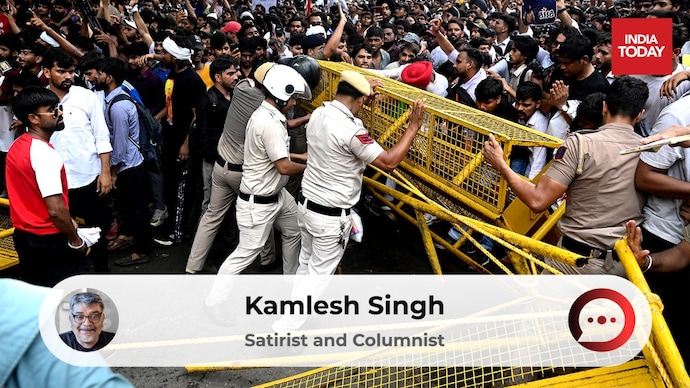
Very little was known about Abhijeet Dipke before he landed in India to a ready-made following called the Cockroach Janta Party movement. Now, as the CJP protests wind down into dialogue after a month on the streets, we still know next to nothing about him. His diehard followers know even less, and mind even less. What we have is a thin resume: a Maharashtra upbringing, a brief stint with the Aam Aadmi Party, a supposed degree in public relations from Boston, and a hero's welcome at the airport. A man trained in public relations returned to find a public desperate to relate. That should worry us more than it flatters him.
Consider the contrast. This country does not lack opposition leaders. It has them in every shade, every age bracket, every level of commitment. From Omar Abdullah to Udayanidhi Stalin, from Sachin Pilot to Rahul Gandhi, these are people with a public record, years of statements, positions taken, causes agitated for.
You may disagree with their politics, but you know their politics. You know what they think, what they stand for, what they would do with power. Yet the youth of this country made a beeline for Jantar Mantar to follow a man about whom they cannot say whether he is a fraud or a saint. They did not know the source of funds for the event. They knew Junaid brings the food, like the milk comes from Mother Dairy. From where does it come to the booth? They do not know. They did not ask.
Nothing in India is unprecedented. Everything that happens has happened before. But this time the hero was not a familiar material. It was not always so. Anna Hazare was famous long before he reached Ramlila Maidan. Arvind Kejriwal, whom this author first met when a newspaper honoured him for public service, had run an NGO for the marginalised and won a Magsaysay for it. Kiran Bedi, Prashant Bhushan, Yogendra Yadav, each arrived with credentials and a track record the public could inspect.
The 2011 movement was led by knowns. The 2026 movement is led by an unknown, which is why Dipke had to go shopping for a track record. He found one in Sonam Wangchuk, whose fast lent the disparate crowd some credibility and, because only he could, some sanity.
Many saw widespread support for a movement. I saw a desperate cry for a leader. Any leader.
About 43% of the voters in the 2024 general election backed the NDA. Rahul Gandhi, being the Leader of the Opposition in the Lok Sabha, should be the representative of the rest of the 57%. After elections are done, the PM is the PM for the entire country, even those who didn't vote for their party. By that logic, the LoP, though just a statutory post, should be the voice of all those who voted and didn't.
The protest was triggered by the failure of the government. But it was sustained by a second failure: the opposition's failure to become the voice of the young. Not for want of trying. Rahul Gandhi spends a good part of his life walking through universities and talking to students. Why, then, did the youth line up behind an untested, unknown commodity instead? That question should keep the opposition awake longer than it keeps the government.
Here is the anatomy of what happened. A mass movement emerges where grievance meets ideology. This one had grievance in abundance and ideology in absence. Dipke spotted the discontent and gave it a stage. He used the images of the dead NEET children to stir sympathy, while the living victims were at home preparing for the reexamination. Any leader with the heart to harvest a tragedy has the makings of a politician, and he has those makings.
The government, for its part, was happy to let the pressure vent. The result was a grievance fest where every disgruntled faction ran its own agenda, and the clashing ideologies cancelled each other out. A leader without an ideology, leading a crowd without a direction. This time.
But what happens when an ideology finds the grievance? If that ideology belongs to people who hold India's broader interest, the energy gets channelised into reform, into politics, into the system. If it does not, we know how the film ends, because it has been running in our neighbourhood on repeat. Sri Lanka, 2022. Bangladesh, 2024. And Nepal, 2025, where a ban on 26 social media platforms detonated a decade of resentment over corruption and joblessness. Within five days, parliament was in flames, the prime minister had resigned, and 74 people were dead.
Now, Nepal's Gen Z are agitating against their new installation because they are surprised to see the promises of a revolution haven't become reality. The grievances in each country were genuine. The aftermath, in each country, was up for grabs. That is the thing about leaderless uprisings: the leadership vacancy does not stay vacant. Somebody always moves in, and the tenant is not always chosen by the tenant.
Nor is the interference hypothetical. Pakistan's ISI runs various operations to stir the communal cauldron India is. Bangladeshi elements have worked overtime to widen the regional rifts. Meta has taken down China-based networks of fake accounts posing as journalists, lawyers and human rights activists, targeting India and Tibet, accusing the Indian government of corruption. Another China-origin operation invented a fictitious activist movement, complete with calls for protests abroad. These were caught early and were clumsy. The next ones will be neither.
We have adversaries running social media farms at industrial scale, and a demographic dividend that lives on those very platforms. Narendra Modi calls our youth India's greatest asset. Assets left unattended become targets.
Which brings me to the government's side of the ledger. Let the safety valve be. Do not tamper with it. The perception of institutional capture does the state no good, even if you plead that the capture is only perception. When politicians switch sides with the ease of switching SIM cards, the credibility of the whole polity drops. It may make the ruling party look invincible, but it sows in young minds the suspicion that there is no recourse, no remedy, because their representatives can be bought and sold. The algorithm has a rhythm and rhyme can be supplied. The repeated allegations of misuse of the ED, the CBI and the Election Commission may well be propaganda. But unanswered propaganda feeds young minds, and a failure to counter the perception reads as an admission. We do not only need a clean polity. We need a polity that is seen to be clean.
Abhijeet Dipke has potential. He may turn out a patriot, a politician, or a passing headline. The movement he rode will subside, as movements do. But the vacancy it revealed will remain: millions of young Indians with real grievances and no political home, waiting for anyone with a megaphone and a moment.
Because at the same moment, India had a private firm sending a rocket into the space, a hydrogen-powered engine rolling on the rails, a PV Sindhu returning with a bang. India is on the cusp of a momentum she has waited decades for, and there are forces, within and without, who would rather she stumbled at the doorstep. The lesson from Kathmandu is not that the young are dangerous. It is that a house with its windows open and its wiring exposed invites every passing spark. We need the house in order. Not to keep the young in. To keep the arsonists out.
(Kamlesh Singh, a columnist and satirist, is Tau of the popular Teen Taal podcast)
Very little was known about Abhijeet Dipke before he landed in India to a ready-made following called the Cockroach Janta Party movement. Now, as the CJP protests wind down into dialogue after a month on the streets, we still know next to nothing about him. His diehard followers know even less, and mind even less. What we have is a thin resume: a Maharashtra upbringing, a brief stint with the Aam Aadmi Party, a supposed degree in public relations from Boston, and a hero's welcome at the airport. A man trained in public relations returned to find a public desperate to relate. That should worry us more than it flatters him.
Consider the contrast. This country does not lack opposition leaders. It has them in every shade, every age bracket, every level of commitment. From Omar Abdullah to Udayanidhi Stalin, from Sachin Pilot to Rahul Gandhi, these are people with a public record, years of statements, positions taken, causes agitated for.
You may disagree with their politics, but you know their politics. You know what they think, what they stand for, what they would do with power. Yet the youth of this country made a beeline for Jantar Mantar to follow a man about whom they cannot say whether he is a fraud or a saint. They did not know the source of funds for the event. They knew Junaid brings the food, like the milk comes from Mother Dairy. From where does it come to the booth? They do not know. They did not ask.
Nothing in India is unprecedented. Everything that happens has happened before. But this time the hero was not a familiar material. It was not always so. Anna Hazare was famous long before he reached Ramlila Maidan. Arvind Kejriwal, whom this author first met when a newspaper honoured him for public service, had run an NGO for the marginalised and won a Magsaysay for it. Kiran Bedi, Prashant Bhushan, Yogendra Yadav, each arrived with credentials and a track record the public could inspect.
The 2011 movement was led by knowns. The 2026 movement is led by an unknown, which is why Dipke had to go shopping for a track record. He found one in Sonam Wangchuk, whose fast lent the disparate crowd some credibility and, because only he could, some sanity.
Many saw widespread support for a movement. I saw a desperate cry for a leader. Any leader.
About 43% of the voters in the 2024 general election backed the NDA. Rahul Gandhi, being the Leader of the Opposition in the Lok Sabha, should be the representative of the rest of the 57%. After elections are done, the PM is the PM for the entire country, even those who didn't vote for their party. By that logic, the LoP, though just a statutory post, should be the voice of all those who voted and didn't.
The protest was triggered by the failure of the government. But it was sustained by a second failure: the opposition's failure to become the voice of the young. Not for want of trying. Rahul Gandhi spends a good part of his life walking through universities and talking to students. Why, then, did the youth line up behind an untested, unknown commodity instead? That question should keep the opposition awake longer than it keeps the government.
Here is the anatomy of what happened. A mass movement emerges where grievance meets ideology. This one had grievance in abundance and ideology in absence. Dipke spotted the discontent and gave it a stage. He used the images of the dead NEET children to stir sympathy, while the living victims were at home preparing for the reexamination. Any leader with the heart to harvest a tragedy has the makings of a politician, and he has those makings.
The government, for its part, was happy to let the pressure vent. The result was a grievance fest where every disgruntled faction ran its own agenda, and the clashing ideologies cancelled each other out. A leader without an ideology, leading a crowd without a direction. This time.
But what happens when an ideology finds the grievance? If that ideology belongs to people who hold India's broader interest, the energy gets channelised into reform, into politics, into the system. If it does not, we know how the film ends, because it has been running in our neighbourhood on repeat. Sri Lanka, 2022. Bangladesh, 2024. And Nepal, 2025, where a ban on 26 social media platforms detonated a decade of resentment over corruption and joblessness. Within five days, parliament was in flames, the prime minister had resigned, and 74 people were dead.
Now, Nepal's Gen Z are agitating against their new installation because they are surprised to see the promises of a revolution haven't become reality. The grievances in each country were genuine. The aftermath, in each country, was up for grabs. That is the thing about leaderless uprisings: the leadership vacancy does not stay vacant. Somebody always moves in, and the tenant is not always chosen by the tenant.
Nor is the interference hypothetical. Pakistan's ISI runs various operations to stir the communal cauldron India is. Bangladeshi elements have worked overtime to widen the regional rifts. Meta has taken down China-based networks of fake accounts posing as journalists, lawyers and human rights activists, targeting India and Tibet, accusing the Indian government of corruption. Another China-origin operation invented a fictitious activist movement, complete with calls for protests abroad. These were caught early and were clumsy. The next ones will be neither.
We have adversaries running social media farms at industrial scale, and a demographic dividend that lives on those very platforms. Narendra Modi calls our youth India's greatest asset. Assets left unattended become targets.
Which brings me to the government's side of the ledger. Let the safety valve be. Do not tamper with it. The perception of institutional capture does the state no good, even if you plead that the capture is only perception. When politicians switch sides with the ease of switching SIM cards, the credibility of the whole polity drops. It may make the ruling party look invincible, but it sows in young minds the suspicion that there is no recourse, no remedy, because their representatives can be bought and sold. The algorithm has a rhythm and rhyme can be supplied. The repeated allegations of misuse of the ED, the CBI and the Election Commission may well be propaganda. But unanswered propaganda feeds young minds, and a failure to counter the perception reads as an admission. We do not only need a clean polity. We need a polity that is seen to be clean.
Abhijeet Dipke has potential. He may turn out a patriot, a politician, or a passing headline. The movement he rode will subside, as movements do. But the vacancy it revealed will remain: millions of young Indians with real grievances and no political home, waiting for anyone with a megaphone and a moment.
Because at the same moment, India had a private firm sending a rocket into the space, a hydrogen-powered engine rolling on the rails, a PV Sindhu returning with a bang. India is on the cusp of a momentum she has waited decades for, and there are forces, within and without, who would rather she stumbled at the doorstep. The lesson from Kathmandu is not that the young are dangerous. It is that a house with its windows open and its wiring exposed invites every passing spark. We need the house in order. Not to keep the young in. To keep the arsonists out.
(Kamlesh Singh, a columnist and satirist, is Tau of the popular Teen Taal podcast)
Very little was known about Abhijeet Dipke before he landed in India to a ready-made following called the Cockroach Janta Party movement. Now, as the CJP protests wind down into dialogue after a month on the streets, we still know next to nothing about him. His diehard followers know even less, and mind even less. What we have is a thin resume: a Maharashtra upbringing, a brief stint with the Aam Aadmi Party, a supposed degree in public relations from Boston, and a hero's welcome at the airport. A man trained in public relations returned to find a public desperate to relate. That should worry us more than it flatters him.
Consider the contrast. This country does not lack opposition leaders. It has them in every shade, every age bracket, every level of commitment. From Omar Abdullah to Udayanidhi Stalin, from Sachin Pilot to Rahul Gandhi, these are people with a public record, years of statements, positions taken, causes agitated for.
You may disagree with their politics, but you know their politics. You know what they think, what they stand for, what they would do with power. Yet the youth of this country made a beeline for Jantar Mantar to follow a man about whom they cannot say whether he is a fraud or a saint. They did not know the source of funds for the event. They knew Junaid brings the food, like the milk comes from Mother Dairy. From where does it come to the booth? They do not know. They did not ask.
Nothing in India is unprecedented. Everything that happens has happened before. But this time the hero was not a familiar material. It was not always so. Anna Hazare was famous long before he reached Ramlila Maidan. Arvind Kejriwal, whom this author first met when a newspaper honoured him for public service, had run an NGO for the marginalised and won a Magsaysay for it. Kiran Bedi, Prashant Bhushan, Yogendra Yadav, each arrived with credentials and a track record the public could inspect.
The 2011 movement was led by knowns. The 2026 movement is led by an unknown, which is why Dipke had to go shopping for a track record. He found one in Sonam Wangchuk, whose fast lent the disparate crowd some credibility and, because only he could, some sanity.
Many saw widespread support for a movement. I saw a desperate cry for a leader. Any leader.
About 43% of the voters in the 2024 general election backed the NDA. Rahul Gandhi, being the Leader of the Opposition in the Lok Sabha, should be the representative of the rest of the 57%. After elections are done, the PM is the PM for the entire country, even those who didn't vote for their party. By that logic, the LoP, though just a statutory post, should be the voice of all those who voted and didn't.
The protest was triggered by the failure of the government. But it was sustained by a second failure: the opposition's failure to become the voice of the young. Not for want of trying. Rahul Gandhi spends a good part of his life walking through universities and talking to students. Why, then, did the youth line up behind an untested, unknown commodity instead? That question should keep the opposition awake longer than it keeps the government.
Here is the anatomy of what happened. A mass movement emerges where grievance meets ideology. This one had grievance in abundance and ideology in absence. Dipke spotted the discontent and gave it a stage. He used the images of the dead NEET children to stir sympathy, while the living victims were at home preparing for the reexamination. Any leader with the heart to harvest a tragedy has the makings of a politician, and he has those makings.
The government, for its part, was happy to let the pressure vent. The result was a grievance fest where every disgruntled faction ran its own agenda, and the clashing ideologies cancelled each other out. A leader without an ideology, leading a crowd without a direction. This time.
But what happens when an ideology finds the grievance? If that ideology belongs to people who hold India's broader interest, the energy gets channelised into reform, into politics, into the system. If it does not, we know how the film ends, because it has been running in our neighbourhood on repeat. Sri Lanka, 2022. Bangladesh, 2024. And Nepal, 2025, where a ban on 26 social media platforms detonated a decade of resentment over corruption and joblessness. Within five days, parliament was in flames, the prime minister had resigned, and 74 people were dead.
Now, Nepal's Gen Z are agitating against their new installation because they are surprised to see the promises of a revolution haven't become reality. The grievances in each country were genuine. The aftermath, in each country, was up for grabs. That is the thing about leaderless uprisings: the leadership vacancy does not stay vacant. Somebody always moves in, and the tenant is not always chosen by the tenant.
Nor is the interference hypothetical. Pakistan's ISI runs various operations to stir the communal cauldron India is. Bangladeshi elements have worked overtime to widen the regional rifts. Meta has taken down China-based networks of fake accounts posing as journalists, lawyers and human rights activists, targeting India and Tibet, accusing the Indian government of corruption. Another China-origin operation invented a fictitious activist movement, complete with calls for protests abroad. These were caught early and were clumsy. The next ones will be neither.
We have adversaries running social media farms at industrial scale, and a demographic dividend that lives on those very platforms. Narendra Modi calls our youth India's greatest asset. Assets left unattended become targets.
Which brings me to the government's side of the ledger. Let the safety valve be. Do not tamper with it. The perception of institutional capture does the state no good, even if you plead that the capture is only perception. When politicians switch sides with the ease of switching SIM cards, the credibility of the whole polity drops. It may make the ruling party look invincible, but it sows in young minds the suspicion that there is no recourse, no remedy, because their representatives can be bought and sold. The algorithm has a rhythm and rhyme can be supplied. The repeated allegations of misuse of the ED, the CBI and the Election Commission may well be propaganda. But unanswered propaganda feeds young minds, and a failure to counter the perception reads as an admission. We do not only need a clean polity. We need a polity that is seen to be clean.
Abhijeet Dipke has potential. He may turn out a patriot, a politician, or a passing headline. The movement he rode will subside, as movements do. But the vacancy it revealed will remain: millions of young Indians with real grievances and no political home, waiting for anyone with a megaphone and a moment.
Because at the same moment, India had a private firm sending a rocket into the space, a hydrogen-powered engine rolling on the rails, a PV Sindhu returning with a bang. India is on the cusp of a momentum she has waited decades for, and there are forces, within and without, who would rather she stumbled at the doorstep. The lesson from Kathmandu is not that the young are dangerous. It is that a house with its windows open and its wiring exposed invites every passing spark. We need the house in order. Not to keep the young in. To keep the arsonists out.
(Kamlesh Singh, a columnist and satirist, is Tau of the popular Teen Taal podcast)

