Einstein was right: Biggest black hole study fails to prove his theory wrong again
Scientists analysed 168 gravitational-wave signals from colliding black holes and found no break from Einstein's theory of gravity. The result tightens limits on rival theories and sets up sharper tests as more detectors come online.
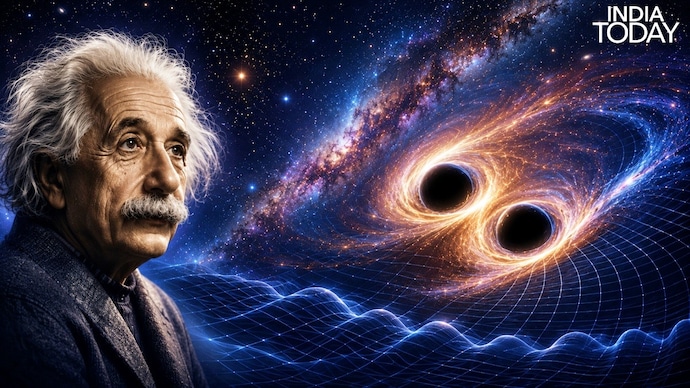
More than 100 years after Albert Einstein proposed his revolutionary theory of general relativity, it has once again survived its toughest test yet.
Scientists from the LIGO-Virgo-KAGRA (LVK) Collaboration have completed the largest-ever investigation into Einstein's theory using 168 gravitational-wave signals produced by colliding black holes.
The findings revealed no evidence that Einstein's description of gravity breaks down, even under the most extreme conditions in the Universe.
The study, which analysed 77 newly detected gravitational-wave events alongside 91 previously observed black hole mergers, places the strongest constraints yet on alternative theories of gravity.
Gravitational waves are tiny ripples in the fabric of space-time generated when massive objects such as black holes spiral together and merge. First predicted by Einstein in 1916 and directly detected for the first time in 2015, these waves have become one of the most powerful tools for testing the laws of physics.
Unlike experiments on Earth, black hole collisions create gravitational fields billions of times stronger than anything humans can produce, offering an unprecedented laboratory to probe whether Einstein's equations still hold.
Researchers examined every stage of the mergers, from the slow inspiral of two black holes to the violent collision and the final "ringdown," when the newly formed black hole vibrates before settling down.
They also searched for tiny distortions in gravitational waves predicted by competing theories of gravity, tested whether the waves travelled exactly as Einstein predicted, and examined whether the final black holes obeyed the famous "no-hair theorem," which states that black holes can be described entirely by their mass, spin and electric charge.
Across all 168 events, the answer remained the same: Einstein was right.
"No statistically significant evidence for new gravitational physics was observed," the collaboration said, noting that the expanded catalogue has significantly tightened the limits on any possible deviations from general relativity.
Among the standout observations was GW250114, now the loudest gravitational-wave signal ever detected. Together with another exceptionally strong event, GW240621, scientists were able to detect not only the dominant vibration of the newly formed black hole but also a weaker secondary oscillation.
Capturing these multiple "ringdown" vibrations represents one of the most precise observational tests of black hole physics ever achieved.
India also played an important role in the landmark study. The LIGO-India Scientific Collaboration (LISC), comprising researchers from 17 institutions, contributed to coordinating, reviewing and validating the scientific analyses.
Dr. Apratim Ganguly of the Inter-University Centre for Astronomy and Astrophysics (IUCAA), Pune, served as the Editorial Team Chair for the publication, while Indian scientists across the world led several key tests of Einstein's theory.
"The latest observing run has delivered several exceptional gravitational-wave events, including the loudest signal ever detected," said Dr. Ganguly. "Although we find no evidence for deviations from Einstein's theory, these results place significantly tighter constraints on possible alternatives and highlight the tremendous scientific potential of the rapidly growing gravitational-wave catalogue."
The findings also offer a glimpse of what lies ahead. As the global network of gravitational-wave detectors becomes more sensitive, and with LIGO-India expected to join the international network in the coming years, scientists anticipate detecting hundreds more black hole mergers, allowing Einstein's theory to be tested with even greater precision.
More than 100 years after Albert Einstein proposed his revolutionary theory of general relativity, it has once again survived its toughest test yet.
Scientists from the LIGO-Virgo-KAGRA (LVK) Collaboration have completed the largest-ever investigation into Einstein's theory using 168 gravitational-wave signals produced by colliding black holes.
The findings revealed no evidence that Einstein's description of gravity breaks down, even under the most extreme conditions in the Universe.
The study, which analysed 77 newly detected gravitational-wave events alongside 91 previously observed black hole mergers, places the strongest constraints yet on alternative theories of gravity.
Gravitational waves are tiny ripples in the fabric of space-time generated when massive objects such as black holes spiral together and merge. First predicted by Einstein in 1916 and directly detected for the first time in 2015, these waves have become one of the most powerful tools for testing the laws of physics.
Unlike experiments on Earth, black hole collisions create gravitational fields billions of times stronger than anything humans can produce, offering an unprecedented laboratory to probe whether Einstein's equations still hold.
Researchers examined every stage of the mergers, from the slow inspiral of two black holes to the violent collision and the final "ringdown," when the newly formed black hole vibrates before settling down.
They also searched for tiny distortions in gravitational waves predicted by competing theories of gravity, tested whether the waves travelled exactly as Einstein predicted, and examined whether the final black holes obeyed the famous "no-hair theorem," which states that black holes can be described entirely by their mass, spin and electric charge.
Across all 168 events, the answer remained the same: Einstein was right.
"No statistically significant evidence for new gravitational physics was observed," the collaboration said, noting that the expanded catalogue has significantly tightened the limits on any possible deviations from general relativity.
Among the standout observations was GW250114, now the loudest gravitational-wave signal ever detected. Together with another exceptionally strong event, GW240621, scientists were able to detect not only the dominant vibration of the newly formed black hole but also a weaker secondary oscillation.
Capturing these multiple "ringdown" vibrations represents one of the most precise observational tests of black hole physics ever achieved.
India also played an important role in the landmark study. The LIGO-India Scientific Collaboration (LISC), comprising researchers from 17 institutions, contributed to coordinating, reviewing and validating the scientific analyses.
Dr. Apratim Ganguly of the Inter-University Centre for Astronomy and Astrophysics (IUCAA), Pune, served as the Editorial Team Chair for the publication, while Indian scientists across the world led several key tests of Einstein's theory.
"The latest observing run has delivered several exceptional gravitational-wave events, including the loudest signal ever detected," said Dr. Ganguly. "Although we find no evidence for deviations from Einstein's theory, these results place significantly tighter constraints on possible alternatives and highlight the tremendous scientific potential of the rapidly growing gravitational-wave catalogue."
The findings also offer a glimpse of what lies ahead. As the global network of gravitational-wave detectors becomes more sensitive, and with LIGO-India expected to join the international network in the coming years, scientists anticipate detecting hundreds more black hole mergers, allowing Einstein's theory to be tested with even greater precision.
More than 100 years after Albert Einstein proposed his revolutionary theory of general relativity, it has once again survived its toughest test yet.
Scientists from the LIGO-Virgo-KAGRA (LVK) Collaboration have completed the largest-ever investigation into Einstein's theory using 168 gravitational-wave signals produced by colliding black holes.
The findings revealed no evidence that Einstein's description of gravity breaks down, even under the most extreme conditions in the Universe.
The study, which analysed 77 newly detected gravitational-wave events alongside 91 previously observed black hole mergers, places the strongest constraints yet on alternative theories of gravity.
Gravitational waves are tiny ripples in the fabric of space-time generated when massive objects such as black holes spiral together and merge. First predicted by Einstein in 1916 and directly detected for the first time in 2015, these waves have become one of the most powerful tools for testing the laws of physics.
Unlike experiments on Earth, black hole collisions create gravitational fields billions of times stronger than anything humans can produce, offering an unprecedented laboratory to probe whether Einstein's equations still hold.
Researchers examined every stage of the mergers, from the slow inspiral of two black holes to the violent collision and the final "ringdown," when the newly formed black hole vibrates before settling down.
They also searched for tiny distortions in gravitational waves predicted by competing theories of gravity, tested whether the waves travelled exactly as Einstein predicted, and examined whether the final black holes obeyed the famous "no-hair theorem," which states that black holes can be described entirely by their mass, spin and electric charge.
Across all 168 events, the answer remained the same: Einstein was right.
"No statistically significant evidence for new gravitational physics was observed," the collaboration said, noting that the expanded catalogue has significantly tightened the limits on any possible deviations from general relativity.
Among the standout observations was GW250114, now the loudest gravitational-wave signal ever detected. Together with another exceptionally strong event, GW240621, scientists were able to detect not only the dominant vibration of the newly formed black hole but also a weaker secondary oscillation.
Capturing these multiple "ringdown" vibrations represents one of the most precise observational tests of black hole physics ever achieved.
India also played an important role in the landmark study. The LIGO-India Scientific Collaboration (LISC), comprising researchers from 17 institutions, contributed to coordinating, reviewing and validating the scientific analyses.
Dr. Apratim Ganguly of the Inter-University Centre for Astronomy and Astrophysics (IUCAA), Pune, served as the Editorial Team Chair for the publication, while Indian scientists across the world led several key tests of Einstein's theory.
"The latest observing run has delivered several exceptional gravitational-wave events, including the loudest signal ever detected," said Dr. Ganguly. "Although we find no evidence for deviations from Einstein's theory, these results place significantly tighter constraints on possible alternatives and highlight the tremendous scientific potential of the rapidly growing gravitational-wave catalogue."
The findings also offer a glimpse of what lies ahead. As the global network of gravitational-wave detectors becomes more sensitive, and with LIGO-India expected to join the international network in the coming years, scientists anticipate detecting hundreds more black hole mergers, allowing Einstein's theory to be tested with even greater precision.

