Why is France shutting down its nuclear reactors during the heatwave?
France has shut down three nuclear reactors and reduced output at several others as a heatwave pushes river temperatures close to legal limits. Here is the science behind why hot rivers, not unsafe reactors, are forcing the cuts.
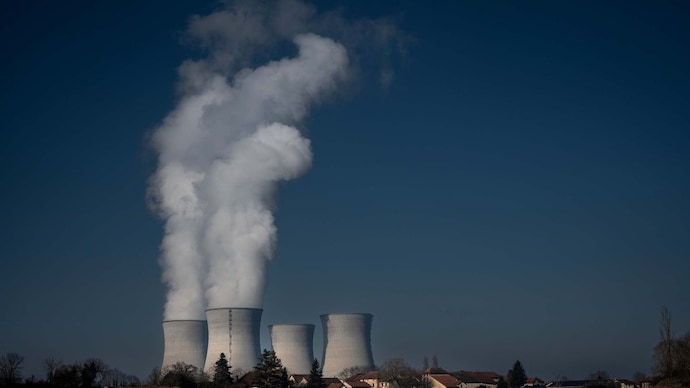
France has switched off three nuclear reactors this week, not because the machines are struggling, but because their rivers are too warm to absorb the heat those reactors need to shed.
As the country's third heatwave since May pushed temperatures past 40 degrees Celsius, state utility EDF confirmed that units at Golfech, Bugey and Chooz have been idled, with several more reactors running below full capacity as a precaution.
WHY DOES A NUCLEAR REACTOR NEED A RIVER AT ALL?
A nuclear reactor is, at its heart, a very elaborate kettle. Fission heats water into high pressure steam, and that steam spins a turbine to make electricity. Once the steam has done its job, it has to be turned back into water, so the cycle can repeat.
This happens inside a condenser, a chamber lined with thousands of tubes carrying cool river water. Heat passes from the spent steam into that water, which is then returned to the river a few degrees warmer than it arrived.
CAN A HOT DAY REALLY STOP A REACTOR THAT RUNS AT THOUSANDS OF DEGREES?
Yes, but not for safety reasons. French law, enforced by the Nuclear Safety Authority (ASN), caps how warm a river is allowed to get after a plant's discharge rejoins it. At Golfech, on the Garonne, the limit downstream is 28 degrees Celsius.
During a heatwave, the river can already sit close to that ceiling before the plant adds anything at all, leaving no room to release warmed water without breaking the rule. EDF must then throttle output or shut a unit down entirely.
WHY IS A FEW DEGREES OF WARM WATER SUCH A PROBLEM FOR RIVERS?
Warm water simply holds less dissolved oxygen, exactly when fish and other river life need more of it, because heat speeds up their metabolism.
That mismatch can suffocate fish, encourage toxic algae, and block migrating species such as salmon from reaching cooler water upstream. The temperature limits exist to stop that damage before it starts.
HOW MUCH ELECTRICITY HAS FRANCE ACTUALLY LOST?
The three idled reactors account for about 3.65 gigawatts, close to 6 per cent of the country's roughly 61 gigawatt nuclear fleet, with output at seven more units adjusted through the day.
Seen over a full year, though, these heat-driven cuts are small. EDF says losses from high river temperatures and low flow have averaged just 0.3 per cent of its annual nuclear generation since 2000.
WHAT IS FRANCE DOING SO THIS DOES NOT KEEP HAPPENING?
EDF has set out an adaptation plan worth 8.7 billion euros over 15 years. One idea already running at the Civaux plant is to cool discharge water before it reaches the river. Engineers are also studying hybrid cooling towers that can switch between evaporative cooling and dry, fan-driven cooling that uses barely any water at all, making output immune to river temperature limits altogether.
For now, France's nuclear fleet is behaving exactly as its rulebook demands: protecting the rivers it depends on, even at the cost of the power it was built to supply.
France has switched off three nuclear reactors this week, not because the machines are struggling, but because their rivers are too warm to absorb the heat those reactors need to shed.
As the country's third heatwave since May pushed temperatures past 40 degrees Celsius, state utility EDF confirmed that units at Golfech, Bugey and Chooz have been idled, with several more reactors running below full capacity as a precaution.
WHY DOES A NUCLEAR REACTOR NEED A RIVER AT ALL?
A nuclear reactor is, at its heart, a very elaborate kettle. Fission heats water into high pressure steam, and that steam spins a turbine to make electricity. Once the steam has done its job, it has to be turned back into water, so the cycle can repeat.
This happens inside a condenser, a chamber lined with thousands of tubes carrying cool river water. Heat passes from the spent steam into that water, which is then returned to the river a few degrees warmer than it arrived.
CAN A HOT DAY REALLY STOP A REACTOR THAT RUNS AT THOUSANDS OF DEGREES?
Yes, but not for safety reasons. French law, enforced by the Nuclear Safety Authority (ASN), caps how warm a river is allowed to get after a plant's discharge rejoins it. At Golfech, on the Garonne, the limit downstream is 28 degrees Celsius.
During a heatwave, the river can already sit close to that ceiling before the plant adds anything at all, leaving no room to release warmed water without breaking the rule. EDF must then throttle output or shut a unit down entirely.
WHY IS A FEW DEGREES OF WARM WATER SUCH A PROBLEM FOR RIVERS?
Warm water simply holds less dissolved oxygen, exactly when fish and other river life need more of it, because heat speeds up their metabolism.
That mismatch can suffocate fish, encourage toxic algae, and block migrating species such as salmon from reaching cooler water upstream. The temperature limits exist to stop that damage before it starts.
HOW MUCH ELECTRICITY HAS FRANCE ACTUALLY LOST?
The three idled reactors account for about 3.65 gigawatts, close to 6 per cent of the country's roughly 61 gigawatt nuclear fleet, with output at seven more units adjusted through the day.
Seen over a full year, though, these heat-driven cuts are small. EDF says losses from high river temperatures and low flow have averaged just 0.3 per cent of its annual nuclear generation since 2000.
WHAT IS FRANCE DOING SO THIS DOES NOT KEEP HAPPENING?
EDF has set out an adaptation plan worth 8.7 billion euros over 15 years. One idea already running at the Civaux plant is to cool discharge water before it reaches the river. Engineers are also studying hybrid cooling towers that can switch between evaporative cooling and dry, fan-driven cooling that uses barely any water at all, making output immune to river temperature limits altogether.
For now, France's nuclear fleet is behaving exactly as its rulebook demands: protecting the rivers it depends on, even at the cost of the power it was built to supply.

