Floods in Himachal, heavy rain in Delhi: India's monsoon to get fierce Tuesday
India's monsoon intensifies on Tuesday, with a red alert in Himachal Pradesh, a yellow alert in Delhi, and continuing flood misery in Assam. Here is what the IMD's latest forecast means for your city and why some regions face flash flood risk.
Somewhere over the Bay of Bengal and the plains of Punjab, several invisible spinning columns of air have lined up at once, and India is about to feel every one of them.
Tuesday, July 21 will be an unusually active monsoon day, the India Meteorological Department (IMD) has said.
The reason is a cluster of what meteorologists call upper-air cyclonic circulations, or pockets of swirling, low-pressure air a few kilometres above the ground that pull in moisture and organise it into rain bands.
The IMD has counted six of these in play right now, sitting over Punjab, south Uttar Pradesh, the Jharkhand-Bihar border, southwest Rajasthan, the west-central Bay of Bengal, and central Assam.
A trough, which is an elongated channel of low pressure, links several of them, stitching the rain together from Bihar all the way to Tripura.
WHAT DO RED, ORANGE AND YELLOW WEATHER ALERTS MEAN?
The IMD's colour codes are an action scale, not a mood scale. Green means no action needed, yellow means watch and stay aware, orange means be prepared to act, and red means take action now.
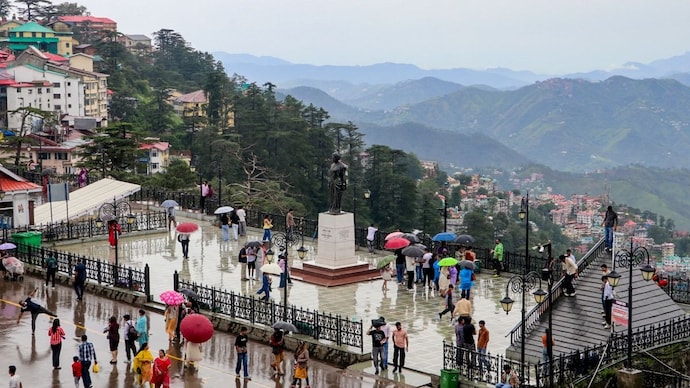
On Tuesday, Chamba, Kangra, Kullu, Mandi and Sirmaur in Himachal Pradesh are on red alert, with rainfall expected to cross 204.4 mm in 24 hours in isolated pockets, the IMD's own threshold for "extremely heavy" rain. Schools have shut in several of these districts.
WHY ARE HIMACHAL, JAMMU AND KASHMIR SO EXPOSED RIGHT NOW?
Both regions sit on steep Himalayan slopes already soaked from days of rain, so any fresh downpour runs off fast instead of soaking in, the classic recipe for a flash flood.
The IMD's flash-flood guidance names Poonch, Rajouri, Kulgam, Srinagar and Anantnag in Jammu and Kashmir, and Dehradun, Uttarkashi, Chamoli and Rudraprayag in Uttarakhand, as districts where saturated catchments could see sudden surface runoff.
This follows flash floods earlier this month that killed people in Poonch, Rajouri and Doda.
WILL DELHI GET RAIN ON JULY 21?
Yes, and it should finally feel cooler. Delhi-NCR is under a yellow alert, with cloudy skies, light to moderate rain in most places, an isolated heavy spell around midday, thunderstorms, and winds gusting to 50 kmph.
Both the maximum (31 to 33 degrees Celsius) and minimum (24 to 26 degrees Celsius) sit below normal for the date.
IS THE FLOODING IN ASSAM GETTING WORSE?
It already has. Over 57,000 people across seven districts are affected, with the Assam State Disaster Management Authority confirming five deaths this season, and the Army and Air Force placed on standby. Fresh, very heavy rain forecast for Assam and Meghalaya on Tuesday will add to an already stretched relief effort, while Nagaland is still recovering from a landslide in Mon district.
Meanwhile, Mumbai sits under an orange alert of its own, and southern India stays comparatively dry, proof that in a country this large, "the monsoon" is never really one weather event at all.
Somewhere over the Bay of Bengal and the plains of Punjab, several invisible spinning columns of air have lined up at once, and India is about to feel every one of them.
Tuesday, July 21 will be an unusually active monsoon day, the India Meteorological Department (IMD) has said.
The reason is a cluster of what meteorologists call upper-air cyclonic circulations, or pockets of swirling, low-pressure air a few kilometres above the ground that pull in moisture and organise it into rain bands.
The IMD has counted six of these in play right now, sitting over Punjab, south Uttar Pradesh, the Jharkhand-Bihar border, southwest Rajasthan, the west-central Bay of Bengal, and central Assam.
A trough, which is an elongated channel of low pressure, links several of them, stitching the rain together from Bihar all the way to Tripura.
WHAT DO RED, ORANGE AND YELLOW WEATHER ALERTS MEAN?
The IMD's colour codes are an action scale, not a mood scale. Green means no action needed, yellow means watch and stay aware, orange means be prepared to act, and red means take action now.
On Tuesday, Chamba, Kangra, Kullu, Mandi and Sirmaur in Himachal Pradesh are on red alert, with rainfall expected to cross 204.4 mm in 24 hours in isolated pockets, the IMD's own threshold for "extremely heavy" rain. Schools have shut in several of these districts.
WHY ARE HIMACHAL, JAMMU AND KASHMIR SO EXPOSED RIGHT NOW?
Both regions sit on steep Himalayan slopes already soaked from days of rain, so any fresh downpour runs off fast instead of soaking in, the classic recipe for a flash flood.
The IMD's flash-flood guidance names Poonch, Rajouri, Kulgam, Srinagar and Anantnag in Jammu and Kashmir, and Dehradun, Uttarkashi, Chamoli and Rudraprayag in Uttarakhand, as districts where saturated catchments could see sudden surface runoff.
This follows flash floods earlier this month that killed people in Poonch, Rajouri and Doda.
WILL DELHI GET RAIN ON JULY 21?
Yes, and it should finally feel cooler. Delhi-NCR is under a yellow alert, with cloudy skies, light to moderate rain in most places, an isolated heavy spell around midday, thunderstorms, and winds gusting to 50 kmph.
Both the maximum (31 to 33 degrees Celsius) and minimum (24 to 26 degrees Celsius) sit below normal for the date.
IS THE FLOODING IN ASSAM GETTING WORSE?
It already has. Over 57,000 people across seven districts are affected, with the Assam State Disaster Management Authority confirming five deaths this season, and the Army and Air Force placed on standby. Fresh, very heavy rain forecast for Assam and Meghalaya on Tuesday will add to an already stretched relief effort, while Nagaland is still recovering from a landslide in Mon district.
Meanwhile, Mumbai sits under an orange alert of its own, and southern India stays comparatively dry, proof that in a country this large, "the monsoon" is never really one weather event at all.
Somewhere over the Bay of Bengal and the plains of Punjab, several invisible spinning columns of air have lined up at once, and India is about to feel every one of them.
Tuesday, July 21 will be an unusually active monsoon day, the India Meteorological Department (IMD) has said.
The reason is a cluster of what meteorologists call upper-air cyclonic circulations, or pockets of swirling, low-pressure air a few kilometres above the ground that pull in moisture and organise it into rain bands.
The IMD has counted six of these in play right now, sitting over Punjab, south Uttar Pradesh, the Jharkhand-Bihar border, southwest Rajasthan, the west-central Bay of Bengal, and central Assam.
A trough, which is an elongated channel of low pressure, links several of them, stitching the rain together from Bihar all the way to Tripura.
WHAT DO RED, ORANGE AND YELLOW WEATHER ALERTS MEAN?
The IMD's colour codes are an action scale, not a mood scale. Green means no action needed, yellow means watch and stay aware, orange means be prepared to act, and red means take action now.
On Tuesday, Chamba, Kangra, Kullu, Mandi and Sirmaur in Himachal Pradesh are on red alert, with rainfall expected to cross 204.4 mm in 24 hours in isolated pockets, the IMD's own threshold for "extremely heavy" rain. Schools have shut in several of these districts.
WHY ARE HIMACHAL, JAMMU AND KASHMIR SO EXPOSED RIGHT NOW?
Both regions sit on steep Himalayan slopes already soaked from days of rain, so any fresh downpour runs off fast instead of soaking in, the classic recipe for a flash flood.
The IMD's flash-flood guidance names Poonch, Rajouri, Kulgam, Srinagar and Anantnag in Jammu and Kashmir, and Dehradun, Uttarkashi, Chamoli and Rudraprayag in Uttarakhand, as districts where saturated catchments could see sudden surface runoff.
This follows flash floods earlier this month that killed people in Poonch, Rajouri and Doda.
WILL DELHI GET RAIN ON JULY 21?
Yes, and it should finally feel cooler. Delhi-NCR is under a yellow alert, with cloudy skies, light to moderate rain in most places, an isolated heavy spell around midday, thunderstorms, and winds gusting to 50 kmph.
Both the maximum (31 to 33 degrees Celsius) and minimum (24 to 26 degrees Celsius) sit below normal for the date.
IS THE FLOODING IN ASSAM GETTING WORSE?
It already has. Over 57,000 people across seven districts are affected, with the Assam State Disaster Management Authority confirming five deaths this season, and the Army and Air Force placed on standby. Fresh, very heavy rain forecast for Assam and Meghalaya on Tuesday will add to an already stretched relief effort, while Nagaland is still recovering from a landslide in Mon district.
Meanwhile, Mumbai sits under an orange alert of its own, and southern India stays comparatively dry, proof that in a country this large, "the monsoon" is never really one weather event at all.

