India is launching a diamond lotus into space: Unique jewel to fly on Vikram-1
A lab-grown diamond lotus made in Bengaluru will fly on Skyroot Aerospace's Vikram-1 mission. The artefact is being presented as a symbol of Indian craftsmanship, culture and innovation.
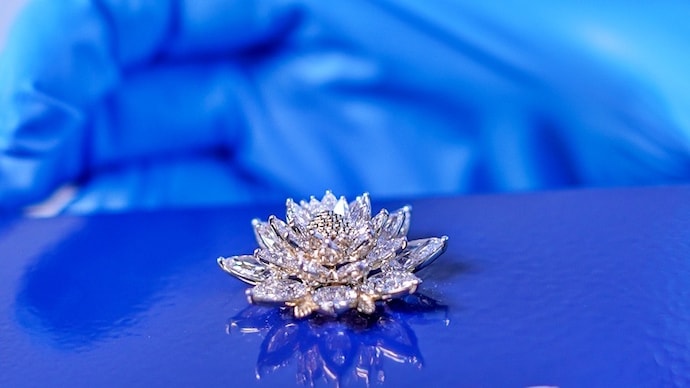
India's first private orbital rocket will carry an unusual payload on its maiden flight, a meticulously crafted lab-grown diamond lotus designed and manufactured in Bengaluru.
Jewellery brand Cosmos Diamonds has announced that one of its signature creations will fly aboard Skyroot Aerospace's Vikram-1 mission, marking what the company describes as the first time an Indian-made lab-grown diamond artefact will travel to space.
In a video unveiling the project, the company said the decision on what to send aboard the rocket was far from straightforward.
"Sending a diamond to space is not ordinary. This is making history. Anything we put on that rocket is a message from India to the world," Diamond Cosmos said, explaining that the team spent months debating what could best represent the country.
Ideas ranged from sending a single large diamond to creating a unique gemstone cut. However, the company ultimately chose a lotus, India's national flower, drawing inspiration from the country's cultural and spiritual heritage.
The designers said they looked to ancient Indian temples, where the lotus frequently appears alongside deities including Buddha, Vishnu, Lakshmi, Brahma, and Saraswati. The flower has long symbolised purity, creation and enlightenment in Indian traditions.
The symbolism also aligned with the company's identity. Cosmos refers to the universe and creation, while several Indian creation stories describe the universe emerging from a lotus. That connection, the team said, made the lotus the ideal emblem to represent India in space.
Designing the artefact, however, involved far more than aesthetics.
The company experimented with multiple versions, including open and partially closed lotus designs, before finalising a structure that features precision-cut lab-grown diamonds surrounding a gold centre. According to the designers, the gold core represents the seat traditionally associated with deities such as Lakshmi and Brahma in Indian iconography.
Unlike conventional jewellery, the space-bound artefact also had to satisfy engineering requirements.
Because diamonds are among the hardest naturally occurring materials, engineers needed to ensure that no gemstone could become detached during launch. The lotus therefore underwent extensive strength, vibration and structural tests to withstand the intense forces experienced during a rocket launch.
The mission will fly aboard Vikram-1, Skyroot Aerospace's maiden orbital launch vehicle, which is set to become the first privately developed Indian rocket to attempt placing satellites into orbit.
While the diamond itself is not a scientific payload, the company says it is intended to serve as a symbol of Indian craftsmanship, innovation and culture, carrying a piece of the country's artistic heritage beyond Earth's atmosphere for the first time.
India's first private orbital rocket will carry an unusual payload on its maiden flight, a meticulously crafted lab-grown diamond lotus designed and manufactured in Bengaluru.
Jewellery brand Cosmos Diamonds has announced that one of its signature creations will fly aboard Skyroot Aerospace's Vikram-1 mission, marking what the company describes as the first time an Indian-made lab-grown diamond artefact will travel to space.
In a video unveiling the project, the company said the decision on what to send aboard the rocket was far from straightforward.
"Sending a diamond to space is not ordinary. This is making history. Anything we put on that rocket is a message from India to the world," Diamond Cosmos said, explaining that the team spent months debating what could best represent the country.
Ideas ranged from sending a single large diamond to creating a unique gemstone cut. However, the company ultimately chose a lotus, India's national flower, drawing inspiration from the country's cultural and spiritual heritage.
The designers said they looked to ancient Indian temples, where the lotus frequently appears alongside deities including Buddha, Vishnu, Lakshmi, Brahma, and Saraswati. The flower has long symbolised purity, creation and enlightenment in Indian traditions.
The symbolism also aligned with the company's identity. Cosmos refers to the universe and creation, while several Indian creation stories describe the universe emerging from a lotus. That connection, the team said, made the lotus the ideal emblem to represent India in space.
Designing the artefact, however, involved far more than aesthetics.
The company experimented with multiple versions, including open and partially closed lotus designs, before finalising a structure that features precision-cut lab-grown diamonds surrounding a gold centre. According to the designers, the gold core represents the seat traditionally associated with deities such as Lakshmi and Brahma in Indian iconography.
Unlike conventional jewellery, the space-bound artefact also had to satisfy engineering requirements.
Because diamonds are among the hardest naturally occurring materials, engineers needed to ensure that no gemstone could become detached during launch. The lotus therefore underwent extensive strength, vibration and structural tests to withstand the intense forces experienced during a rocket launch.
The mission will fly aboard Vikram-1, Skyroot Aerospace's maiden orbital launch vehicle, which is set to become the first privately developed Indian rocket to attempt placing satellites into orbit.
While the diamond itself is not a scientific payload, the company says it is intended to serve as a symbol of Indian craftsmanship, innovation and culture, carrying a piece of the country's artistic heritage beyond Earth's atmosphere for the first time.

