Astronaut clicks never-before-seen picture of Milky Way galaxy from outside Earth
The image is the result of months of orbital photography, specialised camera equipment and an ingenious solution that overcame one of the biggest challenges of photographing stars from a spacecraft racing around Earth.
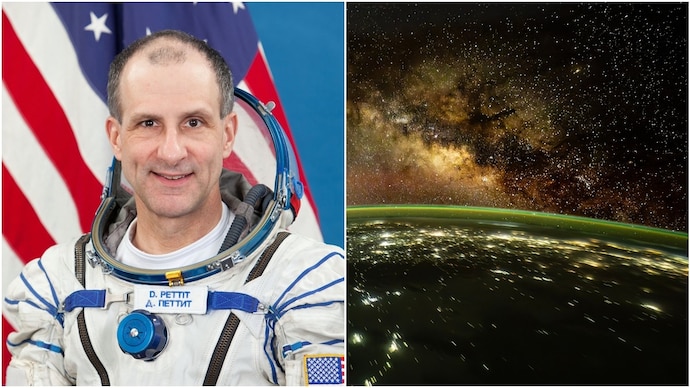
A photograph of the Milky Way captured from the International Space Station (ISS) has taken the internet by storm after it was shared by veteran Nasa astronaut Don Pettit on social media.
The image shows the bright arc of our home galaxy stretching across the darkness of space, while Earth's curved horizon glows below with sparkling city lights and a thin green band of the atmosphere known as airglow.
Pettit revealed that the image is just one of nearly 1.2 million raw photographs he captured during his latest mission aboard the orbiting laboratory, adding that it is among his personal favourites from the expedition.
The photograph was taken during Expedition 72, a mission that saw Pettit spend 220 days aboard the ISS after launching aboard Russia's Soyuz MS-26 spacecraft in September 2024.
During the mission, he carried out scientific experiments, technology demonstrations and Earth observations before returning to Earth in April 2025.
The veteran astronaut also continued his long-standing passion for orbital photography, capturing thousands of images of Earth, stars and celestial events from space.
CAPTURED FROM CUPOLA
This particular image was taken from the Cupola, the ISS's iconic seven-window observation module that offers astronauts panoramic views of Earth and deep space.
Cupola has, therefore, become the preferred location for astronauts to photograph everything from auroras and thunderstorms to distant galaxies.
Pettit used a Nikon Z9 camera paired with a 15 mm Arri Zeiss lens with a wide aperture to collect as much light as possible in the dark conditions of space.
What makes the image particularly remarkable is the sharpness of the stars.
Since the ISS travels around Earth at nearly 28,000 kmph, completing one orbit roughly every 90 minutes at an altitude of about 400 kilometres, long-exposure photographs would normally produce streaks instead of pinpoint stars.
To overcome this, Pettit relied on a custom-built tracking device that compensates for the station's rapid motion, allowing the stars to remain crisp and in focus.
RARE VIEW OF THE GALAXY
Unlike observers on Earth, astronauts photograph the night sky without interference from the planet's atmosphere or light pollution, making faint celestial details far easier to capture.
Pettit said he only recently retrieved the complete archive of his 1.2 million raw images after returning from orbit. Because raw image files preserve significantly more data than standard photographs, they can reveal much finer details during processing.
The result is a photo that showcases not only the beauty of our galaxy but also the precision and ingenuity required to photograph it from a spacecraft speeding around the planet.
Unsurprisingly, the image has quickly attracted widespread admiration for both its clarity and composition.
A photograph of the Milky Way captured from the International Space Station (ISS) has taken the internet by storm after it was shared by veteran Nasa astronaut Don Pettit on social media.
The image shows the bright arc of our home galaxy stretching across the darkness of space, while Earth's curved horizon glows below with sparkling city lights and a thin green band of the atmosphere known as airglow.
Pettit revealed that the image is just one of nearly 1.2 million raw photographs he captured during his latest mission aboard the orbiting laboratory, adding that it is among his personal favourites from the expedition.
The photograph was taken during Expedition 72, a mission that saw Pettit spend 220 days aboard the ISS after launching aboard Russia's Soyuz MS-26 spacecraft in September 2024.
During the mission, he carried out scientific experiments, technology demonstrations and Earth observations before returning to Earth in April 2025.
The veteran astronaut also continued his long-standing passion for orbital photography, capturing thousands of images of Earth, stars and celestial events from space.
CAPTURED FROM CUPOLA
This particular image was taken from the Cupola, the ISS's iconic seven-window observation module that offers astronauts panoramic views of Earth and deep space.
Cupola has, therefore, become the preferred location for astronauts to photograph everything from auroras and thunderstorms to distant galaxies.
Pettit used a Nikon Z9 camera paired with a 15 mm Arri Zeiss lens with a wide aperture to collect as much light as possible in the dark conditions of space.
What makes the image particularly remarkable is the sharpness of the stars.
Since the ISS travels around Earth at nearly 28,000 kmph, completing one orbit roughly every 90 minutes at an altitude of about 400 kilometres, long-exposure photographs would normally produce streaks instead of pinpoint stars.
To overcome this, Pettit relied on a custom-built tracking device that compensates for the station's rapid motion, allowing the stars to remain crisp and in focus.
RARE VIEW OF THE GALAXY
Unlike observers on Earth, astronauts photograph the night sky without interference from the planet's atmosphere or light pollution, making faint celestial details far easier to capture.
Pettit said he only recently retrieved the complete archive of his 1.2 million raw images after returning from orbit. Because raw image files preserve significantly more data than standard photographs, they can reveal much finer details during processing.
The result is a photo that showcases not only the beauty of our galaxy but also the precision and ingenuity required to photograph it from a spacecraft speeding around the planet.
Unsurprisingly, the image has quickly attracted widespread admiration for both its clarity and composition.
A photograph of the Milky Way captured from the International Space Station (ISS) has taken the internet by storm after it was shared by veteran Nasa astronaut Don Pettit on social media.
The image shows the bright arc of our home galaxy stretching across the darkness of space, while Earth's curved horizon glows below with sparkling city lights and a thin green band of the atmosphere known as airglow.
Pettit revealed that the image is just one of nearly 1.2 million raw photographs he captured during his latest mission aboard the orbiting laboratory, adding that it is among his personal favourites from the expedition.
The photograph was taken during Expedition 72, a mission that saw Pettit spend 220 days aboard the ISS after launching aboard Russia's Soyuz MS-26 spacecraft in September 2024.
During the mission, he carried out scientific experiments, technology demonstrations and Earth observations before returning to Earth in April 2025.
The veteran astronaut also continued his long-standing passion for orbital photography, capturing thousands of images of Earth, stars and celestial events from space.
CAPTURED FROM CUPOLA
This particular image was taken from the Cupola, the ISS's iconic seven-window observation module that offers astronauts panoramic views of Earth and deep space.
Cupola has, therefore, become the preferred location for astronauts to photograph everything from auroras and thunderstorms to distant galaxies.
Pettit used a Nikon Z9 camera paired with a 15 mm Arri Zeiss lens with a wide aperture to collect as much light as possible in the dark conditions of space.
What makes the image particularly remarkable is the sharpness of the stars.
Since the ISS travels around Earth at nearly 28,000 kmph, completing one orbit roughly every 90 minutes at an altitude of about 400 kilometres, long-exposure photographs would normally produce streaks instead of pinpoint stars.
To overcome this, Pettit relied on a custom-built tracking device that compensates for the station's rapid motion, allowing the stars to remain crisp and in focus.
RARE VIEW OF THE GALAXY
Unlike observers on Earth, astronauts photograph the night sky without interference from the planet's atmosphere or light pollution, making faint celestial details far easier to capture.
Pettit said he only recently retrieved the complete archive of his 1.2 million raw images after returning from orbit. Because raw image files preserve significantly more data than standard photographs, they can reveal much finer details during processing.
The result is a photo that showcases not only the beauty of our galaxy but also the precision and ingenuity required to photograph it from a spacecraft speeding around the planet.
Unsurprisingly, the image has quickly attracted widespread admiration for both its clarity and composition.

