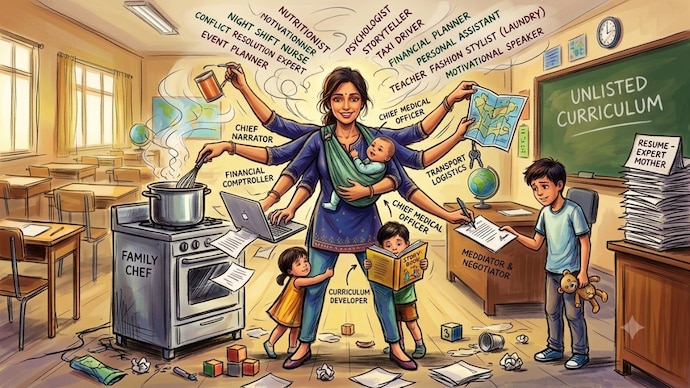
If 'expert mother' were a qualification, what jobs would it qualify you for?
Every qualification in India comes with a syllabus, an examination and a certificate. Except for one. The title of "expert mother" has no curriculum, no assessment and no end. Yet millions of women are expected to earn it before their professional achievements are deemed complete.
There is perhaps no tougher entrance examination in India than the UPSC Civil Services Examination. Every year, lakhs of candidates spend years preparing for it. The syllabus is available in the public domain. The eligibility criteria is transparent. The examination is rigorous, and for those who succeed, the job is recognised across the country.
Now imagine another qualification. Expert Mother.
This time, there is no syllabus, the examiner is society, the evaluation is never ending, and unlike the UPSC, there is no certificate to prove you have passed.
That is what makes Uttar Pradesh Governor Anandiben Patel’s advice to women graduates —“Become an expert mother first, then an IAS officer”—so thought-provoking. Not because motherhood is unimportant, but because the statement cannot be qualified.
WHAT EXACTLY IS AN EXPERT MOTHER?
That’s where the problem begins. We don’t actually know when a woman qualifies for this expertise. Does she earn it after her first child? After raising one into adulthood? Is the examination conducted by relatives, neighbours, social media—or society at large?
The point isn’t to diminish motherhood but to raise questions about why it is presented as something women must master before pursuing professional excellence.
For decades, India has encouraged girls to stay in school, pursue higher education and dream of careers once considered beyond their reach. In many universities today, women don’t just participate, they excel.
The latest AISHE 2023-24 data reflects that shift. Women have outnumbered men in undergraduate enrolment for the seventh consecutive year. The female Gross Enrolment Ratio (GER) stands at 31.2, compared with 28.9 for men, while women’s overall enrolment has risen to 42.2 per cent, driven by states such as Bihar, West Bengal and Kerala.
The irony is hard to miss.
At the very convocation where the Governor made these remarks, women reportedly won nearly 82 per cent of the medals.
MOTHERHOOD QUALITIES ARE CORPORATE LEADERSHIP LESSONS
Now take a moment to think about the skills that motherhood demands (expert or no). Budgeting, planning, negotiation, conflict resolution, crisis management, scheduling, and emotional intelligence. Put these into any corporate job description and they suddenly become leadership competencies.
And when a woman returns to work after spending years raising children, those years are rarely viewed as evidence of leadership. More often than not, they are reduced to a single phrase on a resume: career gap.
The International Labour Organization calls it the motherhood employment penalty — the tendency for mothers to experience lower employment rates and slower career progression than fathers, who often benefit from what researchers describe as the fatherhood premium.
“The phrase ‘expert mother’ reflects an expectation that women must demonstrate excellence both at home and at work before they are considered successful. The workplace, however, rarely rewards caregiving as transferable experience. That’s the contradiction employers need to confront,” says Shipra Beniwal, a senior HR consultant based in Mumbai.
NUMBERS TELL A SIMILAR STORY
India has invested heavily in educating girls. Families are investing too. The NSS 2025 survey, finds the average annual household expenditure on school education for girls stood at Rs 11,666. The figure was Rs 7,660 in rural India and Rs 21,997 in urban areas. Families also spent an average of Rs 2,227 per girl on private coaching.
But education alone has not translated into equal participation in the workforce.
According to the Periodic Labour Force Survey (PLFS) monthly bulletin, the Female Labour Force Participation Rate (LFPR) for those aged 15 years and above stood at 32.8 per cent in May 2026. The rate was 36.7 per cent in rural areas and 24.8 per cent in urban India.
If India is educating more women than ever before, why are so many still missing from the workforce? The answer, many experts argue, lies not in education but in expectations.
“If employers genuinely value resilience, multitasking, stakeholder management and problem-solving, they need to rethink how they view career breaks taken for caregiving. Those years often build competencies that formal workplaces claim to value but seldom recognise,” says Prithvi Kapoor, a career and workplace consultant based in Noida.
And perhaps that is the greatest irony of all. Society often describes motherhood as the toughest job in the world, but the economy rarely counts it as work.
We do celebrate mothers, we depend on them, we expect them to excel at home and at work. So perhaps the real question is not whether women should become expert mothers. It is why “expert mother” remains India’s only qualification that is celebrated in speeches, expected by society, but rarely recognised by the job market.
There is perhaps no tougher entrance examination in India than the UPSC Civil Services Examination. Every year, lakhs of candidates spend years preparing for it. The syllabus is available in the public domain. The eligibility criteria is transparent. The examination is rigorous, and for those who succeed, the job is recognised across the country.
Now imagine another qualification. Expert Mother.
This time, there is no syllabus, the examiner is society, the evaluation is never ending, and unlike the UPSC, there is no certificate to prove you have passed.
That is what makes Uttar Pradesh Governor Anandiben Patel’s advice to women graduates —“Become an expert mother first, then an IAS officer”—so thought-provoking. Not because motherhood is unimportant, but because the statement cannot be qualified.
WHAT EXACTLY IS AN EXPERT MOTHER?
That’s where the problem begins. We don’t actually know when a woman qualifies for this expertise. Does she earn it after her first child? After raising one into adulthood? Is the examination conducted by relatives, neighbours, social media—or society at large?
The point isn’t to diminish motherhood but to raise questions about why it is presented as something women must master before pursuing professional excellence.
For decades, India has encouraged girls to stay in school, pursue higher education and dream of careers once considered beyond their reach. In many universities today, women don’t just participate, they excel.
The latest AISHE 2023-24 data reflects that shift. Women have outnumbered men in undergraduate enrolment for the seventh consecutive year. The female Gross Enrolment Ratio (GER) stands at 31.2, compared with 28.9 for men, while women’s overall enrolment has risen to 42.2 per cent, driven by states such as Bihar, West Bengal and Kerala.
The irony is hard to miss.
At the very convocation where the Governor made these remarks, women reportedly won nearly 82 per cent of the medals.
MOTHERHOOD QUALITIES ARE CORPORATE LEADERSHIP LESSONS
Now take a moment to think about the skills that motherhood demands (expert or no). Budgeting, planning, negotiation, conflict resolution, crisis management, scheduling, and emotional intelligence. Put these into any corporate job description and they suddenly become leadership competencies.
And when a woman returns to work after spending years raising children, those years are rarely viewed as evidence of leadership. More often than not, they are reduced to a single phrase on a resume: career gap.
The International Labour Organization calls it the motherhood employment penalty — the tendency for mothers to experience lower employment rates and slower career progression than fathers, who often benefit from what researchers describe as the fatherhood premium.
“The phrase ‘expert mother’ reflects an expectation that women must demonstrate excellence both at home and at work before they are considered successful. The workplace, however, rarely rewards caregiving as transferable experience. That’s the contradiction employers need to confront,” says Shipra Beniwal, a senior HR consultant based in Mumbai.
NUMBERS TELL A SIMILAR STORY
India has invested heavily in educating girls. Families are investing too. The NSS 2025 survey, finds the average annual household expenditure on school education for girls stood at Rs 11,666. The figure was Rs 7,660 in rural India and Rs 21,997 in urban areas. Families also spent an average of Rs 2,227 per girl on private coaching.
But education alone has not translated into equal participation in the workforce.
According to the Periodic Labour Force Survey (PLFS) monthly bulletin, the Female Labour Force Participation Rate (LFPR) for those aged 15 years and above stood at 32.8 per cent in May 2026. The rate was 36.7 per cent in rural areas and 24.8 per cent in urban India.
If India is educating more women than ever before, why are so many still missing from the workforce? The answer, many experts argue, lies not in education but in expectations.
“If employers genuinely value resilience, multitasking, stakeholder management and problem-solving, they need to rethink how they view career breaks taken for caregiving. Those years often build competencies that formal workplaces claim to value but seldom recognise,” says Prithvi Kapoor, a career and workplace consultant based in Noida.
And perhaps that is the greatest irony of all. Society often describes motherhood as the toughest job in the world, but the economy rarely counts it as work.
We do celebrate mothers, we depend on them, we expect them to excel at home and at work. So perhaps the real question is not whether women should become expert mothers. It is why “expert mother” remains India’s only qualification that is celebrated in speeches, expected by society, but rarely recognised by the job market.

