Kerala | A portable deal with the Adanis
A stake sale at Vizhinjam port, to a Swiss container major, sets off a debate. What will CM Satheesan do?
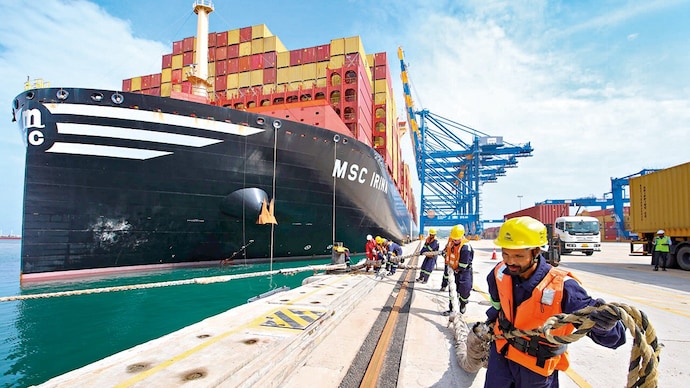
The new congress chief minister, V.D. Satheesan, had not yet exhausted that heady feeling of newfound political celebrityhood conferred on him earlier this summer. Nothing clouded the air except a late monsoon and some sharp repartee between him and the deposed Left. But that honeymoon period has run aground on the angry beaches of Vizhinjam in capital Thiruvananthapuram. This is where an ambitious but controversy-ridden project, India’s first deep-water transshipment port, had started operations in 2024. It’s seeing rollicking business—by this June, it had welcomed its thousandth commercial vessel, including some of the world’s largest mother ships, inducing them to this strategic entrepot sitting just 10 nautical miles from major global shipping lines.
The new congress chief minister, V.D. Satheesan, had not yet exhausted that heady feeling of newfound political celebrityhood conferred on him earlier this summer. Nothing clouded the air except a late monsoon and some sharp repartee between him and the deposed Left. But that honeymoon period has run aground on the angry beaches of Vizhinjam in capital Thiruvananthapuram. This is where an ambitious but controversy-ridden project, India’s first deep-water transshipment port, had started operations in 2024. It’s seeing rollicking business—by this June, it had welcomed its thousandth commercial vessel, including some of the world’s largest mother ships, inducing them to this strategic entrepot sitting just 10 nautical miles from major global shipping lines.
But what lashed ashore was an unseen undercurrent: news that industrialist Gautam Adani had inked a Rs 13,200-crore deal to offload 49 per cent stake in Adani Vizhinjam Port Private Limited (AVPPL)—the project-specific company formed to operate the port concession won by its other entity, the Adani Ports and Special Economic Zone Ltd (APSEZ)—to the Geneva-headquartered MSC, the world’s largest container shipping company. And it had done so without informing the state. The Adani Group had formed AVPPL for financing, building and operating the Vizhinjam port. The unlikely public-private partnership between the Adanis and three successive Kerala governments has held up since 2015—encompassing the Congress and Left. Satheesan has reasons for concern. After all, the state holds 61.5 per cent stake in Vizhinjam International Seaport, owning the core port infrastructure and land. The Centre has 9.6 per cent and APSEZ has 28.9 per cent. The concessionaire agreement with the state government explicitly states that any stake sale of above 25 per cent in AVPPL will constitute a ‘change of ownership’ of the port, and so will need its prior approval.
CLAUSE BYPASSED?
It’s here that the MSC now steps in as potential part-owner. According to the June 30 deal, APSEZ will transfer 49 per cent of its shares in AVPPL to MSC’s Terminal Investment Ltd—in what’s billed as the single largest foreign private investment in Indian port infrastructure. The Kerala government has officially conveyed its displeasure to the Adanis and is vetting the deal for national security and monopoly concerns. On July 1, after media splashed news of the deal, Satheesan clarified in the state assembly: “The Adani Group made the deal without prior communication to the state government. They need to inform us before changing the share pattern.” APSEZ, meanwhile, released documents to say it needs to first inform market regulator SEBI about the deal, then seek the state’s approval.
However, the Opposition, led by the CPI(M), is alleging a “secret deal” between Satheesan and the Adanis. Lending grist to the mill is an older piece of speculation that has now resurfaced: that Satheesan reportedly visited Mangaluru in a private jet on May 1, three days before the assembly poll verdict was declared, to meet top honchos of the Adani group. AICC general secretary K.C. Venugopal, whom Satheesan had pipped to the CM’s post, has chosen to weigh in too, calling it a deal against the interest of the people of the state.
In his formal communication to APSEZ, Satheesan says the port was envisaged as a competitive hub that would offer a level playing field. Selling 49 per cent stake to one party could lead to a monopoly in shipping and container traffic, it feels. The concession agreement allows the Adanis to dilute up to 74 per cent of its stake after the construction period and the first year of operations; the dispute is only over the greenlighting protocol it stipulated.
Ex-Congress leader K.V. Thomas, who negotiated the original agreement for the Oommen Chandy regime (2011-16) and later served as special representative to the Pinarayi government (2016-26), says the deal is legally kosher. His argument, though, focuses on commercial viability. “Vizhinjam requires huge investment. The deal will facilitate faster development,” he told india today. APSEZ, too, says the strategic collaboration would “deliver significant advantages”, citing rival “Southeast Asian hubs” and “strengthening presence” on East Africa trade routes.
Vizhinjam has a capacity of 1.6 million Twenty-foot Equivalent Units (TEUs) now; expansion will up that to 5.7 million TEUs by 2029. By then, if the deal clears the hurdles, APSEZ’s stake in AVPPL will have fallen to 51 per cent. Satheesan’s own political stakes here, however, are unquantifiable.

