Ethanol blending | Fuel under fire
As India makes E20 petrol the new normal, motorists report falling mileage and engine trouble. Government insists the fuel is safe, tested and vital for energy security
Bihar-based YouTuber Manish Kashyap recently alleged that his new Toyota Innova Hycross developed engine knocking and vibrations after running on E20 fuel and that the company rejected his warranty claim. Another widely shared post on X came from a car owner who said she was being “forced to destroy” the vehicle she had “fought so hard to get”, alleging that E20 fuel had sharply reduced its mileage and impaired its air-conditioning.
Bihar-based YouTuber Manish Kashyap recently alleged that his new Toyota Innova Hycross developed engine knocking and vibrations after running on E20 fuel and that the company rejected his warranty claim. Another widely shared post on X came from a car owner who said she was being “forced to destroy” the vehicle she had “fought so hard to get”, alleging that E20 fuel had sharply reduced its mileage and impaired its air-conditioning.
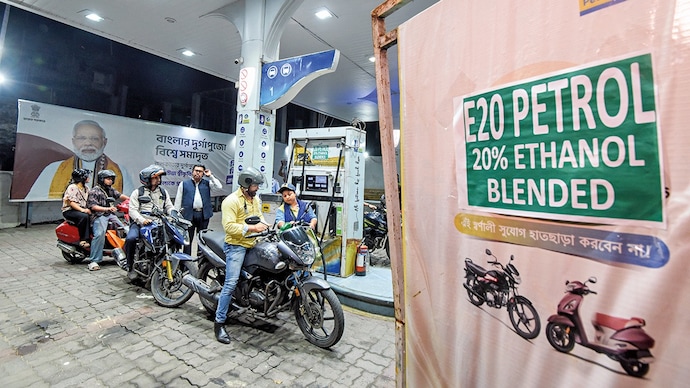
Such complaints have multiplied since April, when the Centre made E20 petrol—a blend of 20 per cent ethanol and 80 per cent petrol—the standard fuel sold across India. Ethanol, produced by fermenting crops such as sugarcane, maize and grains, is blended with petrol to reduce dependence on fossil fuels. Yet many car and bike owners, especially those with older, non-E20-compatible vehicles, say the switch has come at a cost. “My car’s mileage has dropped from around 18 kmpl to 11-12 kmpl, and sometimes even into single digits,” says Gurugram-based Sunil Malhotra, who owns a 2019 Honda City.
This has sparked a debate over whether the nationwide rollout of E20 has outpaced the transition to compatible vehicles. The Centre argues that the ethanol-blended fuel is both scientifically validated and strategically necessary. That case acquired special urgency due to the West Asia crisis, which is still disrupting crude oil supplies. Prime Minister Narendra Modi in late March described ethanol blending as a “saving grace”, saying the programme had helped India avoid importing around 45 million barrels of crude oil annually while also saving over Rs 1.5 lakh crore in foreign exchange. Since then, three key ministries—petroleum & natural gas, road transport & highways, and information & broadcasting—have mounted an aggressive defence.
Its most vocal advocate remains Union road transport and highways minister Nitin Gadkari. “All this is false propaganda. There is no harm from ethanol,” he says about the surge of complaints. Since taking office in 2014, Gadkari has championed ethanol-blended fuels as a way to reduce India’s energy bill. Recently, he unveiled a flex-fuel version of the Maruti Suzuki WagonR and two such Hero MotoCorp motorcycles, compatible with ethanol blends ranging from E20 to E85. To support his claims about ethanol’s safety, Gadkari points to extensive testing by the Automotive Research Association of India (ARAI). “After about 100,000 km of testing, ARAI has said that no vehicle engine failure was observed [by the use of ethanol-blended petrol]...no impact on vehicle performance, startability, drivability and metal capability,” he says.
THE OFFICIAL RESEARCH
The government’s case rests primarily on a couple of studies. A 2021 ARAI study examined how E20 affected eight metals, six rubber materials (elastomers) and four engineering plastics commonly used in vehicle fuel systems. It found “insignificant” corrosion in metals and broadly similar or, in some cases, better performance across other materials, although two elastomers and one plastic showed greater changes in some measured properties. The researchers said the findings would help refine fuel-system components.
The same year, an inter-ministerial expert committee constituted by NITI Aayog examined vehicle technology, ethanol supply and infrastructure before recommending a roadmap for a nationwide phased transition to E20 by 2025-26. It acknowledged three practical challenges: lower fuel efficiency in older engine calibrations, the need for E20-compatible materials in some fuel-system components, and the gradual introduction of E20-compatible vehicles alongside the fuel rollout.
Rather than carrying out fresh research, it relied on a 2014-15 study commissioned by the ministry of heavy industries that found no evidence of engine failures, drivability problems or abnormal engine wear from the use of E20. It did, however, identify greater degradation in a few elastomers and plastics, besides a 2-6 per cent decline in fuel efficiency. Addressing such concerns, ARAI director Reji Mathai recently acknowledged a similar decline with E20, describing it as “minimal”. “Any variations in real-world fuel consumption and overall efficiency,” he added, “are driven by external operational factors, including driver behaviour, road conditions and the baseline condition of the vehicle under test.”
The National Policy on Biofuels, notified in 2018, targeted 20 per cent ethanol blending in petrol by 2030. When the target was advanced to 2025-26, the roadmap also envisaged achieving 10 per cent blending by November 2022. That milestone was reached in June 2022. From April 2023, all new petrol vehicles were required to be E20-compatible. “Obviously, after 2023, both the cars and the fuel are mandated for E20. That is not a cause of concern,” says Rahul Bharti, executive director of Maruti Suzuki. “The concern is about cars manufactured and sold before 2023, which were primarily designed for E10.” Bharti says Maruti began extensively testing E20 even before it became mandatory and found “no problem in terms of wear and tear, corrosion or damage” to either the life of the vehicle or the parts that come into contact with the fuel, including in pre-2023 models designed for E10.
THE COST EQUATION
Vikram Gulati, executive vice president and country head of Toyota Kirloskar, says the West Asia crisis underlines India’s “vulnerability” to imported crude. Ethanol blending, he argues, helped “mitigate the impact on the economy and the pockets of the consumers”. But I.V. Rao, Distinguished Fellow at TERI and former head of R&D at Maruti Suzuki, says the consumer economics of E20 are more complicated than often portrayed. Since ethanol has lower energy content than petrol, he says, “a marginal drop in fuel efficiency is inevitable” because more fuel must be burnt to cover the same distance unless engines are specifically optimised for higher blends. He also points to the possible need for more E20-compatible fuel-system components, which could raise maintenance and lifecycle costs over time.
The 2021 NITI Aayog roadmap itself acknowledged that oil marketing companies (OMCs) pass on changes in fuel costs due to ethanol blending to consumers. It warned that if ethanol became more expensive than petrol, ethanol-blended fuel could cost consumers more. That scenario has since materialised. According to the petroleum ministry, ethanol, which was cheaper than petrol in 2020-21, now costs more at the refinery stage. OMCs currently procure ethanol from distilleries at government-fixed prices of Rs 58-72 a litre, depending on the feedstock, while petrol’s refinery transfer price stood at about Rs 70.5 a litre in early July. The ministry, therefore, argues that the programme is driven less by the promise of cheaper fuel than by energy security, lower crude imports, environmental goals and support for farmers (see The E20 Debate).
Preparations for the next phase of ethanol blending are already under way. The Bureau of Indian Standards has notified fuel specifications for E22, E25, E27 and E30, while the Centre has begun consultations with vehicle manufacturers and other stakeholders on a staged transition beyond E20. In June, the government rolled out E85 for flex-fuel vehicles (FFVs) and exempted E22-E30 from central excise duty, though no rollout timeline has been announced for them. Officials are understood to be internally evaluating a shift to E21 around 2027 and E25 around 2029.
Internationally, there is no single template. Brazil mandates E30 as its standard blend but has a predominantly FFV fleet capable of running on blends of up to E100. The US, by contrast, has retained E10 as its standard fuel while expanding access to E15 and supporting millions of FFVs that can run on up to E85. Japan has virtually no ethanol blending but plans to introduce E10 by 2030 and E20 by 2040.
BEYOND THE FUEL TANK
For environmentalists, the debate goes beyond fuel cost or vehicle performance. The Centre for Science and Environment (CSE) argues that the aggressive push for ethanol risks placing pressure on water and food security. “Every litre of ethanol we burn in our cars costs us 10,000 litres of water from our farms,” says CSE executive director Anumita Roychowdhury. “At a time when the Central Ground Water Board classifies large parts of Maharashtra, Uttar Pradesh and Punjab as over-exploited, diverting food crops into fuel tanks is not energy policy. It’s water policy by the back door.” She further warns that guaranteed demand for ethanol is encouraging farmers to shift from pulses, millets and oilseeds towards maize and sugarcane.
The petroleum ministry seeks to dissipate such concerns by saying modern ethanol plants consume only three to five litres of processed water to produce a litre of ethanol and increasingly operate with zero-liquid-discharge systems. It also argues that only surplus rice, identified by the Department of Food and Public Distribution after meeting national food security requirements, is diverted for ethanol production.
India’s ethanol experiment is no longer confined to government roadmaps or lab reports. Motorists measure it every day in kilometres per litre; policymakers, in barrels of crude not imported. Whether the two align will determine E20’s success.

