Samsung debuts wide-screen Galaxy Z Fold 8 and flagship Fold 8 Ultra, sets stage for foldable battle with Apple
Samsung has launched a trio of foldables, the Galaxy Z Fold 8, Galaxy Z Fold 8 Ultra, and Galaxy Z Flip 8. Here is everything you need to know about them.
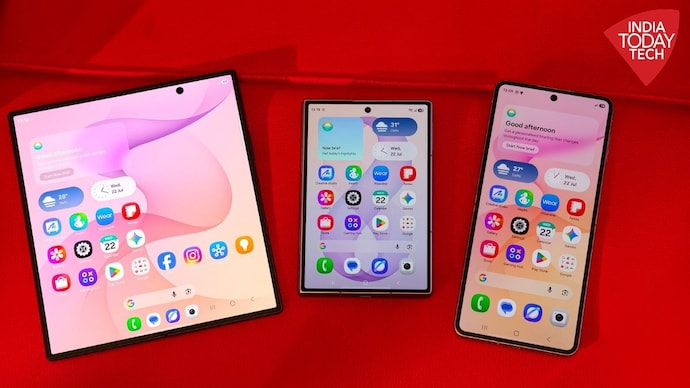
Samsung has officially launched its 2026 flagship foldable roster, introducing a dual-tier Fold strategy for the very first time. At one end lies the wide-screen Galaxy Z Fold 8, while on the other side, you have the flagship Galaxy Z Fold 8 Ultra, the direct sequel to last year’s Galaxy Z Fold 7. The Galaxy Z Flip 8 completes the portfolio. Joining the Fold 8, Fold 8 Ultra, and Flip 8 are a couple of wearable refreshes: the Galaxy Watch 9 and Galaxy Watch Ultra 2.
The Galaxy Z Fold 8 starts at Rs 1,79,999 (12GB/256GB) and goes up to Rs 2,39,999 (16GB/1TB). The Galaxy Z Fold 8 Ultra starts at Rs 1,99,999 (12GB/256GB) and goes up to Rs 2,59,999 (16GB/1TB). The Galaxy Z Flip 8 starts at Rs 1,24,999 (12GB/256GB) and goes up to Rs 1,44,999 (12GB/512GB).
On the sidelines of Galaxy Unpacked, Samsung executives sat down with India Today Tech to detail the philosophy behind introducing two Fold devices simultaneously this year and the potential target audience for each of them.
Fold 8, Fold 8 Ultra, and Flip 8 details
Addressing the naming scheme—moving from a single flagship Fold to a wide-screen Fold 8 and a flagship Fold 8 Ultra—Samsung explained that the move aims to bring seamlessness across the brand’s top-tier lineup.
“In 2025, when we introduced the Fold 7, we talked about an Ultra experience. From that standpoint, it's a natural progression that we are bringing a Fold 8 Ultra because now, between the S26 Ultra and Fold 8 Ultra, the gap is extremely narrow,” a Samsung spokesperson told India Today Tech.
The Galaxy Z Fold 8 Ultra represents the absolute pinnacle of Samsung's hardware engineering. Measuring just 4.1mm unfolded and 8.9mm folded while weighing 215g, the Ultra packs a large 8-inch 120Hz inner display (2504 x 2256p) and a 6.5-inch cover screen. It brings a flagship-grade 200MP main camera, a 50MP ultrawide, a 10MP 3X telephoto, and a massive 5,000mAh battery—the largest battery ever fitted into a Samsung Fold.
“We have tried to make it a true flagship device so that a customer doesn't have to compromise when moving onto a foldable due to any reason. The battery is perfect, the display is brighter, and the camera system is pretty close to what the S26 Ultra delivers,” the spokesperson added.
The most noticeable hardware change on the standard Fold 8 is its wider, “content-native” 4:3 aspect ratio for the inner screen (the cover is a 16:10). According to Samsung, this design choice came after tracking how young consumers spend their time on devices.
“This stems from how consumer behaviour has changed over the last couple of years. On average, most users spend 40 to 50 minutes a day on either Reels or Shorts. That changing behaviour actually inspired us to do this,” the spokesperson said.
“No consumer would articulate it as 'I need a 4:3 aspect ratio,' because aspect ratio is something they see in the form of content—they aren't usually thinking about dimensions. Looking at how people consume content, this device will have many takers because it marries directly into their daily habits, delivering a far more immersive experience irrespective of format.”
Made using an ultra-durable Flex Titanium chassis and an Armour FlexHinge, the Fold 8 is being billed as the world’s lightest folding device at just 201g. When unfolded, it measures just 4.5mm (9.7mm folded), earning the title of the flattest fold ever engineered.
It ditches the narrow cover screens of past generations with a 5.5-inch cover display and an expansive 7.6-inch 120Hz QXGA+ Dynamic AMOLED 2X inner display boasting up to 3,000 nits’ peak brightness. It is powered by the Snapdragon 8 Elite Gen 5 for Galaxy, paired with up to 16GB RAM and 1TB storage, a 4,800mAh battery with 45W fast charging, and dual 50MP cameras.
Alongside the Fold duo, Samsung also refreshed its clamshell model with the Galaxy Z Flip 8, driven by an Exynos 2600 chip, a larger 4.1-inch Super AMOLED cover display, a 6.9-inch main display, and a 4,300mAh battery wrapped in a sleek 180g frame.
Dispelling rumours that the Flip series might be sunsetted in favour of dual Folds, Samsung emphasized that the clamshell form factor remains core to its identity.
“The Flip has a very stable set of consumers looking for pocketability and unique camera angles. It is not at all getting phased out—all three devices now have very different and unique user bases,” the spokesperson reiterated.
Samsung versus Apple
While Samsung continues to innovate hardware, experts say that the market in 2026 is vastly different from the early days of foldable tech.
According to market estimates from CyberMedia Research (CMR), foldables currently represent approximately 0.28% of overall smartphone shipments in key growth markets like India, with Samsung holding a commanding share of over 85%. CMR projects that Samsung’s 2026 lineup could drive year-on-year sales growth in excess of 50% over the previous generation.
However, analysts point out that Samsung’s historic dominance was largely achieved in the absence of aggressive global competition. Prabhu Ram, Vice President of the Industry Research Group (IRG) at CMR, pointed out that, “Over the past several product cycles, Samsung's foldable strategy was characterized by incremental refinement rather than substantive innovation. Samsung’s 2026 foldable lineup can be interpreted as a direct response to rising competitive and market pressures from Chinese OEMs.”
Apple's first foldable iPhone, expected to launch this September, appears to be well-positioned to meaningfully expand the foldable category and pose a serious challenge to Samsung's leadership, even if its initial volumes may be measured.
"Samsung's competitive moat will increasingly depend on AI-led software differentiation and ecosystem integration, rather than on form factor or hardware iteration alone. This challenge is compounded by ongoing memory and storage cost pressures affecting the industry, which have already led to device price increases and are expected to disproportionately affect higher-specification portfolios like the Ultra,” Ram said.
When pressed on how Samsung views Apple's impending entry into the foldable space, Samsung executives remained focused on their first-mover advantage and the transformative nature of flexible screens.
"We do not comment on competition. But from our standpoint, this is the beginning of something really, really disruptive. Consumers just need enough opportunity to experience the device firsthand—because until you experience a Fold, you don't realize what you're missing out on. Once you transition to a Fold, it is very difficult to ever go back to a traditional slab phone."
Samsung has officially launched its 2026 flagship foldable roster, introducing a dual-tier Fold strategy for the very first time. At one end lies the wide-screen Galaxy Z Fold 8, while on the other side, you have the flagship Galaxy Z Fold 8 Ultra, the direct sequel to last year’s Galaxy Z Fold 7. The Galaxy Z Flip 8 completes the portfolio. Joining the Fold 8, Fold 8 Ultra, and Flip 8 are a couple of wearable refreshes: the Galaxy Watch 9 and Galaxy Watch Ultra 2.
The Galaxy Z Fold 8 starts at Rs 1,79,999 (12GB/256GB) and goes up to Rs 2,39,999 (16GB/1TB). The Galaxy Z Fold 8 Ultra starts at Rs 1,99,999 (12GB/256GB) and goes up to Rs 2,59,999 (16GB/1TB). The Galaxy Z Flip 8 starts at Rs 1,24,999 (12GB/256GB) and goes up to Rs 1,44,999 (12GB/512GB).
On the sidelines of Galaxy Unpacked, Samsung executives sat down with India Today Tech to detail the philosophy behind introducing two Fold devices simultaneously this year and the potential target audience for each of them.
Fold 8, Fold 8 Ultra, and Flip 8 details
Addressing the naming scheme—moving from a single flagship Fold to a wide-screen Fold 8 and a flagship Fold 8 Ultra—Samsung explained that the move aims to bring seamlessness across the brand’s top-tier lineup.
“In 2025, when we introduced the Fold 7, we talked about an Ultra experience. From that standpoint, it's a natural progression that we are bringing a Fold 8 Ultra because now, between the S26 Ultra and Fold 8 Ultra, the gap is extremely narrow,” a Samsung spokesperson told India Today Tech.
The Galaxy Z Fold 8 Ultra represents the absolute pinnacle of Samsung's hardware engineering. Measuring just 4.1mm unfolded and 8.9mm folded while weighing 215g, the Ultra packs a large 8-inch 120Hz inner display (2504 x 2256p) and a 6.5-inch cover screen. It brings a flagship-grade 200MP main camera, a 50MP ultrawide, a 10MP 3X telephoto, and a massive 5,000mAh battery—the largest battery ever fitted into a Samsung Fold.
“We have tried to make it a true flagship device so that a customer doesn't have to compromise when moving onto a foldable due to any reason. The battery is perfect, the display is brighter, and the camera system is pretty close to what the S26 Ultra delivers,” the spokesperson added.
The most noticeable hardware change on the standard Fold 8 is its wider, “content-native” 4:3 aspect ratio for the inner screen (the cover is a 16:10). According to Samsung, this design choice came after tracking how young consumers spend their time on devices.
“This stems from how consumer behaviour has changed over the last couple of years. On average, most users spend 40 to 50 minutes a day on either Reels or Shorts. That changing behaviour actually inspired us to do this,” the spokesperson said.
“No consumer would articulate it as 'I need a 4:3 aspect ratio,' because aspect ratio is something they see in the form of content—they aren't usually thinking about dimensions. Looking at how people consume content, this device will have many takers because it marries directly into their daily habits, delivering a far more immersive experience irrespective of format.”
Made using an ultra-durable Flex Titanium chassis and an Armour FlexHinge, the Fold 8 is being billed as the world’s lightest folding device at just 201g. When unfolded, it measures just 4.5mm (9.7mm folded), earning the title of the flattest fold ever engineered.
It ditches the narrow cover screens of past generations with a 5.5-inch cover display and an expansive 7.6-inch 120Hz QXGA+ Dynamic AMOLED 2X inner display boasting up to 3,000 nits’ peak brightness. It is powered by the Snapdragon 8 Elite Gen 5 for Galaxy, paired with up to 16GB RAM and 1TB storage, a 4,800mAh battery with 45W fast charging, and dual 50MP cameras.
Alongside the Fold duo, Samsung also refreshed its clamshell model with the Galaxy Z Flip 8, driven by an Exynos 2600 chip, a larger 4.1-inch Super AMOLED cover display, a 6.9-inch main display, and a 4,300mAh battery wrapped in a sleek 180g frame.
Dispelling rumours that the Flip series might be sunsetted in favour of dual Folds, Samsung emphasized that the clamshell form factor remains core to its identity.
“The Flip has a very stable set of consumers looking for pocketability and unique camera angles. It is not at all getting phased out—all three devices now have very different and unique user bases,” the spokesperson reiterated.
Samsung versus Apple
While Samsung continues to innovate hardware, experts say that the market in 2026 is vastly different from the early days of foldable tech.
According to market estimates from CyberMedia Research (CMR), foldables currently represent approximately 0.28% of overall smartphone shipments in key growth markets like India, with Samsung holding a commanding share of over 85%. CMR projects that Samsung’s 2026 lineup could drive year-on-year sales growth in excess of 50% over the previous generation.
However, analysts point out that Samsung’s historic dominance was largely achieved in the absence of aggressive global competition. Prabhu Ram, Vice President of the Industry Research Group (IRG) at CMR, pointed out that, “Over the past several product cycles, Samsung's foldable strategy was characterized by incremental refinement rather than substantive innovation. Samsung’s 2026 foldable lineup can be interpreted as a direct response to rising competitive and market pressures from Chinese OEMs.”
Apple's first foldable iPhone, expected to launch this September, appears to be well-positioned to meaningfully expand the foldable category and pose a serious challenge to Samsung's leadership, even if its initial volumes may be measured.
"Samsung's competitive moat will increasingly depend on AI-led software differentiation and ecosystem integration, rather than on form factor or hardware iteration alone. This challenge is compounded by ongoing memory and storage cost pressures affecting the industry, which have already led to device price increases and are expected to disproportionately affect higher-specification portfolios like the Ultra,” Ram said.
When pressed on how Samsung views Apple's impending entry into the foldable space, Samsung executives remained focused on their first-mover advantage and the transformative nature of flexible screens.
"We do not comment on competition. But from our standpoint, this is the beginning of something really, really disruptive. Consumers just need enough opportunity to experience the device firsthand—because until you experience a Fold, you don't realize what you're missing out on. Once you transition to a Fold, it is very difficult to ever go back to a traditional slab phone."
Samsung has officially launched its 2026 flagship foldable roster, introducing a dual-tier Fold strategy for the very first time. At one end lies the wide-screen Galaxy Z Fold 8, while on the other side, you have the flagship Galaxy Z Fold 8 Ultra, the direct sequel to last year’s Galaxy Z Fold 7. The Galaxy Z Flip 8 completes the portfolio. Joining the Fold 8, Fold 8 Ultra, and Flip 8 are a couple of wearable refreshes: the Galaxy Watch 9 and Galaxy Watch Ultra 2.
The Galaxy Z Fold 8 starts at Rs 1,79,999 (12GB/256GB) and goes up to Rs 2,39,999 (16GB/1TB). The Galaxy Z Fold 8 Ultra starts at Rs 1,99,999 (12GB/256GB) and goes up to Rs 2,59,999 (16GB/1TB). The Galaxy Z Flip 8 starts at Rs 1,24,999 (12GB/256GB) and goes up to Rs 1,44,999 (12GB/512GB).
On the sidelines of Galaxy Unpacked, Samsung executives sat down with India Today Tech to detail the philosophy behind introducing two Fold devices simultaneously this year and the potential target audience for each of them.
Fold 8, Fold 8 Ultra, and Flip 8 details
Addressing the naming scheme—moving from a single flagship Fold to a wide-screen Fold 8 and a flagship Fold 8 Ultra—Samsung explained that the move aims to bring seamlessness across the brand’s top-tier lineup.
“In 2025, when we introduced the Fold 7, we talked about an Ultra experience. From that standpoint, it's a natural progression that we are bringing a Fold 8 Ultra because now, between the S26 Ultra and Fold 8 Ultra, the gap is extremely narrow,” a Samsung spokesperson told India Today Tech.
The Galaxy Z Fold 8 Ultra represents the absolute pinnacle of Samsung's hardware engineering. Measuring just 4.1mm unfolded and 8.9mm folded while weighing 215g, the Ultra packs a large 8-inch 120Hz inner display (2504 x 2256p) and a 6.5-inch cover screen. It brings a flagship-grade 200MP main camera, a 50MP ultrawide, a 10MP 3X telephoto, and a massive 5,000mAh battery—the largest battery ever fitted into a Samsung Fold.
“We have tried to make it a true flagship device so that a customer doesn't have to compromise when moving onto a foldable due to any reason. The battery is perfect, the display is brighter, and the camera system is pretty close to what the S26 Ultra delivers,” the spokesperson added.
The most noticeable hardware change on the standard Fold 8 is its wider, “content-native” 4:3 aspect ratio for the inner screen (the cover is a 16:10). According to Samsung, this design choice came after tracking how young consumers spend their time on devices.
“This stems from how consumer behaviour has changed over the last couple of years. On average, most users spend 40 to 50 minutes a day on either Reels or Shorts. That changing behaviour actually inspired us to do this,” the spokesperson said.
“No consumer would articulate it as 'I need a 4:3 aspect ratio,' because aspect ratio is something they see in the form of content—they aren't usually thinking about dimensions. Looking at how people consume content, this device will have many takers because it marries directly into their daily habits, delivering a far more immersive experience irrespective of format.”
Made using an ultra-durable Flex Titanium chassis and an Armour FlexHinge, the Fold 8 is being billed as the world’s lightest folding device at just 201g. When unfolded, it measures just 4.5mm (9.7mm folded), earning the title of the flattest fold ever engineered.
It ditches the narrow cover screens of past generations with a 5.5-inch cover display and an expansive 7.6-inch 120Hz QXGA+ Dynamic AMOLED 2X inner display boasting up to 3,000 nits’ peak brightness. It is powered by the Snapdragon 8 Elite Gen 5 for Galaxy, paired with up to 16GB RAM and 1TB storage, a 4,800mAh battery with 45W fast charging, and dual 50MP cameras.
Alongside the Fold duo, Samsung also refreshed its clamshell model with the Galaxy Z Flip 8, driven by an Exynos 2600 chip, a larger 4.1-inch Super AMOLED cover display, a 6.9-inch main display, and a 4,300mAh battery wrapped in a sleek 180g frame.
Dispelling rumours that the Flip series might be sunsetted in favour of dual Folds, Samsung emphasized that the clamshell form factor remains core to its identity.
“The Flip has a very stable set of consumers looking for pocketability and unique camera angles. It is not at all getting phased out—all three devices now have very different and unique user bases,” the spokesperson reiterated.
Samsung versus Apple
While Samsung continues to innovate hardware, experts say that the market in 2026 is vastly different from the early days of foldable tech.
According to market estimates from CyberMedia Research (CMR), foldables currently represent approximately 0.28% of overall smartphone shipments in key growth markets like India, with Samsung holding a commanding share of over 85%. CMR projects that Samsung’s 2026 lineup could drive year-on-year sales growth in excess of 50% over the previous generation.
However, analysts point out that Samsung’s historic dominance was largely achieved in the absence of aggressive global competition. Prabhu Ram, Vice President of the Industry Research Group (IRG) at CMR, pointed out that, “Over the past several product cycles, Samsung's foldable strategy was characterized by incremental refinement rather than substantive innovation. Samsung’s 2026 foldable lineup can be interpreted as a direct response to rising competitive and market pressures from Chinese OEMs.”
Apple's first foldable iPhone, expected to launch this September, appears to be well-positioned to meaningfully expand the foldable category and pose a serious challenge to Samsung's leadership, even if its initial volumes may be measured.
"Samsung's competitive moat will increasingly depend on AI-led software differentiation and ecosystem integration, rather than on form factor or hardware iteration alone. This challenge is compounded by ongoing memory and storage cost pressures affecting the industry, which have already led to device price increases and are expected to disproportionately affect higher-specification portfolios like the Ultra,” Ram said.
When pressed on how Samsung views Apple's impending entry into the foldable space, Samsung executives remained focused on their first-mover advantage and the transformative nature of flexible screens.
"We do not comment on competition. But from our standpoint, this is the beginning of something really, really disruptive. Consumers just need enough opportunity to experience the device firsthand—because until you experience a Fold, you don't realize what you're missing out on. Once you transition to a Fold, it is very difficult to ever go back to a traditional slab phone."

