Assam | Early warning failure
Flash floods wreak havoc in the state with even normally safe Upper Assam districts inundated
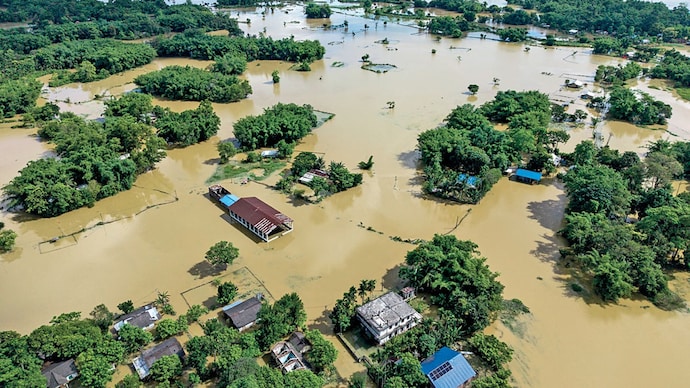
Nepalikhuti, a village some 12 km from Nazira town in Assam’s Sivasagar district, has fallen silent. For over a week now, hundreds of families have been living under tarpaulin sheets. Their houses are buried under mud, the air is filled with the stench of dead livestock, and the roads remain blocked in every direction.
Nepalikhuti, a village some 12 km from Nazira town in Assam’s Sivasagar district, has fallen silent. For over a week now, hundreds of families have been living under tarpaulin sheets. Their houses are buried under mud, the air is filled with the stench of dead livestock, and the roads remain blocked in every direction.
Nepalikhuti, a village some 12 km from Nazira town in Assam’s Sivasagar district, has fallen silent. For over a week now, hundreds of families have been living under tarpaulin sheets. Their houses are buried under mud, the air is filled with the stench of dead livestock, and the roads remain blocked in every direction.
Nepalikhuti is the last village in Assam along the Nagaland border. It received no warning before the flood arrived. Farmer Binod Sharma says that, on July 19, he had gone out to look at the swollen Dikhow river, but it didn’t look too bad. “But, suddenly, the floodwaters rushed in. The water level rose so fast, I didn’t know what to do,” he says.
Assam faces floods every year, and the state has seen years with higher death tolls. What made this year’s flood different was the areas it entered and the speed at which it arrived. Sivasagar, Charaideo and Jorhat lie on the southern bank of the Brahmaputra, on land long considered above ‘normal flood level’. On July 23, the three neighbouring Upper Assam districts accounted for 678,000 of the affected people, more than 94 per cent of the state’s total. Seventy-eight people are dead, 40 still missing. Across Assam, nearly 49,000 hectares of cropland were submerged, more than 88,000 livestock affected with over 26,500 animals dead.
The immediate trigger came from outside Assam. Rajiv Lochan Deka, head of the department of agrometeorology at Assam Agricultural University, says, “The flash floods were caused by extreme rainfall in Nagaland’s Mon, Wokha, Longleng and Mokokchung districts on July 18-20. It led to significant downstream run-off that surged into Sivasagar, Jorhat and Charaideo.” Assam, too, was getting heavy rain—Sonari town in Charaideo district got 190 mm on the night of July 18 alone. The catchment areas, saturated by pre-monsoon showers, were already in a condition where they would release water rather than absorb it. Among Deka’s list of factors that made the situation worse: deforestation, loss of natural wetlands and road construction.
Assam chief minister Himanta Biswa Sarma blamed it on the excess rainfall: 493 per cent above normal in Mokokchung and 436 per cent above normal in Charaideo, which prevented the swollen Brahmaputra’s tributaries from draining their water. Pijush Hazarika, Assam’s minister for agriculture, irrigation and parliamentary affairs, told the assembly on July 23 that these were the worst floods in eastern Assam in over 60 years.
LESSONS NOT LEARNT
Could the destruction have been prevented? Nayan Sharma, an adjunct professor at IIT Roorkee and a river engineer, feels the scale of destruction was perhaps avoidable. The main failure, he says, was in forecasting and issuing warnings. The country’s satellite systems can now detect such weather systems hours and sometimes days in advance. But Assam’s early warnings network was not connected well enough to use the information. Sharma proposes several practical measures: strengthening embankments with geosynthetics and articulated concrete blocks, building drainage sluices at natural low points, and clearing and channelising the heavily silted Bhogdoi. His most urgent recommendation: “100 per cent afforestation in watershed areas.”
The recommendations are not new. The BJP came to power in Assam in 2016 with a promise to make the state flood-free. A scheme called ‘Living with Floods’ was introduced in the 1990s but later withdrawn following allegations of corruption. Experts say the larger problem lies in an approach that identifies high-risk flood zones and concentrates resources only in those areas. That leaves districts classified as low-risk unprepared when they suddenly face a major flood.

