Bullet trains | An Indian reset
India fast-tracks its high-speed railway project by shedding its dependence on Japan and undertaking its own civil works, indigenous trainsets and European signalling
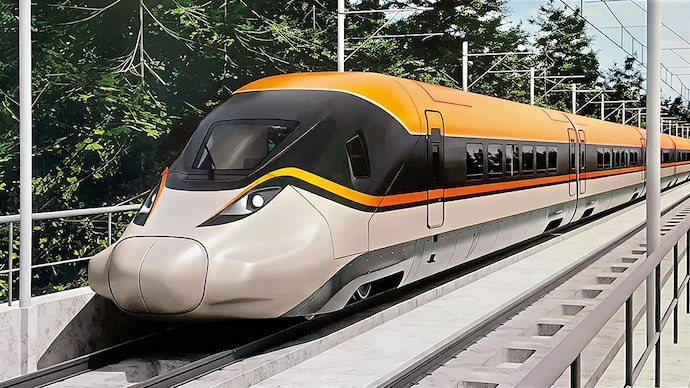
Nearly a decade after Prime Minister Narendra Modi and his then Japanese counterpart Shinzo Abe presided over the groundbreaking ceremony for India’s first bullet train project, the Mumbai-Ahmedabad high-speed rail corridor is finally entering the final leg of its journey.
Nearly a decade after Prime Minister Narendra Modi and his then Japanese counterpart Shinzo Abe presided over the groundbreaking ceremony for India’s first bullet train project, the Mumbai-Ahmedabad high-speed rail corridor is finally entering the final leg of its journey.
Nearly a decade after Prime Minister Narendra Modi and his then Japanese counterpart Shinzo Abe presided over the groundbreaking ceremony for India’s first bullet train project, the Mumbai-Ahmedabad high-speed rail corridor is finally entering the final leg of its journey.
Already three years behind its original deadline of completion by 2023, the 508-km project has gathered pace over the past year. Land acquisition is complete, statutory clearances have been secured and utility shifting finished. Gujarat is well ahead, with civil works substantially complete across much of the alignment, track-bed construction under way and overhead electrification progressing rapidly. Foundation work has been completed at eight of the 12 stations, while work continues at the remaining four stations in Maharashtra. River bridges, depots and the underground Bandra-Kurla Complex station in Mumbai are taking shape and tunnelling has begun on the 21-km underground stretch, which includes India’s first undersea rail tunnel—a 7-km section beneath Thane Creek. “The first section will open in August next year,” says Union railways minister Ashwini Vaishnaw. “We are now constructing about 15-16 km every month. The progress is very good.” The first section he refers to is the 100-km Surat-Bilimora-Vapi stretch in Gujarat.
Yet as India’s first bullet train approaches the tracks, it has quietly become a very different project from the one unveiled in September 2017. The financing remains overwhelmingly Japanese. Much else does not. For example, the tracks and bridges were already being built by Indian engineering companies to the Japanese Shinkansen (bullet train) blueprint. Now, even the trains that will run on the corridor’s first operational stretch will be made in India. Most significantly, the signalling system—the technological heart of any high-speed rail (HSR) network—will be European rather than Japanese. The result: when services begin in 2027, the trains will run at around 250 kmph, slower than Japan’s latest bullet trains that exceed 300 kmph. They will also be made of steel rather than the lightweight aluminium typically used in Shinkansen trainsets.
As for financing one of India’s most ambitious infrastructure projects, Japan offered terms few countries could match. It extended a soft loan of about Rs 79,000 crore, covering 81 per cent of the initial estimated cost of Rs 98,000 crore, at an interest rate of just 0.1 per cent, repayable over 50 years, with a 15-year grace period. That meant India would not have to begin repayments for a decade and a half.
Little wonder that when the Indian and Japanese premiers came together in Ahmedabad on September 14, 2017, PM Modi made no attempt to hide his gratitude. “The credit for this bullet train goes entirely to my dear friend Shinzo Abe,” he said at the groundbreaking ceremony. “Yeh bullet train ek prakaar se Japan ka Bharat ko bahut bada saugaat hai...ek prakaar se muft mein yeh poora project banta chala ja raha hai (This bullet train is Japan’s gift to India. In a way, the project is being built almost for free).”
Japanese generosity, however, came accompanied by a precondition. The project’s core systems—from trains and signalling to electrical equipment—were to be sourced from Japanese companies or consortia led by them, leaving India with little flexibility. It soon became evident that bids from a limited pool of Japanese vendors were significantly costlier than international alternatives. As costs escalated and delays mounted, the political optics became increasingly difficult to ignore. It was then that India realised it had to gradually untangle itself from parts of the original procurement framework.
THE FIRST BREAKTHROUGH
Civil construction was the first to break out of Japan’s exclusivity clause. It involved prolonged negotiations, what officials called “rail diplomacy”. “We had to bargain hard with Japan,” recalls Mukul Saran Mathur, former general manager of Indian Railways, who steered the project in its initial phase. “They eventually relented, but on the condition that there would be strict Japanese oversight on the quality of the work, as India had never constructed anything like this before.” But Japanese firms executing even the civil works would be “needlessly expensive”, according to Mathur. “Besides, how would our engineering capability upgrade if we remain just a consumer of the technology and not a builder?” The waiver of that requirement opened the door for Indian companies such as Afcons and L&T to take charge of large parts of the civil works.
But building tracks, bridges and stations was only one part of creating an HSR network. Two critical pieces remained—the trains themselves and the signalling system. It was here that India ran into a far bigger hurdle.
THE OTHER ROADBLOCKS
The Mumbai-Ahmedabad corridor had been designed around Japan’s Shinkansen technology, leaving Japanese behemoths Kawasaki and Hitachi as the only companies capable of supplying the E5 Shinkansen trainsets. “Effectively, it was turning out to be a single tender-like situation for us, which, ideally, is a no-no,” says a senior railways ministry official, on condition of anonymity. “After a lot of discussions, we even agreed in principle to go with a limited number of vendors as it was a bilateral agreement. But the prices they quoted were atrocious, knowing we couldn’t go anywhere else.”
Officials say the quoted price worked out to Rs 40-60 crore per coach—taking the cost of a single trainset to around Rs 1,000 crore, several times the cost of a Vande Bharat rake. “When Vande Bharat, which can run at 180 kmph, costs Rs 100-120 crore, a bullet train to cost Rs 1,000 crore was just not going to be justifiable in India,” says Shubhranshu, a rail mobility expert who was among the lead architects of Vande Bharat. “For a project to truly symbolise India’s progress, the trains had to be manufactured domestically.”
By now, delays—first over land acquisition and later procurement—had also begun to inflate the project’s cost. Already revised to Rs 1.08 lakh crore, the expense was heading towards Rs 1.6 lakh crore. Since repayments are denominated in Yen, exchange-rate movements further increased India’s long-term liability, taking the effective cost close to Rs 2 lakh crore.
The original 2023 completion target had long slipped. Even conservative estimates placed completion of the full corridor around 2029. India proposed waiting for Japan’s next-generation E10 Shinkansen instead of procuring the ageing E5 series trainsets. But the E10 is still under development and is unlikely to be available for export before the early 2030s, making that an unviable option.
If rolling stock presented one challenge, signalling posed an even bigger one. Japan’s HSR network uses its proprietary Digital Signalling-Automatic Train Control (DS-ATC) system, while much of the rest of the world has standardised around the European Train Control System (ETCS). ETCS also underpins Kavach, India’s automatic train protection system, making it more interoperable and economical.
Yet, even as late as last year, the project appeared to have reached the point of no return on its technology choices. The August 2025 India–Japan Annual Summit Joint Statement seemed to reaffirm that trajectory. “They (the two PMs) concurred to work towards the commencement of operations at the earliest and cooperate on the introduction of the latest Japanese Shinkansen technology in India,” it said. “The Indian side appreciates Japan’s offer to introduce, in the early 2030s, the E10 series of the Shinkansen that runs on the Japanese signalling system.”
This was even as India had, almost simultaneously, decided on a technological pivot—adopting ETCS Level 2 in place of DS-ATC after prolonged diplomatic negotiations with Japan. The German multinational conglomerate Siemens won the Rs 4,100-crore signalling contract in May 2025. “India is making so many HSR corridors, so it is only natural that it would choose a technology that gives it the maximum flexibility in terms of choosing the core technology,” says Tilak Raj Seth, head of Mobility at Siemens India.
The trains themselves were the final piece of the puzzle to fall into place this year. In February, a newly formed partnership between defence PSU Bharat Earth Movers Limited (BEML) and Hyderabad-based Medha Servo Drives—the supplier of propulsion and control systems for the first Vande Bharat trains—won the contract to build 16 trainsets for the HSR corridor. Awarded on a single-tender nomination basis, the contract is understood to carry a quoted price of about Rs 250 crore per trainset. Under the arrangement, BEML will build the coaches, undertake final assembly and fit out the interiors, while Medha will supply the propulsion, traction and electrical systems. The order builds on a 2024 contract under which BEML was tasked with developing two prototype trainsets, designated B28, for Rs 886.87 crore. Designed for a top speed of 280 kmph, the prototypes are expected to be ready by early 2027. “Finally, India will have to run trains that can reach speeds of upwards of 300 kmph. This is more a stopgap arrangement. And if Japan wants to supply trainsets, it will have to manufacture for the system (ETCS) that is in use the world over,” says Seth.
THE JOURNEY AHEAD
With the major technology choices now settled, the National High Speed Rail Corporation Ltd (NHSRCL) is clearing the decks for the Cabinet to decide on the seven HSR corridors announced in this year’s Union budget, including Delhi-Varanasi and Chennai-Bengaluru. Estimated to cost about Rs 350 crore per km, the projects are likely to rely on a mix of financing models, including possible World Bank assistance.
“The USP of any HSR network is its ability to convert what are now occasional, planned journeys into long-distance daily commutes,” says a senior NHSRCL official. “That, in turn, means relying increasingly on non-fare revenues such as commercial development.”
Another unresolved issue is operations. Few organisations anywhere have experience running a commercial HSR network. Discussions are under way on appointing an Operations and Maintenance contractor, with names such as the Delhi Metro doing the rounds. The Japanese, too, have been informally encouraged to explore partnerships with Indian firms and enter the fray. At the same time, the NHSRCL has invited global rolling stock majors to present their capabilities for developing the B35—an indigenous bullet train designed for a top speed of 350 kmph (320 kmph operational) and intended as the standard platform for all future HSR corridors. India is also putting in place a two-stage safety certification regime, with third-party international auditors clearing the trains before final approval by a government body.
Where does Japan fit in now? “The Japanese team has indicated that E10 is under development. It will be introduced simultaneously in India and Japan. The timelines and other contractual terms and conditions are under discussion,” says Vaishnaw. That shift was evident during Japanese PM Sanae Takaichi’s visit to New Delhi in early July. Compared with previous joint statements, this one read like a diplomatic tightrope walk. “Japan fully understands India’s target to commence commercial operations on priority sections in 2027 and remains committed to extending the necessary cooperation. They (the respective premiers) acknowledged the goal of introducing the E10.... They also expressed willingness to explore possible ways to cooperate on future high-speed corridors.” Notably, there was no mention of signalling. Those in the know say there were some backroom talks on whether to include E10 at all.
The Japanese embassy did not respond to queries from india today. But, in May, speaking while announcing the financial results of JR East—a key Japanese technical advisor on the Mumbai-Ahmedabad project—the company’s vice president, Atsuko Itoh, reiterated that the safety standards associated with Japanese bullet trains could not be guaranteed if they operated with European signalling. She also said that negotiations with India had been difficult.
Whether or not those differences are eventually resolved, India is determined to not let anything come in the way of its HSR ambitions, enabled by initial Japanese financing if not its signalling systems or trainsets. For the Modi government, this seems to be a dream that must come true, whatever it takes.

