Madhya Pradesh | Codeine capital
The Vindhya region has seen huge hauls of illicit cough syrups made of codeine. The drug scourge has ravaged the area
As dusk settles in on Rewa’s kabaadi mohalla (scrap colony) and its ragged residents slowly drift home from work, groups begin to gather in the shadows. Walking up to one such, we ask a woman standing in an unlit spot for six bottles of cough syrup. She stares back, wary that the strangers may be police decoys. “Kal aana (Come tomorrow) with Rs 3,000,” she says and walks away, not committing to anything. The kabaadi colony’s notoriety has spread in town, it is well-known as a haven for cough syrup peddlers.
As dusk settles in on Rewa’s kabaadi mohalla (scrap colony) and its ragged residents slowly drift home from work, groups begin to gather in the shadows. Walking up to one such, we ask a woman standing in an unlit spot for six bottles of cough syrup. She stares back, wary that the strangers may be police decoys. “Kal aana (Come tomorrow) with Rs 3,000,” she says and walks away, not committing to anything. The kabaadi colony’s notoriety has spread in town, it is well-known as a haven for cough syrup peddlers.
As dusk settles in on Rewa’s kabaadi mohalla (scrap colony) and its ragged residents slowly drift home from work, groups begin to gather in the shadows. Walking up to one such, we ask a woman standing in an unlit spot for six bottles of cough syrup. She stares back, wary that the strangers may be police decoys. “Kal aana (Come tomorrow) with Rs 3,000,” she says and walks away, not committing to anything. The kabaadi colony’s notoriety has spread in town, it is well-known as a haven for cough syrup peddlers.
Welcome to Rewa, formerly the capital of Vindhya Pradesh (it was merged into the larger state of Madhya Pradesh in 1956), and now, according to authorities, the state’s ‘codeine capital’. Rewa city, along with the surrounding districts of Satna, Sidhi, Singrauli, Mauganj and Maihar—collectively called the Vindhya region—has seen a massive spurt in cough syrup abuse and addiction cases in the past few years. Cough syrups with codeine phosphate in them are most in demand, given the high the substance ensures. Consumption of around 100 ml of a codeine-based cough syrup can give a high spanning 24-36 hours.
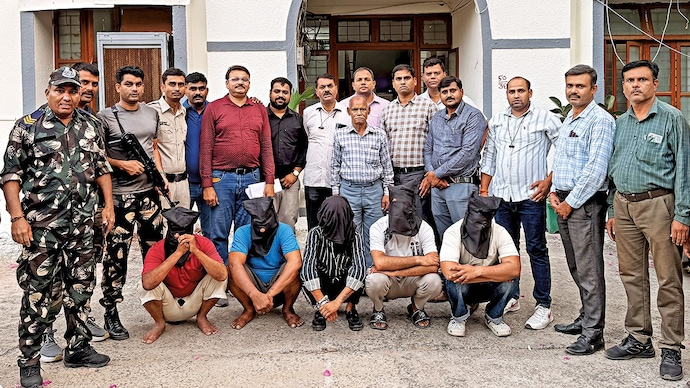
Between January 1, 2025, and May 31, 2026, the police confiscated 84,547 bottles of the syrups (worth Rs 1.01 crore) from the six districts of Rewa division. Some 685 people have been arrested under the Narcotic Drugs and Psychotropic Substances (NDPS) Act. Last year, 2,000-odd poly substance addicts sought treatment at Rewa’s Shyam Shah Medical College, most of whom abused cough syrup too. The problem is so acute the state police now has a dedicated ‘Operation Prahaar’, to bring the syrup tsunami under control. In late May, in the single biggest seizure perhaps in central India, a special task force (STF) seized 73,000 bottles in a raid in capital Bhopal. Again, the consignment was bound for the Vindhya region.
So, why is cough syrup abuse so big in the Vindhya region? “A key reason is the unregulated supply, made easier by the large border the region shares with Uttar Pradesh,” says Gaurav Rajput, IG, Rewa. The office of the drug controller is the main agency responsible for dealing with the misuse, but since there are inter-state issues involved, monitoring and control become a problem. “For the past few months, we have been working with a UP special task force (STF) which is taking action on their side,” adds Rajput.
On the demand side, Rewa watchers propose an interesting reason for cough syrups being a popular fix. Caste and class consciousness still play a big role here in society, with alcohol consumption considered taboo, especially among the non-labouring castes. Cough syrups emit no odour and, outwardly, the addict appears sober. This helps many to stay high in the daytime too, with little negative impact on, say, jobs that are not too demanding. The theory may not be backed by any studies, but has many takers among the locals.
Also central to understanding the acuteness of the problem is also how Rewa has grown in the past couple of decades. The city did not have a passenger rail line till the 1990s. Enhanced connectivity, now with an airport added last year, has brought markers of prosperity in its wake. Neighbouring Singrauli district has seen the mushrooming of many mineral-based industries and is now being called the ‘power capital’ of central India—with a large number of generation units in and around it. All this development has had a trickledown effect across the landscape. Rewa now has flyovers, branded hotels and malls, something that would have been inconceivable even a decade ago. The sudden loss of the old rhythms of life has concomitantly seen a rise in disruptive behaviour like addiction. Rewa MLA and deputy chief minister Rajendra Shukla says, “Come what may, we have to stop this supply of cough syrup. If we don’t crush it now, the next generation will not be able to enjoy the benefits of Rewa’s prosperity.”
THE SUPPLY CHAIN
The police investigation so far has revealed a logistics network that’s difficult to disentangle from legit business. A bulk of the seized ‘medicine’ was manufactured in units at Baddi (Himachal Pradesh) and Haridwar (Uttarakhand). The cough syrup is purchased by stockists from the plants. Securing a licence for stocking is not difficult as permissions are given by state-level offices. Once at the stockist, the contraband is picked up by pushers who get papers to show supply to a retailer. But the syrup never reaches the shop.
A recent bust laid open the operation. On June 23, Bhopal resident Rahul Kushwaha was arrested at a beach in Thiruvananthapuram, Kerala. He had been on the run for a month, wanted in connection with an illegal cough syrup factory bust in Bhopal’s Gandhi Nagar, where some 50,000 bottles of ‘Onerex’ and 23,125 bottles of ‘Off-Kuff’ cough syrups were recovered. Ten people were arrested and a number of machines used for packaging and resealing the bottles were seized.
The accused had removed the labels and were repackaging the contents after deleting batch numbers. “The removal of batch numbers ensured the stock would not be traced back to the manufacturer,” says Rajesh Bhadoria, assistant inspector general (AIG), MP STF. “Samples have been sent to the drug controller labs as we suspect that other narcotics have been added to the syrup to make it more potent.” To prevent anything being tracked back to the masterminds, all the cogs in the wheel worked in a vacuum.
CRACKING DOWN
The Madhya Pradesh police have been cracking down, invoking sections of the NDPS Act, the Drugs and Cosmetics Act and even Section 111 of the Bharatiya Nyaya Sanhita (BNS), related to organised crime, while booking the accused. In Rewa, two notorious cough syrup smugglers, Bucchi Sahu and Prince Dubey, have been behind bars for a year now. But, in a strange twist, sources on the street say when the crackdown intensifies, there is in fact more profit to be made. A bottle of cough syrup sells for as much as Rs 1,000 at times in Rewa, when supply is low. The extent of profiteering is immense: Bucchi, a low-level street peddler a few years go, now allegedly has two houses and some seven other plots. The Rewa police is now invoking the Prevention of Money Laundering Act (PMLA) to attach the properties of the accused.
The region, meanwhile, suffers, with families destroyed and hundreds of addicts facing serious health issues. IG Rajput says they are trying their best but admits there are “multiple issues” involved. “So long as there is demand from within society, it’ll not be easy plugging the supply 100 per cent,” he says. The syrup’s biggest pull in the Vindhya landscape is its ability to offer a fix without being detected. So, since the smell is absent, how does one identify an addict? A tea vendor near the kabaadi mohalla explains, “A cough syrup addict invariably asks for heaps of sugar in his tea. Khade chammach ki chai peete hain (they want so much sugar in their tea the spoon stands in the cup)”. It’s a win-win for addicts—both opioids and sugar trigger the brain’s reward centres, releasing dopamine and endorphins and increasing the high. It’s the only bittersweet truth in an addict’s life.
ADDICTIVE CURE
Banned in the US, codeine still gives a high in India
The US Food and Drug Administration (USFDA) banned codeine in the 1970s. In India, production and use is regulated but still not completely banned. However, in June 2023, the Centre banned the manufacture of 14 fixed dose combinations (FDC) drugs, two of which included codeine and codeine phosphate.
An opioid analgesic, in medical formulations, codeine works on the brain receptors to relieve pain. In large doses, it works as a central nervous system depressant. The addict gets a dopamine rush that produces a sense of euphoria initially, which later turns to sedation, heaviness in the limbs and altered mental state. Consumption of 100 ml of syrup with codeine phosphate gives a high for 24-36 hours.
“Excessive consumption leads to drowsiness, lethargy, constipation and even suppression of breathing, which may prove fatal. It also leads to impaired vision and a slowing down of reaction time, often leading to accidents,” says Dr Sudhanshu Dixit, an ENT specialist practising in Rewa. Bluish lips, cold, clammy skin, slowed breathing are common signs of severe overdosing. The deaddiction ward at Rewa’s Shyam Shah Medical College treated 2,000-odd poly substance addicts in 2025, a 10–12 per cent jump from the previous year. “Some 65 per cent of our patients in the ward are cough syrup addicts,” says hospital superintendent Dr Rahul Mishra.

